Reject the AI-Driven Dystopia
“AI and automation aren’t coming—they’re already here. And our 20th-century tax and labor laws have absolutely no idea what to do with them.”
 The evidence is no longer speculative. Automation has moved from the factory floor into the office, the newsroom, the call center, the accounting department, the law firm, the hospital, and the truck cab. Machines write code, draft contracts, diagnose disease, generate images, answer customers, and drive vehicles. Every month brings another headline about a company replacing hundreds of white-collar workers with software, or a plant replacing a shift with robotics, or a logistics firm replacing drivers with autonomous systems. The result is not a single dramatic collapse but a slow, grinding displacement that leaves families, towns, and whole industries gasping for air. The next decade will not ask whether automation is coming. It will ask who bears the cost, who captures the gain, and whether the American nation still has the will and the law to protect its own people.
The first challenge is the sheer scale of displacement. White-collar workers once believed education and credentials insulated them. That illusion is dying. Entry-level analysts, junior programmers, paralegals, copywriters, customer service representatives, and administrative staff are already being displaced by generative systems that cost a fraction of a salary and never sleep. Blue-collar workers face a parallel assault from robotics, autonomous vehicles, and automated warehouses. The result is a pincer movement against the American worker. Manufacturing towns that never recovered from offshoring now face a second wave of joblessness as remaining plants automate. Office parks that once hummed with commuters are emptying as firms discover they can do more with fewer people. The labor force is being divided into a small class of engineers, owners, and managers who control the machines, and a vast class of workers who are told to  retrain, relocate, or resign themselves to lower wages and diminished status.
The human cost is not merely economic. Work is not only a paycheck. It is a source of dignity, identity, routine, community, and masculine and feminine vocation. When a father loses his job, he does not simply lose income. He loses the daily arena in which he exercised responsibility. When a mother is pushed out of a stable position, the household loses not only money but time, order, and security. When a town loses its factory, it loses its bowling league, its diner, its church attendance, its Little League sponsors, and its young people. The social fabric thins until only addiction, debt, and government dependency remain. Policymakers in Washington speak of “disruption” and “transition” as if these were neutral terms. For millions of Americans, they mean humiliation. The growing underclass is not a bug in the system. It is the predictable result of a system that treats labor as a cost to be eliminated rather than a good to be protected.
The fiscal strain is already visible. As wages stagnate and jobs disappear, tax revenues fall at the federal, state, and local levels. At the same time, demand for Medicaid, housing assistance, food programs, disability payments, and emergency services rises. Cities and counties that depend on payroll taxes and property taxes face a double blow: fewer workers paying in, more households needing help. Federal deficits, already enormous, will rise further because of automatic stabilizers and the political pressure to send checks to displaced workers. Universal basic income is now openly discussed in serious circles, not because it is a proven success but because the political class fears a population without work and without hope. Yet a permanent subsidy for idleness is not a solution. It is a sedative. It can buy temporary peace while destroying the incentive to work and the moral meaning of labor. It can also become a mechanism of control, tying citizens 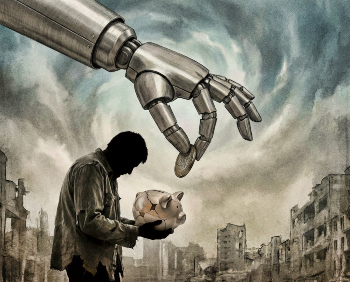 to a distant bureaucracy that determines how much they may receive and under what conditions.
The second challenge is the policy debate itself, which remains trapped in three inadequate answers: universal basic income, skills-retraining grants, and robot taxes. Each has a kernel of truth and a fatal weakness. Universal basic income acknowledges that automation may destroy more jobs than it creates. But it treats citizens as dependents rather than workers. It can discourage labor, weaken families, and expand the administrative state. Skills-retraining grants acknowledge that workers need new abilities. But retraining is often a cruel promise when the new skills are obsolete before the loans are repaid, and when the jobs that remain are concentrated in a handful of prosperous metros. Robot taxes acknowledge that automation creates windfall gains that should be shared. But taxes on robots can be evaded, can slow productivity, and can simply accelerate offshoring to countries that welcome the machines. None of these policies addresses the deeper question: who governs the transition, and for whose benefit?
The legislative paralysis is not accidental. Congress is structured for a slower age, when industries changed over decades, and legislation could be negotiated among a few durable blocs. Today, technology changes faster than the committee process. Federal agencies write rules that are outdated before they are published. Trade agreements still reward multinational firms for moving production abroad. Tax law still subsidizes debt, automation, and offshoring in ways that punish small businesses and family farms. Labor law still assumes a full-time employee with a single employer, even as gig, contract, and platform work become the norm. As a result, decentralized workforce models are outpacing federal legislation. Companies can classify workers, relocate operations, and deploy algorithms across borders while regulators struggle to define basic terms. Into that vacuum step the largest corporations and the most connected lobbyists, shaping the rules to their advantage while ordinary Americans are told to be flexible.
The third challenge is the rise of decentralized work and the erosion of national sovereignty. Remote work, online platforms, and global contracting have freed some workers from geography, but they have also freed employers from responsibility. A firm can hire a contractor in one state, route the work through a server in another, bank the profit in a third, and deny benefits in all of them. Local communities lose the tax base, the civic participation, and the stable employment that once made them viable. National governments lose the ability to enforce labor standards, protect wages, or even count how many people are working. The technocratic dream is a borderless economy managed by experts, where citizens are mobile units of production and nations are obstacles to efficiency. That dream is incompatible with America First. A nation that cannot control its borders, its labor market, or its industrial base is not a nation. It is a market with a flag.
The consequences of inaction are grim. We will see more hollowed-out cities, more opioid deaths, more fatherless homes, 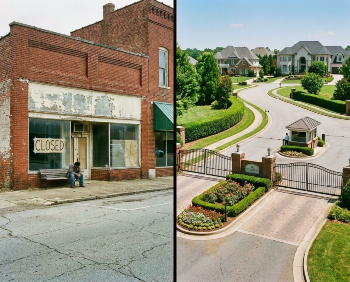 more young men without work, more young women delaying families because they cannot afford them, and more children raised by screens instead of parents. We will see a permanent underclass dependent on transfers, while a credentialed elite insulates itself in gated communities and private schools. Rural counties will lose hospitals, schools, and churches. We will see political extremism rise as trust in institutions collapses. We will see a government respond by surveilling, taxing, and managing the population rather than restoring work. And we will see the American dream redefined as the modest hope of a monthly deposit from a distant agency. That is not a future worthy of our forefathers’ sacrifices.
Meanwhile, the political class offers slogans where structure is needed. Congress cannot even define what a worker is in the platform age, let alone tax the machine or guarantee a wage. Agencies write rules for a labor market that has already moved on. Courts strike down one regulatory theory only for another to be tested. Every year of delay deepens the damage: another plant closes, another office tower empties, and another town loses its last bank branch and its last reason to stay. The people who write the policy papers and collect the speaking fees will be fine. The people who assemble the cars and stock the shelves will not. The gap between the governed and the governing has never been this wide in living memory, and automation widens it every quarter.
But despair is not a policy, and fear is not a faith. The same nation that built the transcontinental railroad, won two world wars, landed on the moon, and electrified the countryside is not finished. The machine age can be met with American ingenuity, American industry, and American moral clarity. The task is not to stop technology but to make it serve the nation. That means an America First industrial policy that rewards production at home, protects strategic industries, and rebuilds the factories and workshops that sustain communities. It means a tax code that stops punishing marriage, family, and small business while rewarding offshoring and automation without responsibility. It means trade policy that puts American workers before multinational profits. It means immigration policy that serves the national interest and protects the wage floor for citizens. It means a labor policy that recognizes new forms of work without abandoning workers’ dignity.
It also means a moral renewal that no algorithm can produce. The family must be restored as the first economy, the first school, and the first welfare system. Fathers must be present. Mothers must be honored. Churches must teach that work is a calling, not a curse, and that dominion over creation is a sacred trust. Trade schools and apprenticeships must regain the respect they lost when every child was told to go to college, and every college was told to serve the global market. Local communities must rebuild the institutions that make life meaningful: the parish, the union hall, the volunteer fire department, the county fair, the small factory, the family farm. Christian nationalism offers a framework for this renewal because it understands that God ordains nations for justice, worship, and the protection of the household. It rejects the false choice between globalism and isolation. It affirms that a people may love their own land, history, and neighbors and still love Christ above all.
Christian Nationalism is imperative. We need a coherent nation with coherent beliefs that cross all demographics across the nation. Those coherent beliefs must transcend race and nationality. We can do it. Here’s how. Click Here.
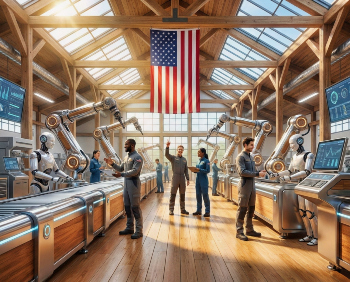 We have done hard things before. We tamed the frontier, wired the plains, and out-produced tyrants who swore we could not. The generation that stormed the beaches did not ask whether the future was safe; they built it. Their grandchildren can do the same. The tools are different, but the task is familiar: to harness new power for old virtues—faith, family, work, and country. That is not nostalgia. It is a program, and it is already being written in workshops, kitchens, and churches across this land.
America First is not a rejection of the world. It is a commitment to order at home. It says that the American worker matters, the American family matters, the American flag matters, and the American Constitution matters. It says that technology must be a tool, not a master. It says that the rule of law must govern the machine before the machine governs us. It says that displaced workers are not refuse to be managed but citizens to be defended. The next decade will be difficult, but it need not be dark. With faith in God, love of family, and a renewed national purpose, we can turn automation from a threat into an instrument of abundance. We can build factories that hum with robots and ring with human laughter. We can train young people in trades that matter. We can protect the vulnerable without making them dependent. We can make America a place where work is honorable, families are strong, and liberty is ordered under God. The future is not yet written. Let us write it as Americans, and let us write it for the glory of God.
Dave
Sources:
Robot Taxes, a Public Wealth fund, and a 4-Day Workweek
Universal Basic Income
Backstop US Labor Law