Say No To European International Censorship
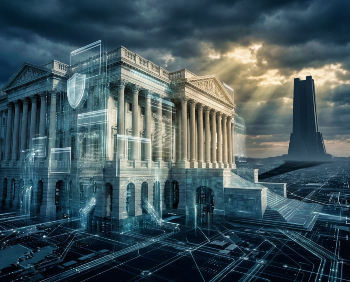 Europe has always understood something that American political leaders keep rediscovering: the law is more powerful than the argument. In Brussels and London, a generation of regulators has decided that the fastest way to control speech in the twenty-first century is to control identity. The method is dressed in the language every parent understands, and no patriot can safely oppose — child safety. It is presented as a technical measure. It is anything but.
The American people should understand that this is not a foreign dispute. It is already here, arriving not through treaties or congressional votes but through the most ordinary and most effective channel imaginable: a friendly lobbyist with a bill, a sympathetic statehouse, and a sincere-sounding statistic about children and smartphones.
The Pattern in England
Begin with the raw material, because it is genuinely alarming and largely unknown to Americans.
In August 2024, after three children were murdered at a dance studio in Southport, rumors began circulating that a Muslim asylum seeker was responsible. A political activist named Bernie Spofforth copied and pasted one of those rumors to the platform X and added a single sentence: “If this is true, then all hell is about to break loose.” The rumor was false. She recognized as much when the post took off, and she deleted it.
Five months later, she describes five police officers arriving at her home, three cars and a van, and being arrested. She was held for thirty-six hours. Her alleged crime was misinformation.
Think about what that sentence means, and then think about it in the American context. In this country, to be arrested you must be suspected of breaking a law. In Britain, Spofforth says, “you don’t need to break the law to be arrested. If someone says they feel harmed by what you’ve said, then you can be arrested. If someone says that what you’ve said is deeply offensive and they’re very distressed by it, you can be arrested.” That is not law enforcement. That is a discretionary license to disappear, anyone a government finds inconvenient.
 Other cases establish the pattern’s boundaries. Comedian Graham Linehan was detained at Heathrow Airport on suspicion of inciting violence over three posts. Dimitrie Stoica was sentenced to three months for violating the 2023 Online Safety Act. Lucy Connolly served a year for incitement after the Southport stabbings, calling for mass deportations and saying people could “set fire” to the hotels where migrants were lodging “for all I care.”
And then the political framework. Prime Minister Keir Starmer blamed social media — not the killer, not the failure of the state to stop him — for the riot, warning that “violent disorder, clearly whipped up online” was a crime “happening on your premises.” Deflection is the tell. A government that cannot explain its failure to protect children will explain it by criminalizing the witnesses.
Then came the policy. In 2025, Starmer announced a nationwide digital identity scheme, BritCard: “You will not have to have a digital ID to work in the United Kingdom.” The proposal collapsed under political pressure. But the Online Safety Act’s requirement for “highly effective age assurance” survived, and the European Union is moving in parallel under the Digital Services Act.
With Palantir, Flock cameras and other intrusions into citizen privacy, the United States is already too close for comfort. Taken to their logical conclusion, we could sleepwalk into European censorship within a few years without knowing it.
Why Anonymity Is the Real Target
The surface rationale is children. The structural logic is anonymity.
An investigator with the effort.news outlet has documented the lobbying apparatus: organizations such as 5Rights, founded by Baroness Beeban Tania Kidron of the House of Lords, and Reset Tech, part of a five-member consortium, advancing age-verification frameworks in American state legislatures. The reason is simple. “If you’re anonymous, then they can’t arrest you.” Anonymity is the oldest technological safeguard for the unpopular, the powerless, and the merely irritating — a protection that matters enormously to Christians who are mocked and reported, to whistleblowers, and to ordinary Americans who do not wish to be algorithmically profiled for the crime of having an opinion.
The transformation is unavoidable once identity is collected. Verification systems do not verify minors. They verify whoever connects, and then retain, store, and cross-reference the data. What begins as a children’s gate becomes, functionally, a universal credential.
This is why the “child safety” framing must be interrogated, not accepted. Those who sincerely want to protect children can do so without building a universal identity infrastructure. If the necessary tool for child protection is a permanent biometric record of every citizen who touches the internet, then child protection was never the goal. It was the marketing.
 The Extraterritorial Assault
The most revealing episode concerns 4chan. In April 2025, Britain’s communications regulator Ofcom informed the site’s owners that they must certify compliance with the Online Safety Act by ensuring British citizens could not access “harmful” material — or face up to eighteen million pounds in fines, roughly $24 million. (1) Notice the structure: a foreign government threatening to fine an American company, on American infrastructure, about content Americans are legally free to publish.
The American response deserves more attention than it received. Preston Byrne, the free speech attorney representing 4chan, replied to Ofcom’s threats with a picture of a hamster and a promise that future correspondence would be “shredded and used to line his enclosure upon receipt.” When Ofcom persisted, he escalated to AI-generated images of ever larger hamsters.
This was not idle comedy. Byrne understood something precise: “These guys aren’t taking this seriously. They’re not taking America seriously. They’re not taking our Constitution seriously. So I’m not going to take them seriously.” The strategy, he explains, was designed “to get the attention of people who matter in Washington, D.C.”
It worked. Versions of his model legislation — the Guaranteeing Rights Against Novel International Tyranny and Extortion Act, or the GRANITE Act — have been introduced in committees in both the House and the Senate. A foreign regulator reached for censorship, and the American legislative branch reached for a record.
 The Constitutional Exposure
Here the Tenth Amendment must be invoked plainly, because Americans have badly underdeveloped the legal register of this fight.
Texas Journal can help you assert your 10th Amendment Rights. Click Here
The federal government has no enumerated power to regulate the content of speech, license websites, certify ages, or issue identity credentials. Under the Tenth Amendment, powers not delegated to the United States and not prohibited to the states are reserved to the states and the people. When a state legislature accepts an age-verification mandate designed by British and European entities, and the mandate’s architecture delivers data to foreign regulators, the state has not exercised its police power. It has exercised someone else’s.
And the First Amendment conflict is structural rather than cosmetic. Byrne’s formulation is exact: the United States holds that an American on American soil, using American infrastructure, is fully protected by the First Amendment; Britain asserts that an American running American infrastructure on American soil must obey British law. “If they win this fight, then the First Amendment will effectively cease to exist online.”
That is the stake. Not a British content dispute. The architecture of American constitutional order.
Why the Technology Is on Our Side
The good news is not rhetorical. It is empirical.
When Britain’s age-verification regime took effect, Proton VPN became the number one free download on the U.K. Apple App Store within days, and the company reported a 1,400% increase in sign-ups. One of the people caught in the British system put it plainly: “They’re so technologically stupid, they think they can ban VPNs. Of course they can’t. But they’ll find other ways around verifying your online name, face, age, and IP address. And once they have that, it doesn’t matter if you are an anonymous account on X.”
 Governments keep announcing the next verification layer. Meanwhile, circumvention methods keep scaling, because the underlying technology is adversarial and the state is not. Even one-party states have failed to eliminate privacy tools.
A further dimension should give conservatives pause about their own reflexes. The regulatory instinct is to demand a new federal law to prohibit a new European law. But the deeper warning is that the intermediate regime — where authorities believe they might control the information environment while citizens are still organizing — is the most unstable. Stable governments tend to sit at either end of the spectrum. “We’re seeing the E.U. rapidly rush from one end of the spectrum to the other, where more and more information control is being imposed…to suppress the democratic process itself.”
Which is exactly why the American answer cannot be a new layer of American command-and-control. It must restore constitutional limits.
The Case for Fortress America
I want to be careful with this phrase, because it has been misused. Fortress America is not isolationism, and it is not xenophobia. It is the plainest possible assertion of sovereignty: that this republic’s laws govern this republic’s territory, and that no external power, however well-funded, however sincerely motivated, however cleverly packaged, acquires jurisdiction over the speech of American citizens.
But it must be a Fortress America in the spirit of our founding: a fortress of law rather than a fortress of men. The Founders did not build walls against the world; they built walls against arbitrary government. Their concern was not foreigners. It was any authority — domestic or foreign — reaching past its proper sphere.
Which is why the right posture is aggressive, not defensive, on the constitutional question. The Tenth Amendment is not a fallback position for when Washington fails. It is the affirmative claim that enumerated powers are the whole of the federal power. And the practical program is not abstract:
In the statehouses, expose the sponsors. When a bill arrives drafted by foreign-connected nonprofits, find out who wrote it, who funded the studies cited in its justification, and put that in front of legislators and the press. You can help your state legislator with a State Sovereignty Resolution. In the courts, defend the first lawsuit. Every state that passes such a mandate creates a defendant, and every defendant creates a precedent. In Congress, support the GRANITE Act without apology and make it plain what is at stake. And in the streets — or rather, in the apps and on the networks — use the tools. The gatekeepers cannot stop what they cannot ban, and they have not yet shown they can.
There is also a moral dimension, and this nation is not finished with it. A people who love convenience will surrender identity. A people who love approval will surrender truth. A people who love safety will surrender liberty, and will discover, as many have, that liberty was the thing providing the safety.
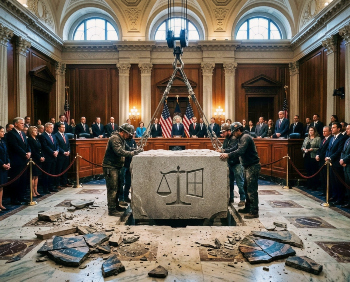 Conclusion: The Wall We Must Build
The war against anonymity is raging in Europe, and it is coming to the United States through a channel most Americans never thought to watch: their own state legislatures, invited in by polite people carrying foreign legislation.
Consider what is being proposed, stripped of its reassuring vocabulary. A digital identity required for employment. A biometric record required to participate in public life online. A foreign body empowered to define “harmful” content for companies operating on American soil. A doctrine of “misinformation” in which an angry opinion on a tragedy becomes a criminal matter.
Every step is described as modest. Every step is, in fact, terminal.
There was a time when Americans were told that the Bill of Rights was a technicality to be balanced against public safety. There was a time when a foreign power could not reach an American company without a treaty. And there was a time when a serious person might say that requiring identification to read the news was an obviously absurd proposition.
Our grandchildren will not find these things strange. That is the point of the argument we are making now.
Build the fortress. Not a fortress against the world — a fortress for the republic, in the law, in the states, in the courts, and in the character of a people who understand that a free nation is one where no man is reduced to a row in a spreadsheet, and no woman goes to prison for a deleted post.
Europe’s plan for your anonymity won’t fail on its own. It will fail because American lawyers filed the case, American journalists published the documents, American legislators introduced the bill, and American citizens showed up at the hearings.
The Patriot Pool is an effective way for you to resist. Click Here!
That is how this ends. Not with a proclamation, but with a wall built by people who decided that freedom was worth defending on an ordinary Tuesday.
Dave
Questions? Call!
940-353-1398
Sources:
Europe’s Plot To End Americans’ Online Anonymity
The European Union Wants To Punish People for Their Speech—Without Even a Trial
The E.U. Just Proposed Its Most Sweeping Social Media Restriction to Date
European Cars Are Spying on Their Drivers. The Same Tech Could Be Coming to the U.S.
Russia Wants To Censor Americans. Why Are U.S. Tech Companies Helping?