Last Updated: October 30, 2026
Quick Summary
To file a Section 1983 lawsuit in Texas, confirm someone acting under color of state law violated a federal right, calendar the filing deadline, and file a complaint in the federal district and division where the events occurred. Then pay the fee or request a fee waiver, serve each defendant, and track response deadlines.
- The claim must rest on a federal constitutional or statutory right, not just unfair conduct.
- Texas borrows the state’s personal-injury limitations period, usually one to two years.
- File in the federal district and division where the arrest, search, or confinement occurred.
- Incarcerated plaintiffs must complete the grievance process before filing under the PLRA.
- Keep copies of every filing and respond to every court order on time.
Table of Contents
- What a Section 1983 Lawsuit Allows You to Do
- Who Can Bring a Section 1983 Claim and Against Whom
- Section 1983 Elements of a Claim You Must Prove
- Section 1983 Statute of Limitations in Texas
- Choosing the Right Texas Federal Court
- Preparing a 42 U.S.C. § 1983 Complaint Form
- Section 1983 Complaint Example: Drafting Your Facts
- Your Texas Filing Checklist and What Happens Next
- Frequently Asked Questions
 What a Section 1983 Lawsuit Allows You to Do
Section 1983 is a federal civil-rights statute, codified at 42 U.S.C. § 1983. It lets a person sue someone who, acting under color of state law, violates their federal constitutional or statutory rights. In practice, that often means police, prison staff, public officials, or local governments.
The statute is not a shortcut to money. It is a tool to enforce rights, and it can produce damages, injunctive relief, or both. The U.S. Courts reported that civil-rights case filings rose 27% over two decades, a trend that reflects how often people turn to this remedy (U.S. Courts report on civil-rights case filings rising 27 percent over two decades).
Knowing what the statute covers is the first step. A claim that does not rest on a federal right will not succeed, however unfair the conduct seems.
Who Can Bring a Section 1983 Claim and Against Whom
Any person whose federal rights were violated by a state actor may bring a Section 1983 claim. The defendant must have acted under color of state law. A private individual acting purely on their own is generally not covered.
Here are the main categories to keep in mind:
- Plaintiffs: Anyone whose federal constitutional or statutory rights were violated.
- State and local officials: Police officers, jail staff, and elected or appointed officials acting in their official role.
- Government entities: Counties and cities can be sued, but only under specific rules tied to their own policies.
Section 1983 litigation is a large part of federal civil dockets. A Federal Judicial Center report found it represents 1 in 10 civil cases filed in U.S. district courts (Federal Judicial Center report on Section 1983 litigation over prison and jail conditions).
Individual-Capacity vs. Official-Capacity Claims
Who you name, and how, changes what you can win. An individual-capacity claim seeks money damages from an official personally. An official-capacity claim is really a claim against the government entity the official works for. Damages in official-capacity suits generally come from the entity, while injunctive relief can run against the official in that role. Choose the form that matches the relief you need, and consult a qualified attorney if you are unsure how to structure your claims.
 Section 1983 Elements of a Claim You Must Prove
To win, you must show two core things:
- A federal right was violated, such as a First, Fourth, or Eighth Amendment right, or a Fourteenth Amendment due process or equal protection right.
- The violation was committed by someone acting under color of state law.
Filing alone does not establish a valid claim. A 2022 systematic review of Texas Section 1983 suits filed by incarcerated people reported that relief was unlikely, largely because plaintiffs did not establish a claim in the first place (JE Palacios, systematic review of Section 1983 lawsuits filed by incarcerated people in Texas, 2022). Build your facts around each element before you file.
Section 1983 Statute of Limitations in Texas
Section 1983 has no deadline of its own. Courts borrow the state’s personal-injury limitations period. The ACLU of Texas describes that period as usually one to two years, but the exact deadline depends on the claim, so confirm it for yours (ACLU of Texas Civil Rights Resource Guide for Incarcerated People).
Missing the deadline usually ends the case, so calendar it early. Count from the date of the injury, not the date you discovered the lawyer’s advice or the case outcome.
Choosing the Right Texas Federal Court
Section 1983 cases are typically filed in federal district court, not state court. Getting the district and division right matters because filing in the wrong place can draw a transfer order, a dismissal, or a delay that eats into your limitations period.
The four districts and their divisions
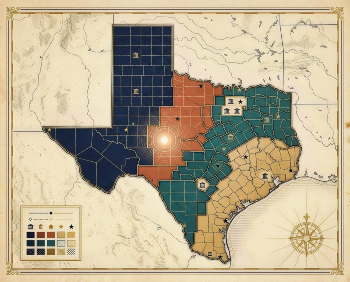
Texas is divided into four federal judicial districts, Northern, Southern, Eastern, and Western, and each district is subdivided into divisions. The division is the actual courthouse where your case will be assigned, so the division matters as much as the district. A few practical anchors:
- Northern District: covers the Dallas-Fort Worth metroplex and much of north and northwest Texas, with divisions including Dallas, Fort Worth, Amarillo, Lubbock, San Angelo, Abilene, and Wichita Falls.
- Southern District: covers Houston, Galveston, Corpus Christi, Brownsville, McAllen, Laredo, and Victoria.
- Eastern District: covers Beaumont, Tyler, Sherman, Marshall, Texarkana, and Lufkin.
- Western District: covers Austin, San Antonio, El Paso, Waco, Del Rio, Midland-Odessa, and Pecos.
Confirm the current division boundaries on the district court’s own website before you file. District boundaries and divisional assignments are set by statute and court order and can change.
Venue: where the case is allowed to be filed
Venue for a Section 1983 case is governed by 28 U.S.C. § 1391(b). A civil action may be brought in:
- A judicial district where any defendant resides, if all defendants reside in the same state;
- A judicial district in which a substantial part of the events or omissions giving rise to the claim occurred; or
- If neither applies, any judicial district in which any defendant is subject to the court’s personal jurisdiction.
 For most Section 1983 cases, the second prong controls: file where the arrest, search, use of force, confinement, or other conduct happened. If the events straddle two districts, you generally have a choice, and the local rules of each candidate court should be compared before you pick.
Local rules, forms, and filing method
Each district court publishes its own local rules and often its own forms. The local rules govern page limits, formatting, certificate-of-service requirements, and whether certain filings must be made electronically. Most Texas federal district courts require represented parties to file through PACER’s Case Management/Electronic Case Files (CM/ECF) system, and many permit, or require, pro se filers to use CM/ECF as well after registering. Paper filing is still accepted at the clerk’s office in many divisions, but the trend is toward electronic filing, and a paper filer should confirm the current policy with the clerk before mailing anything.
A practical sequence:
- Identify the division where the events occurred.
- Open that court’s website and download the local rules and any pro se filing guide.
- Check the court’s fee schedule and its policy on in forma pauperis applications.
- Confirm whether the court requires electronic filing, paper filing, or permits either.
- Note the clerk’s mailing address and physical address for the division; they are not always the same.
Why the choice can matter beyond convenience
Different divisions within the same district can have different local rules, different motion practices, and different median times to disposition. A case filed in a busy urban division may move on a different schedule than one filed in a smaller division. That does not mean you should forum-shop; venue rules constrain where you may file, but it does mean you should read the local rules of the division you are actually filing in, not the rules of a different division in the same district.
Preparing a 42 U.S.C. § 1983 Complaint Form
A Section 1983 complaint is a federal pleading, and it must satisfy Federal Rule of Civil Procedure 8(a): a short and plain statement of the grounds for jurisdiction, a short and plain statement of the claim showing the pleader is entitled to relief, and a demand for the relief sought. Rule 8(d) allows pleading in the alternative, and Rule 10(b) requires numbered paragraphs, each limited as far as practicable to a single set of circumstances.
What the complaint itself must contain
At a minimum, a workable Section 1983 complaint should:
- Identify the court and the parties. Name each plaintiff and each defendant, and state each defendant’s role (for example, “Officer J. Doe, in his individual capacity, a patrol officer employed by the City of Example Police Department”).
- Establish jurisdiction. Cite 28 U.S.C. § 1331 (federal question) and 28 U.S.C. § 1343(a)(3) (civil-rights jurisdiction).
- State the claim. Identify the specific constitutional or federal statutory right violated and tie each defendant to specific conduct.
- Allege color of state law. State facts showing each defendant acted under color of state law, for example, that the defendant was on duty, in uniform, using authority conferred by the state or a local government.
- Address capacity. State whether each defendant is sued in an individual capacity, an official capacity, or both. Capacity affects who pays a judgment and which defenses apply.
- Request relief. State the specific damages, injunctive relief, declaratory relief, or combination you seek. Rule 54(c) limits a final judgment to the relief demanded in the pleadings, so plead the relief you actually want.
- Sign the complaint. Rule 11(a) requires a signature, and the signature certifies that the filing is not being presented for an improper purpose and that the factual contentions have evidentiary support or are likely to after discovery.
Required accompanying documents
 A complaint is rarely the only paper the clerk needs. A typical filing package includes:
- Civil cover sheet. Form JS-44, used by the clerk for statistical and administrative purposes. It is not a pleading, but most clerks will not accept a new civil action without it.
- Filing fee or in forma pauperis application. The district-court filing fee is set by federal statute and adjusted by administrative order, so confirm the current amount on the district court’s website before you file. If you cannot pay, file a motion to proceed in forma pauperis under 28 U.S.C. § 1915, supported by the court’s financial affidavit form.
- Summons. Prepare a summons for each defendant using Form AO 440. The clerk will issue the summons after the complaint is filed, and the plaintiff is responsible for service under Rule 4.
- Copies. File the original plus enough copies for each defendant and the court’s file. Many clerks require a copy for each defendant to be served.
- Certificate of service or filing-user registration. If the court requires electronic filing, register for CM/ECF; if paper filing is permitted, include a certificate of service where the local rules require one.
Filing fees, in forma pauperis, and prisoner screening
The filing fee is set by federal statute and adjusted by administrative order, so confirm the current amount on the district court’s website before you file. A plaintiff who cannot pay may request in forma pauperis status under 28 U.S.C. § 1915. Incarcerated plaintiffs face additional requirements under the Prison Litigation Reform Act, 42 U.S.C. § 1997e, including exhaustion of available administrative remedies before suit and a statutory screening process under 28 U.S.C. § 1915A, under which the court must review a prisoner complaint and dismiss it if it is frivolous, malicious, fails to state a claim, or seeks relief from an immune defendant. Courts can also dismiss frivolous or failing claims before service under § 1915(e)(2).
A sequenced Texas filing checklist
Use this order to avoid the most common procedural missteps:
- Confirm the deadline. Section 1983 borrows the forum state’s personal-injury limitations period, and accrual is generally a question of federal law and can vary with the facts. Calendar the deadline from the date of the injury, not the date you learned of the legal theory.
- Identify each defendant and capacity. Decide whether you are suing individuals, the municipality, or both, and state capacity in the complaint.
- Draft the complaint using numbered paragraphs, one set of circumstances per paragraph.
- Complete Form JS-44 (civil cover sheet).
- Prepare the summons on Form AO 440 for each defendant.
- Pay the fee or file the in forma pauperis motion with the court’s financial affidavit.
- File with the clerk of the correct division, electronically through CM/ECF if the court requires it, or in paper if permitted.
- Serve each defendant under Rule 4 within the time allowed by the rules.
- Track the response deadline. After service, each defendant has a set time to answer or move to dismiss under Rule 12.
- Keep copies of everything and respond to every court order on time.
What happens after filing
Filing does not guarantee a recovery. After the complaint is filed, the court may screen it (especially in prisoner cases), the clerk issues summons, the plaintiff serves the defendants, and the defendants may answer or move to dismiss. Qualified immunity is a common defense at the motion-to-dismiss and summary-judgment stages. Discovery follows if the case survives, and settlement or trial may follow discovery. Expect the process to take months, not weeks, and expect procedural demands that are easier to meet with an attorney or a legal aid organization.
The checklist below sets out the core items a Section 1983 complaint and its accompanying filing package must include, as described in the article.
| Item | What it is | Note |
|---|---|---|
| Complaint | Federal pleading under Rule 8(a) | Numbered paragraphs, one set of circumstances each |
| Civil cover sheet | Form JS-44 | Used by the clerk, not a pleading |
| Summons | Form AO 440 for each defendant | Plaintiff handles service under Rule 4 |
| Filing fee | Set by federal statute and administrative order | Confirm current amount on the court’s website |
| In forma pauperis motion | Filed under 28 U.S.C. § 1915 | For plaintiffs who cannot pay the fee |
| Copies | Original plus copies for each defendant | Clerks often require one per defendant |
Section 1983 Complaint Example: Drafting Your Facts
Write facts in the order they happened. State who did what, when, and where. For example: “On March 3, the officer stopped my vehicle without a stated reason and searched it without consent.” Each sentence should tie a defendant to a specific act that violated a right.
Avoid legal conclusions alone. “The officer violated my rights” says little. Describe the conduct, then explain which right it violated.
Your Texas Filing Checklist and What Happens Next
Before you file, confirm the following:
- The claim rests on a federal constitutional or statutory right.
- The defendant acted under color of state law.
- You identified each defendant and their capacity.
- The filing deadline has not passed.
- You chose the correct federal district.
- The complaint is signed, and you handled the fee or fee waiver.
After filing, the court screens the complaint, then serves the defendants, who may move to dismiss. Defenses such as qualified immunity are common, so expect a fight. Keep copies of everything, respond on time, and consider consulting an attorney or a legal aid organization, since the procedural demands are real.
Understanding your rights and the tools the Constitution gives you to defend them is an important first step. Register with Texas Journal to access more guidance on asserting your rights under the law.
Dave
Questions? Call!
940-353-1398

Frequently Asked Questions
What is a Section 1983 lawsuit?
A Section 1983 lawsuit is a civil case brought under 42 U.S.C. § 1983 against a person acting under color of state law who violated a federal constitutional or statutory right. The statute lets people sue state and local officials and, in some cases, local government entities for civil-rights violations. Federal courts hear these claims. Because the statute gives you a federal cause of action, you can bring it in federal district court rather than relying only on state remedies.
How long do I have to file a Section 1983 lawsuit in Texas?
Section 1983 claims borrow the state’s personal injury limitations period. The deadline depends on the specific claim and when the injury occurred, so you should confirm the period that applies to your facts. Missing the deadline can bar the claim entirely, so act early and document the dates of the events you describe.
Can I file a Section 1983 lawsuit without a lawyer?
Yes, you can file a Section 1983 claim without an attorney. Research summaries note, however, that the legal and procedural complexity can be overwhelming for people without legal experience. Plaintiffs must meet pleading standards, serve defendants properly, and respond to defenses such as qualified immunity. Many people seek free legal aid, a law school clinic, or a prisoner rights organization before filing.
What must I prove in a Section 1983 claim?
To win a Section 1983 claim, you must show that a person acting under color of state law deprived you of a right secured by the Constitution or federal law. Courts look for a specific violation, such as excessive force under the Fourth Amendment or a due process violation under the Fourteenth Amendment. You also need to tie the defendant’s conduct to the harm you suffered, and in many cases overcome defenses like qualified immunity.