


Table of Contents
- Why the Republic vs. Democracy Debate Still Shapes American Politics
- The Core Difference Between Democracy and Republic
- Direct Democracy vs Representative Democracy: How Citizens Participate in Lawmaking
- What a Constitutional Republic Actually Requires
- Majority Rule and Individual Rights: Where the Tension Lives
- Republic vs Democracy: A Side-by-Side Comparison
- How the Debate Plays Out Beyond the United States
- Constitutional Evidence: What the Document Actually Says
- How the Republic vs Democracy Debate Is Used in Contemporary Political Rhetoric
- Common Myths About the Republic vs Democracy Distinction
- Conclusion: Why Precision Matters for Self-Government
- Frequently Asked Questions
Last Updated: October 12, 2026
 Why the Republic vs Democracy Debate Still Shapes American Politics
The republic vs. democracy debate isn’t an academic footnote.
Most Americans use “democracy” and “republic” interchangeably. That habit hides a real constitutional question: who holds political authority, and how is it exercised?
Here is the short version.
Below, we cover the founding-era debate, how direct and representative government differ, what a constitutional republic requires, and how the terms get weaponized in contemporary rhetoric.
The Core Difference Between Democracy and Republic
Democracy is a system of government in which supreme power rests with the people, exercised through voting, elections, and public participation.
A republic is a system in which the people choose representatives to govern on their behalf, under a constitution that limits what government can do.
The distinction is about mechanism, not virtue. A democracy can be direct or representative. A republic is by definition representative, and it adds constitutional limits on top of popular rule.
How the Terms Overlap More Than They Conflict
The overlap is larger than most online arguments admit. Representative democracy and constitutional republic describe much of the same machinery: elections, elected representatives, law-making through a legislative process, and accountability to citizens.
Political theorists have argued for decades that the two concepts are not opposites. A Harvard Kennedy School publication on democracy versus republic treats the distinction as part of a longstanding, ongoing debate rather than a clean binary. The Smithsonian’s historical exploration of republicanism and democracy makes a similar point: American founding principles drew on both traditions at once.
So when someone insists the United States is a republic “not a democracy,” the honest response is that the country is a constitutional republic built on representative democracy. Both labels apply.
What the Founding Era Actually Debated
The founding generation did not debate whether the people should rule. They debated how.
The core worry was faction and majority tyranny. A pure direct democracy, in which citizens vote on every law themselves, concentrates power in whatever majority shows up.
That is why the Constitution sets up elected representatives, staggered terms, and separate branches. The design assumes the people are the source of political authority, then builds checks and balances so no single majority can act without limit.
 Direct Democracy vs Representative Democracy: How Citizens Participate in Lawmaking
Direct democracy and representative democracy differ in one practical way: who writes and passes the laws.
In a direct democracy, citizens vote on laws and policies themselves. In a representative democracy, citizens elect representatives who pass laws and administer government on their behalf.
Most modern systems are representative. Direct democracy survives in specific tools rather than whole systems.
Where Direct Democracy Still Operates Today
Direct democracy shows up in ballot initiatives, referendums, and recall elections. Many states let citizens gather signatures and put a proposed law or constitutional amendment directly before voters.
These mechanisms are genuine exercises of popular rule.
Representative government handles most lawmaking because it scales. A state with millions of residents cannot hold a town meeting on every budget line. Elected representatives do that work, and elections hold them accountable.
The practical split looks like this:
- Direct tools: ballot initiatives, referendums, recalls, local town meetings
- Representative tools: legislative sessions, committee hearings, executive agencies, courts
- Shared foundation: voting, elections, and public participation in both
What a Constitutional Republic Meaning Actually Requires
A constitutional republic is a government in which elected representatives exercise political authority under a constitution that limits their power and protects individual rights. The constitution, not the current majority, sets the boundaries.
That definition matters because it separates a republic from a simple majority-rule system. Three requirements do the heavy lifting:
- A written constitution that defines government powers and prohibits certain actions
- The rule of law, meaning law applies equally to officials and citizens
- Limited government, with enumerated powers rather than open-ended authority
Constitutional Limits and the Rule of Law
Constitutional government works only if limits are enforceable. That is the job of separated branches and an independent judiciary.
The National Archives’ Constitution transcript and founding documents lay out the structure plainly: enumerated powers, separated branches, and a Bill of Rights that names rights government cannot violate.
This is where the republic vs. democracy debate gets concrete. If the majority could pass any law it wanted, the system would be pure majority rule.
 Majority Rule and Individual Rights: Where the Tension Lives
Majority rule and individual rights pull against each other, and every constitutional system has to manage the friction.
Majority rule is how decisions get made. Individual rights are what majorities cannot override. The Bill of Rights exists precisely because popular majorities can be wrong, and the founders knew it.
This is the sharpest edge of the republic vs democracy distinction. A system that is only democratic answers to the majority.
How Minority Rights Are Protected in Practice
Protections operate through several channels at once:
- Constitutional rights that courts enforce against legislation
- Separation of powers, which forces compromise before laws pass
- Supermajority requirements for constitutional amendments
- Federalism, which keeps states’ rights and state governments as separate power centers
- Judicial review, which lets courts invalidate laws that violate the Constitution
These safeguards are not anti-democratic. They are the structure that keeps popular rule from becoming majority tyranny.
The Legal Information Institute overview of constitutional law explains how judicial review enforces constitutional limits.
Republic vs Democracy: A Side-by-Side Comparison
The clearest way to see the republic vs democracy difference is to compare them directly on structure, participation, and safeguards.
| Feature | Democracy | Republic |
|---|---|---|
| Source of authority | The people | The people |
| How laws are made | Directly by voters or through representatives | Through elected representatives |
| Role of constitution | May be unwritten or flexible | Central; limits government power |
| Majority rule | Primary decision mechanism | Constrained by rights and law |
| Minority protections | Varies; weaker in pure forms | Built into constitutional structure |
| Example tools | Ballot initiatives, referendums | Legislature, courts, executive agencies |
| Primary risk | Majority tyranny | Elite drift from public accountability |
Both columns share the same foundation: popular sovereignty. The difference is what gets built on top. A republic adds constitutional government, the rule of law, and institutional checks to representative democracy.
That is why the comparison is not really a contest. It describes two layers in the same system.
 How the Debate Plays Out Beyond the United States
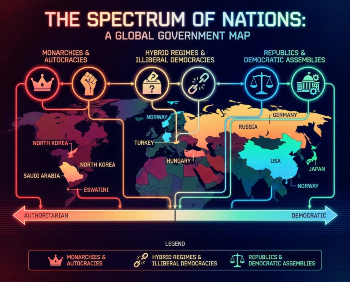
Most American coverage of the republic vs democracy debate stays inside the American frame. That is a mistake, because the rest of the world shows something the domestic argument tends to hide: a republic is a form of government, while democracy describes where political authority comes from. Those two things can combine in very different ways, and sometimes not at all.
Once you separate the two concepts, the international picture stops looking like a contradiction and starts looking like a spectrum.
Republics That Are Not Democratic
The clearest proof that “republic” and “democracy” are not synonyms is the existence of republics that hold no meaningful elections.
- The People’s Republic of China is a republic in name and structure; it has a constitution, a national legislature, and a president, but it is not a democracy. Political authority is not contestable through free, competitive elections.
- The Democratic People’s Republic of Korea uses both words in its official name. It is neither a democracy nor a functioning constitutional republic in any sense that political scientists recognize.
- The Islamic Republic of Iran holds elections, but an unelected body vets candidates before they can appear on the ballot, limiting how far popular authority actually reaches.
These cases matter because they break the assumption that calling a country a republic says anything about how democratic it is. A republic can be authoritarian. The label describes the structure of government, not the source of its legitimacy.
Democracies That Are Not Republics
The reverse case is just as instructive. A country can be strongly democratic without being a republic in the strict sense.
- The United Kingdom is a constitutional monarchy with a parliamentary democracy. The head of state inherits the role rather than being elected, so the country is not a republic, yet it holds free elections, protects speech and assembly, and subjects government to courts and constitutional conventions.
- Canada, Australia, and New Zealand follow a similar model: parliamentary democracy under a constitutional monarchy, with an elected legislature and an independent judiciary.
- Sweden, Denmark, Norway, and the Netherlands are constitutional monarchies that consistently rank among the world’s most democratic systems.
If “republic” were required for democracy, none of these countries would qualify. They clearly do. That is the strongest evidence that the two terms describe different things.
 Republics That Are Also Democracies
Most modern republics are also democracies, which is why the American debate gets confusing.
- France is a constitutional republic with a written constitution, a directly elected president, and a prime minister accountable to the legislature.
- Germany is a federal constitutional republic whose Basic Law creates a constitutional court empowered to strike down legislation that violates fundamental rights.
- Switzerland combines a federal republic with extensive direct democracy: citizens vote on national referendums several times a year and can propose constitutional amendments by petition.
- Ireland is a parliamentary republic with a written constitution, an elected president with largely ceremonial powers, and a tradition of citizen assemblies that feed recommendations into constitutional change.
Each of these countries is a republic in structure and a democracy in source of authority. None of them treats the two labels as rivals.
What the Comparison Actually Shows
Line the examples up, and a pattern emerges:
| Country | Form of government | Source of authority | Direct democracy tools |
|---|---|---|---|
| United States | Constitutional republic | Representative democracy | State and local ballot measures |
| France | Constitutional republic | Representative democracy | Limited national referendums |
| Germany | Federal constitutional republic | Representative democracy | Very limited |
| Switzerland | Federal republic | Representative plus direct democracy | Frequent national referendums |
| United Kingdom | Constitutional monarchy | Parliamentary democracy | Rare national referendums |
| China | Republic (one-party) | Not democratic | None |
Two conclusions follow. First, republic and democracy are not opposites; they answer different questions. Second, the American version of the debate is not really about which word is correct. It is about which features of the system a speaker wants to emphasize: the constitutional limits that make it a republic, or the popular elections that make it a democracy.
That framing is more useful than the domestic shouting match, because it lets you evaluate any country on two separate axes instead of forcing every system into a single label.
Constitutional Evidence: What the Document Actually Says
The strongest version of the republic vs democracy debate stops trading slogans and starts reading the text. The Constitution is short enough to check directly, and what it says, and does not say, is more interesting than either side usually admits.
The Word “Democracy” Does Not Appear
Search the Constitution, including the Bill of Rights and the later amendments, and you will not find the word “democracy.” That absence is real, and it is the fact most often cited by people who argue the country is a republic, not a democracy.
But absence of a word is not prohibition of a concept. The Constitution also never uses the phrase “separation of church and state,” yet the First Amendment’s religion clauses are universally understood to create one.
The Guarantee Clause
The one place the Constitution uses the word “republican” is Article IV, Section 4:
“The United States shall guarantee to every State in this Union a Republican Form of Government, and shall protect each of them against Invasion; and on Application of the Legislature, or of the Executive (when the Legislature cannot be convened) against domestic Violence.”
This is the Guarantee Clause, and it is the single most quoted line in the entire debate. Read carefully, it does three things:
- It requires each state to have a republican form of government.
- It commits the federal government to defend states against invasion.
- It commits the federal government to defend states against domestic violence on request.
What it does not do is define “republican form of government.” The framers left that term to be interpreted, and the Supreme Court has generally treated disputes over it as political questions rather than cases it will decide. That silence is why the clause gets cited so often and settles so little.
Article I and the Structure of Representation
Article I, Section 1 vests all legislative power in a Congress composed of a Senate and a House of Representatives. Article I, Section 2 requires House members to be chosen “by the People of the several States” every two years.
That amendment is useful evidence in the debate. The country deliberately made its national legislature more directly democratic over time. If the founders had intended the system to be permanently anti-democratic, they would not have used the amendment process that way.
The Bill of Rights as a Limit on Majorities
The first ten amendments list things the government cannot do: Congress shall make no law respecting an establishment of religion, or abridging the freedom of speech, or of the press, or the right of the people to assemble and petition.
These provisions are the constitutional backbone of the argument that the United States is a republic in the limiting sense: even a large majority cannot pass a law that violates them, and courts can strike such a law down.
The Fifteenth, Nineteenth, Twenty-Fourth, and Twenty-Sixth Amendments
The other side of the ledger is just as textual. Four amendments expanded who could participate in elections:
- The Fifteenth Amendment (1870) barred denial of the vote based on race.
- The Nineteenth Amendment (1920) barred denial of the vote based on sex.
- The Twenty-Fourth Amendment (1964) banned poll taxes in federal elections.
- The Twenty-Sixth Amendment (1971) lowered the voting age to eighteen.
Each of these amendments made the system more democratic in the literal sense of expanding popular participation. A constitution that repeatedly expands the franchise is not a constitution that rejects democracy.
What the Text Actually Supports
Put the provisions side by side and the constitutional record supports both labels:
| Provision | What it shows |
|---|---|
| Article IV, Section 4 (Guarantee Clause) | The system is republican in form |
| Article I, Sections 1-3 | Lawmaking runs through elected representatives |
| Bill of Rights | Majorities are constrained by enumerated limits |
| Fourteenth Amendment | States are bound by due process and equal protection |
| Fifteenth, Nineteenth, Twenty-Fourth, Twenty-Sixth Amendments | The franchise has been repeatedly expanded |
| Seventeenth Amendment | The Senate became directly elected |
The honest reading is that the Constitution creates a representative system in which the people are the ultimate source of authority, exercised through elections, and bounded by limits the majority cannot remove through ordinary legislation. That is a republic in structure and a democracy in source of legitimacy. The text does not force a choice between the two.
For readers who want to verify any of this directly, the National Archives’ transcript of the Constitution and amendments publishes the full text, and the Legal Information Institute’s overview of the Guarantee Clause summarizes how courts have treated it. Reading the primary source is the fastest way to move past the slogans.
 How the Republic vs Democracy Debate Is Used in Contemporary Political Rhetoric
The debate is no longer just about political theory. It is a rhetorical tool, and both sides use it.
One common move is to say, “We are a republic, not a democracy,” to argue that certain majority-backed proposals are illegitimate.
Both framings oversimplify. The republic vs. democracy debate is real, but it isn’t a switch that flips the system from one to the other. It is a description of how popular rule and constitutional limits work together.
Precision is the antidote.
Common Myths About the Republic vs Democracy Distinction
Several myths keep circulating. Here are the most common ones, and what the record actually shows.
Myth: The United States is a republic, not a democracy. Reality: The United States is a constitutional republic with representative democracy.
Myth: A republic has no majority rule. Reality: Majorities still decide most questions. The Constitution limits which questions they can decide and how.
Myth: The distinction is just semantics. Reality: It shapes real arguments about court power, federal authority, and individual rights.
Conclusion: Why Precision Matters for Self-Government
The republic vs. democracy debate will keep resurfacing because it touches the deepest question in American politics: who holds political authority, and what limits apply to it. Getting the terms right is not pedantry.
Texas Journal exists for citizens who want that precision. We provide constitutional education, guidance on how the United States Constitution’s powers actually work, and a focus on states’ rights as a check on federal overreach.
If you want to understand your rights, defend founding principles, and stop Washington from usurping freedoms, start here. Click here to join the movement and put constitutional knowledge to work.

Frequently Asked Questions
What is the difference between a republic and a democracy?
A democracy emphasizes rule by the people, often through direct voting on laws or policies. A republic emphasizes representative government, where elected officials make decisions on citizens’ behalf within a constitutional framework. The key difference lies in how much direct control citizens exercise over lawmaking versus how much authority they delegate to elected representatives.
Is a republic a type of democracy?
Many political scientists classify a republic as a form of democracy because both systems derive authority from the people. A republic adds constitutional limits and representative structures to prevent tyranny of the majority. In this view, a constitutional republic is a specific type of democracy that prioritizes the rule of law and protection of individual rights over pure majority rule.
Is the United States a republic or a democracy?
The United States operates as a constitutional republic with democratic features. Citizens elect representatives to make laws, and the Constitution establishes limits on government power. The founding principles emphasize popular sovereignty alongside checks and balances. In practice, the American system combines representative government with periodic elections, making it both a republic and a functioning democracy.
What is the difference between direct democracy and representative democracy?
In a direct democracy, citizens vote directly on laws and policies, as seen in some state ballot initiatives. In a representative democracy, citizens elect officials who then make legislative decisions. The United States primarily uses representative democracy at the federal level, though direct democracy appears in local referendums and certain state processes.
What does the Constitution say about a republican form of government?
Article IV, Section 4 of the U.S. Constitution guarantees each state a republican form of government. This clause affirms that states must maintain representative systems with elected officials rather than monarchies or other non-representative structures. It reinforces the founding principle that political authority flows from the people through elected representatives.
Can a republic protect individual rights from majority rule?
A constitutional republic is designed to protect individual rights from an unchecked majority. The Bill of Rights, judicial review, and separation of powers create safeguards that prevent temporary majorities from infringing on fundamental liberties. This structure distinguishes a constitutional republic from a pure democracy, where majority preferences could override minority protections.

