Last Updated: November 13, 2026
Quick Summary
Six key individual liberties limit government power: speech and expression, religion and conscience, the right to keep and bear arms, due process, assembly and press, and privacy against unreasonable search. Each liberty comes from the Bill of Rights, ratified in 1791, and each draws a specific line where government authority stops. When government acts against a protected liberty, it must justify itself, not the other way around.
- The Bill of Rights is the first ten amendments, ratified together in 1791.
- Government cannot silence speech because officials dislike the viewpoint.
- Due process means the government cannot take life, liberty, or property without fair notice and a hearing.
- Police generally need a warrant supported by probable cause to search.
- Most liberty protection happens in permit offices, school boards, and local agencies, not courtrooms.
Table of Contents
- Why the Framers Set Individual Liberties Against Government Power
- A Bill of Rights List Simple Enough to Keep Straight
- 1. Freedom of Speech and Expression
- 2. Freedom of Religion and Conscience
- 3. The Right to Keep and Bear Arms
- 4. Due Process and Legal Protections
- 5. Freedom of Assembly and the Press
- 6. Privacy and Protection Against Unreasonable Search
- Examples of Individual Liberties in Modern Life
- Government Power and Individual Rights: Where the Line Really Sits
- Frequently Asked Questions
 Why the Framers Set Individual Liberties Against Government Power
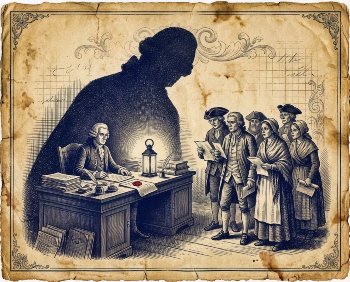
The Framers built the Constitution on a simple fear: power concentrates unless something stops it. Individual liberties are the specific limits they wrote into the text to keep that from happening. This guide from Texas Journal walks through six of those liberties, with concrete examples of how each one draws a line against government power.
The design was deliberate. A government strong enough to govern is also strong enough to overreach, so the Framers separated powers, reserved authority to the states, and then added a Bill of Rights as a backstop. That backstop matters because it shifts the burden. When government acts against a protected liberty, it has to justify itself, not the other way around.
That tension between government power and individual rights is the throughline of everything below. Six liberties, six examples, one question: where does government authority stop?
A Bill of Rights List Simple Enough to Keep Straight
The Bill of Rights is the first ten amendments to the Constitution, ratified together in 1791, and it functions as a written list of things the federal government may not do to you (Bill of Rights (1791)). Six of those protections drive most modern fights over individual liberties.
Here is the short version, and the framework we use for the rest of this article:
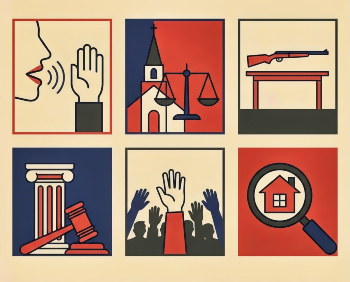
| Liberty | Source | Core Limit on Government |
|---|---|---|
| Speech and expression | First Amendment | Cannot punish or silence protected expression |
| Religion and conscience | First Amendment | Cannot establish a religion or block free exercise |
| Keep and bear arms | Second Amendment | Cannot infringe the right to keep and bear arms |
| Due process | Fifth and Fourteenth Amendments | Cannot deprive life, liberty, or property without fair procedure |
| Assembly and press | First Amendment | Cannot block peaceful assembly or punish the press |
| Privacy and search | Fourth Amendment | Cannot search or seize without proper legal grounds |
For the full text of each amendment in context, keep the Bill of Rights reference handy as you read.
1. Freedom of Speech and Expression
Speech is the liberty Americans invoke most and understand least precisely. The First Amendment protects expression from government punishment, but it does not protect every act, and it never binds private employers or platforms. The First Amendment text is short; the case law around it is not.
Where Government Power Stops and Speech Begins
Government power stops at protected expression. It can regulate time, place, and manner, and it can punish true threats, incitement, fraud, and obscenity, but it cannot silence speech because officials dislike the viewpoint. That viewpoint rule is the sharpest edge of this liberty.
 The Landmark Cases That Drew the Line
The doctrine is not abstract; it was built case by case. In Texas v. Johnson (1989), the Supreme Court held that burning the American flag as political protest is expression protected by the First Amendment, striking down a state flag-desecration statute. In Brandenburg v. Ohio (1969), the Court set the modern incitement standard: government may punish advocacy only when it is directed to inciting imminent lawless action and is likely to produce it. In Tinker v. Des Moines (1969), the Court protected students’ silent black-armband protest in public school, establishing that students do not shed their constitutional rights at the schoolhouse gate. In New York Times Co. v. Sullivan (1964), the Court required public officials to prove “actual malice” to win a defamation suit over criticism of their official conduct, giving political speech broad breathing room.
The Tests Courts Actually Apply
When a speech regulation is challenged, courts sort it into a category and apply a matching test. Content-neutral rules on time, place, and manner, such as noise limits or permit requirements for large gatherings, are upheld if they are narrowly tailored to a significant government interest and leave open ample alternative channels of communication. Content-based restrictions, by contrast, face strict scrutiny: the government must show a compelling interest and use the least restrictive means. Commercial speech gets intermediate scrutiny under the Central Hudson framework. True threats, fighting words, obscenity under Miller v. California, and child pornography fall outside protection. Knowing which test applies often predicts the outcome before the facts are even argued.
Modern Battlegrounds
Speech fights have moved online and into new forums. Public officials who block critics from their social media accounts have been sued under the First Amendment, with courts asking whether the official was acting in a governmental or personal capacity. State laws regulating how large platforms moderate content have been challenged as compelled-speech and viewpoint-discrimination problems. Public school and university policies on harassing speech, pronoun usage, and campus protests continue to generate litigation. Government pressure on private platforms, sometimes called jawboning, raises the question of when informal coercion becomes a First Amendment violation.
A common mistake is assuming the First Amendment reaches private decisions. It does not. When a social platform removes a post, that is a private company exercising its own judgment, not government infringement. Knowing which actor you are dealing with decides whether a liberty claim exists at all.
We are not attorneys, and nothing here is legal advice. Speech disputes often turn on facts that need a licensed lawyer’s review; see our disclaimer explaining our role.
2. Freedom of Religion and Conscience
Religious liberty has two clauses pulling in opposite directions. The Establishment Clause stops government from adopting or promoting a religion. The Free Exercise Clause stops government from burdening religious practice without adequate justification.
In practice, the fights land in schools, zoning boards, and licensing offices. A town cannot require a church to obtain a permit its rules do not impose on comparable gatherings. A public school cannot organize prayer as part of instruction. A licensing agency cannot deny a professional credential because of an applicant’s faith.
Where it gets difficult is when a neutral law collides with a sincere religious practice. Courts weigh the government’s interest against the burden imposed, and the outcome turns on facts.
 3. The Right to Keep and Bear Arms
The Second Amendment protects an individual right to keep and bear arms, separate from any military service. It is not unlimited, and the line-drawing is where nearly every modern legal fight happens. For the actual text and background, the Second Amendment reference lays it out plainly.
The practical examples look like this. A state cannot ban the possession of firearms in the home outright. A licensing scheme cannot be built to make the right impossible to exercise in practice. At the same time, courts have upheld restrictions aimed at specific categories of people and specific sensitive places.
4. Due Process and Legal Protections
Due process is the liberty that makes the others enforceable. It means government cannot take your life, liberty, or property without fair notice and a fair hearing. The Fifth Amendment applies it to the federal government; the Fourteenth Amendment applies it to the states.
Examples are everywhere once you look. A property owner facing condemnation gets notice and a hearing. A defendant gets counsel and a jury. An agency cannot revoke a license without stating the grounds and letting the holder respond.
If you are dealing with an encounter on the street rather than in a courtroom, practical guidance on knowing what to say, what to sign, and when to ask for a lawyer. That matters because due process protections are easiest to lose in the first ten minutes of an interaction.
5. Freedom of Assembly and the Press
Assembly and press freedom protect the machinery of dissent. The right to gather peacefully and the right to publish without government punishment are what let the other liberties be exercised in public rather than in private complaint.
The limits are procedural, not viewpoint-based. Government can require permits for large gatherings on public streets, set noise rules, and manage traffic. It cannot condition a permit on the group’s message or refuse one because the cause is unpopular.
The press clause works the same way. Government cannot punish a publisher for critical coverage, and it cannot use licensing or access rules to shut down outlets it dislikes.
 6. Privacy and Protection Against Unreasonable Search
The Fourth Amendment protects people against unreasonable searches and seizures. The Fourth Amendment reference covers the standard in full.
The Baseline Rule and Its Exceptions
The default is a warrant: police generally need one, supported by probable cause and particular in describing the place to be searched and the persons or things to be seized. But a large share of real-world encounters run through recognized exceptions: consent, search incident to a lawful arrest, plain view, exigent circumstances, automobile searches under Carroll v. United States (1925), and inventory searches. Each exception has its own boundaries, and officers frequently rely on more than one at a time. If an exception does not fit, the evidence may be suppressed under the exclusionary rule, a remedy the Court applied to the states in Mapp v. Ohio (1961).
Landmark Cases That Set the Standard
Several decisions define the modern boundary. In Katz v. United States (1967), the Court held that the Fourth Amendment protects people, not places, and that government wiretapping of a public phone booth was a search because the caller had a reasonable expectation of privacy. In Terry v. Ohio (1968), the Court allowed a brief investigative stop and pat-down on reasonable suspicion, short of probable cause. In United States v. Jones (2012), the Court held that attaching a GPS tracker to a car and monitoring it for 28 days was a search, with several justices emphasizing the prolonged monitoring. In Riley v. California (2014), the Court required a warrant to search the digital contents of a cell phone incident to arrest, rejecting the idea that a phone is like a pocket address book. In Carpenter v. United States (2018), the Court held that acquiring seven days or more of historical cell-site location records is a search requiring a warrant, recognizing that digital data can reveal a person’s whole life.
Modern Digital Privacy in Practice
The amendment’s text is fixed; the technology is not. Automated license plate readers, cloud storage, smart-home devices, and commercial data brokers create records the Framers could not have imagined. The constitutional question stays the same: does the government have lawful grounds to access this, or is it an unreasonable search dressed up as routine procedure? But the answer now depends on whether the collection is a search at all, whether a warrant or exception applies, and whether the data was obtained from a third party. The third-party doctrine, which long held that information voluntarily shared with a company loses Fourth Amendment protection, has been narrowed in the digital context by Carpenter and remains a live battleground.
Examples That Clarify the Boundary
Police generally need a warrant to search your home. They need a warrant or a recognized exception to search your phone. A traffic stop has to stay within the reason for the stop; a stop for a broken taillight does not authorize a full vehicle search. A border search has its own rules, generally more permissive at the border than in the interior. A subpoena to a bank or phone company is not a search of you in the same sense as a search of your house, which is why the third-party question matters so much.
We are not attorneys, and nothing here is legal advice. Search-and-seizure questions are fact-specific and often time-sensitive; see our disclaimer explaining our role and consider consulting a licensed lawyer in your state.
 Examples of Individual Liberties in Modern Life
Abstract rights become real when they show up in ordinary situations. Here are examples of individual liberties in action, and each one shows the same pattern: a government actor, a protected interest, and a question about justification.
- A homeowner challenges a municipal inspection that arrived without a warrant or consent.
- A parent objects to a school practice that treats a religious observance as optional but penalizes absence.
- A small publisher refuses a state demand for its source notes.
- A gun owner appeals a permit denial that came with no written reason.
- A protester contests a permit fee that applies only to groups the city finds inconvenient.
Notice what these have in common. None of them requires a landmark Supreme Court case. Most liberty protection happens in permit offices, school boards, and local agencies, long before anything reaches a courtroom.
One honest caveat: we are not attorneys, and nothing here is legal advice. We publish a plain-language disclaimer explaining our role because constitutional questions often need a licensed lawyer in your state.
Government Power and Individual Rights: Where the Line Really Sits
The line between government power and individual rights is not fixed. It moves with the facts, the forum, and the government interest at stake. What stays constant is the structure: a protected liberty, a government action, and a burden of justification.
That is why the Constitution protects liberty through procedure as much as through text. Notice requirements, hearing rights, warrant standards, and appeal deadlines are not paperwork. They are the mechanism that makes a right usable by an ordinary person on an ordinary Tuesday.
Federalism adds a second layer. States hold general police power, and the Constitution limits what both state and federal government can do. That is why state-level engagement matters so much: the officials closest to you are the ones most likely to test a boundary first.
The gap between a right written on paper and a right you can actually exercise comes down to knowing the procedure and using it. Texas Journal exists to close that gap, with constitutional education built for citizens rather than law reviews. Members get guidance on how the Constitution’s limits apply in practice, tools to track overreach from Washington and state agencies, and the Patriot Pool, a force multiplier that connects readers pushing back in their own communities. Start by reviewing the membership options and see where your own state stands.
Subscribe for Updates – Play for Free – Click Here!
Dave
Questions? Call!
940-353-1398
Frequently Asked Questions
What are examples of individual liberties?
The clearest examples sit in the Bill of Rights: speaking freely, worshipping or not worshipping as you choose, keeping and bearing arms, refusing warrantless searches of your home, assembling with others, and receiving due process before the government takes your life, liberty, or property. Each one limits government power rather than granting it. State constitutions often add protections of their own, which is why the same conduct can be treated differently across state lines.
Can the government limit constitutional rights?
Yes, but only within the boundaries the courts have drawn. Speech can be restricted when it crosses into threats, incitement, or fraud. Religious practice can be limited by neutral laws that apply to everyone. The test is rarely whether a right exists but whether the government’s action is narrow enough and justified enough to survive judicial review. An attorney can tell you how those tests apply to your situation.
What is the relationship between government power and individual rights?
They are two sides of one design. The Constitution grants the federal government enumerated powers and reserves the rest to the states and the people under the Tenth Amendment. Every individual liberty is a fence around that grant. When agencies, legislatures, or executives act beyond their authority, the remedy is not a new right but enforcement of the old limit through courts, state officials, and public pressure. Understanding the fence matters more than memorizing the list.
How does the Constitution protect individual liberty beyond the Bill of Rights?
Three mechanisms do most of the work. Separation of powers and checks and balances make it hard for one branch to act alone. Federalism lets states serve as laboratories and as counterweights to Washington. Judicial review lets courts strike down acts that exceed constitutional authority. The Fourteenth Amendment later applied most Bill of Rights protections against state governments through selective incorporation, and the Ninth Amendment makes clear that listing some rights does not disparage others.
What are the 10 rights in the Bill of Rights?
The first eight amendments list specific protections: speech, religion, assembly, press, petition, arms, quartering of soldiers, search and seizure, grand jury and double jeopardy, self-incrimination, speedy trial, jury trial, and bans on excessive bail and cruel punishment. The Ninth says the enumeration of certain rights does not deny others. The Tenth reserves powers not delegated to the federal government to the states or the people. Together they form the short list most citizens mean when they talk about individual liberties.