


Table of Contents
- 1. Master Constitutional Activism for Beginners
- 2. Practice Digital Civic Engagement and Media Literacy
- 3. How to Challenge Local Government Overreach
- 4. How to Verify Local School Board Budget Transparency for Parents
- 5. Build Local Coalitions for Collective Action
- 6. Support the Republic Through State-Level Advocacy
- How Texas Journal Supports the Republic
- Frequently Asked Questions
1. Master Constitutional Activism for Beginners
Constitutional activism for beginners starts with knowing the rights you already hold and showing up where decisions get made. This guide  from Texas Journal walks through six concrete ways to support the republic in 2026, from public comment at city hall to state-level advocacy. Most citizens never use these tools, not because they are complicated, but because nobody explained them.
The first step is simple: read the First and Second Amendments yourself. The First Amendment protects speech, assembly, petition, press, and religion. The Second protects the right to keep and bear arms. You don’t need a law degree to quote them accurately at a public meeting, and that accuracy separates effective activism from noise.
Know Your First Amendment and Second Amendment Rights
Read the actual text before you cite it. The First Amendment covers five freedoms, and most citizens forget the petition clause. That clause gives you the right to formally ask government to change course, and it applies at every level, from a school board to Congress.
The Second Amendment protects an individual right to keep and bear arms, as confirmed in District of Columbia v. Heller. Knowing the boundaries of both amendments keeps your arguments credible when officials push back.
Attend Local Government Meetings and Speak During Public Comment
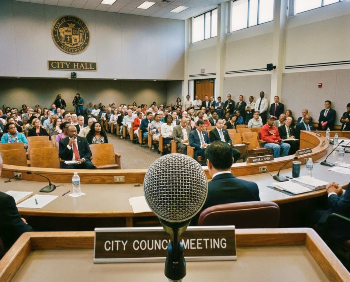
Show up and sign the speaker card. Nearly every city council and county commission reserves time for public comment, and most meetings draw only a handful of residents. That empty room is your advantage.
A common mistake is treating public comment like a speech. It is not. You get two or three minutes, so state your name, district, specific concern, and requested action. Then stop.
2. Practice Digital Civic Engagement and Media Literacy
Digital civic engagement uses online platforms to verify information, organize neighbors, and pressure officials between elections. It is now one of the fastest ways to support the republic, because a well-documented post can reach more constituents in an hour than a week of door knocking.
The catch is credibility. One shared false claim undoes months of trust, so verification has to come first.
Verify Sources Before Sharing Political Content
Media literacy is the practice of checking who published a claim, when, and what evidence backs it. Before you share anything political, run three checks:
- Open the original document, not the screenshot of it

- Confirm the date, because old stories recirculate constantly
- Search for the same claim from a second independent outlet
If a post cites a bill number, pull the bill text from the official state legislature site. If it cites a budget figure, find the line item. Most viral claims collapse at this stage.
Use Social Media to Mobilize Your Community
Mobilization works when the ask is specific. “Show up Tuesday at 6 p.m. at the county annex to oppose Item 7” outperforms “get involved” every time.
Build a simple system: one group chat per neighborhood, one shared calendar, one folder of source documents. When a vote is scheduled, post the agenda link, the item number, and a one-sentence summary of what the measure does.
3. How to Challenge Local Government Overreach
Challenging local government overreach means using open records law, public comment, and organized attendance to force transparency before a vote happens. The goal is not confrontation for its own sake. It is documentation.
File Public Records Requests Under Your State’s Open Records Act
Every state has an open records statute, though the names differ. Some call it a Public Information Act, others an Open Meetings Act or Freedom of Information Act. The mechanics are similar everywhere:
- Identify the records precisely, such as “all emails between the city manager and [vendor] from March 1 to April 15”
- Submit in writing to the designated records officer
- Track the statutory response deadline your state sets
- Appeal in writing if the request is denied or ignored
 Keep requests narrow. A broad request invites delay; a specific one gets answered.
Organize Neighbors to Attend City Council and County Commission Meetings
Numbers change outcomes. When five residents speak on the same item, officials notice. When thirty do, the item often gets tabled.
Assign roles before the meeting. One person speaks on the legal question, one on cost, one on process. Bring printed copies of the relevant statute or budget line for anyone who wants one.
| Problem | Fix | Who Acts |
|---|---|---|
| Vote scheduled with no notice | Request agenda packet, post it publicly | One organizer |
| Officials deflect questions | Cite statute and item number on record | Designated speaker |
| Low turnout | Send specific time, place, item number | Group chat lead |
| Records request ignored | File written appeal by deadline | Records volunteer |
4. How to Verify Local School Board Budget Transparency for Parents
Verifying local school board budget transparency for parents comes down to two documents: the line-item budget and the monthly expenditure report. Districts publish both, though sometimes only after a formal request.
Request and Review Line-Item Budget Documents
Ask the district’s business office for the adopted budget at the line-item level, plus current-year actual expenditures to date. Compare the two. A common mistake is reviewing only the summary page, which hides where money actually moved.
Look for categories that grew faster than enrollment, and for consulting or legal line items that appear mid-year without a board vote.
Ask Specific Questions During School Board Meetings
Specific questions get specific answers. “What is the current fund balance, and what is the projected shortfall for next fiscal year?” beats “Where is the money going?”
Ask for the answer on the record, in the minutes. If the board cannot answer, request that the question be carried to the next meeting with a written response.
5. Build Local Coalitions for Collective Action
Coalitions turn isolated complaints into a bloc that officials have to answer. Collective action works because a single parent raising a budget question is a comment; forty parents asking the same question is a constituency. The unique angle here is that a local coalition is also the launchpad for state and national advocacy. A group that wins a local fight has the credibility, the email list, and the documented record to take the same issue to the state legislature.
Start with shared concerns rather than shared politics. School budgets, property taxes, road maintenance, and utility rates cut across party lines and give you the broadest possible base. A coalition built on a single national issue tends to fracture; one built on a shared local problem tends to hold.
Identify Shared Concerns Across Neighborhoods
Map the issues that touch more than one neighborhood. A redevelopment plan, a tax ratification election, or a utility rate increase usually affects several districts at once.
Hold one meeting per neighborhood and write down every concern raised. Patterns show up fast, and those patterns become your platform. A practical method is to sort concerns into three buckets:
- Immediate: a vote scheduled in the next 30 days
- Medium-term: a budget cycle or election in the next year
- Structural: a rule or process that keeps producing the same problem
The immediate bucket gets your first action. The structural bucket becomes the issue you eventually take to the state level.
Partner with Existing Civic Organizations
Do not build from scratch. Existing groups already have members, meeting space, and email lists. Reach out to:
- Parent-teacher associations
- Homeowner and neighborhood associations
- Local taxpayer groups
- Church and community service organizations
- Volunteer fire departments and civic clubs
Bring a specific ask. Groups respond to “will you send two members to the county meeting on Item 7” far better than “will you support our cause.” A common pattern is that a group will send one observer to a first meeting, two to a second, and a full delegation once they see the issue is real and the meetings are productive.
Assign Roles and Build a Simple System
A coalition without roles is a group chat. Assign four functions before your first public action:
- Researcher: pulls the agenda packet, the statute, and the budget line
- Speaker: delivers the two-minute public comment on record
- Recruiter: fills the room and tracks who showed up
- Documenter: records what officials said and publishes it
 Keep one shared folder for source documents and one shared calendar for votes. When a vote is scheduled, post the agenda link, the item number, and a one-sentence summary of what the measure does.
Escalate from Local to State
Once your coalition has a documented local win, the same group can testify before a state committee, submit written testimony, and ask your state representative to sponsor a bill. That escalation path is what separates a one-time protest from durable civic infrastructure. The local fight builds the record; the state fight changes the rule that created the problem in the first place.
6. Support the Republic Through State-Level Advocacy
State-level advocacy is where individual citizens still have the most leverage, because state legislatures set the rules that govern schools, elections, taxes, and most of daily life. Washington gets the coverage; your state capital is where the votes actually land. The most effective approach treats state advocacy as one layer of a two-layer system: grassroots local support on one side, national and state policy advocacy on the other. Most citizens pick one and ignore the other, which is why their efforts stall.
Understand the Local vs. National Support Framework
Local support and national advocacy are not competing strategies. They reinforce each other, and the citizens who move policy fastest are the ones who work both layers at once.
- Local layer: city council, county commission, school board, and special districts. These bodies set property tax rates, zoning, school calendars, and utility rates. Turnout is often in the single digits, so a handful of informed residents can swing an outcome.
- State layer: the legislature, the governor’s office, and state agencies. These set election rules, curriculum standards, licensing requirements, and the bulk of criminal and civil law.
- National layer: Congress and federal agencies. These set the framework, but most of what you experience day to day is decided closer to home.
The practical rule: use local action to build credibility and a track record, then carry that record to the state level. A resident who has spoken at ten school board meetings is a credible witness before a legislative committee. A resident who has only signed an online petition is not.
Track State Legislation and Contact Your Representatives
Every state legislature publishes a bill tracking system online. Set alerts for keywords tied to your issues, and read the bill text, not the press release about it. A bill’s fiscal note, which estimates the cost to the state, is often more revealing than the bill’s title.
When you contact a representative, be brief and specific. Name the bill number, state your position in one sentence, and give one reason. Calls and short emails get logged; long essays get skimmed. A common pattern is that a single well-timed call from a constituent in the district carries more weight than a hundred form emails from outside it.
If you want to testify in person, most committees publish a sign-up process and a time limit, often two to three minutes. Bring printed copies of your testimony for the committee clerk. Written testimony becomes part of the public record even if you never speak.
Support Candidates Who Back States’ Rights
States’ rights is the constitutional principle that powers not delegated to the federal government remain with the states or the people, as set out in the Tenth Amendment. Candidates who take that principle seriously tend to vote against federal mandates that bypass your state legislature.
Support them with time, not just money. Canvassing, phone banking, and hosting a neighborhood meet-and-greet all move votes more reliably than a donation. A common pattern in down-ballot races is that a candidate’s margin is decided by a few hundred votes, which means a single committed volunteer can matter more in a state house race than in a presidential one.
Tenth Amendment, Legal Information Institute
Connect Local Wins to State Policy
The strongest state advocacy is built on documented local outcomes. If your coalition got a school board to publish line-item budgets, that is a model other districts can adopt through state legislation. If your county commission tabled a redevelopment plan after public comment, that is evidence a state transparency rule would work.
Bring those local results to your state representative as a concrete proposal, not a complaint. Lawmakers respond to a bill idea that already has a proven local example behind it. That is how grassroots support becomes state policy, and how state policy eventually shapes national debate.
How Texas Journal Supports the Republic
Texas Journal exists to give citizens the constitutional grounding and the practical tools to act on everything above. Where most outlets report on government, Texas Journal teaches you how to use the abilities the Constitution already grants you, from petition and public comment to open records requests and state-level advocacy.
The platform focuses on states’ rights as the durable path to restoring founding principles, and it treats constitutional education as a skill rather than a subject. Readers who want more than occasional insight can join the Patriot Pool, which functions as a force multiplier by connecting members to the movement rather than leaving them to organize alone.
If your goal is to understand your rights and then use them, Texas Journal is built for exactly that.

Frequently Asked Questions
What does it mean to support the republic?
Supporting the republic means actively upholding the Constitution and the principles of self-governance. It involves exercising your rights, staying informed, and participating in civic processes from local school board meetings to state legislative advocacy. The goal is to ensure government remains accountable to the people and that founding principles like limited government and individual liberty are preserved for future generations.
How can citizens participate in local government to protect constitutional rights?
Start by attending city council, county commission, and school board meetings. Speak during public comment periods to voice concerns about overreach. File public records requests to uncover how decisions are made and how funds are spent. You can also run for local office, serve on citizen advisory boards, and organize neighbors to collectively challenge policies that infringe on constitutional rights. These actions create accountability at the level where it matters most.
Why is local activism important for national stability?
Local activism is the foundation of national stability because it ensures government remains close to the people. When citizens engage at the local level, they hold officials accountable, prevent the accumulation of unchecked power, and protect individual liberties. A republic thrives when its citizens actively participate in governance, not just during elections but every day. Strong local involvement creates a ripple effect that strengthens the entire nation.
How do I get involved in school board transparency initiatives?
Begin by requesting detailed budget documents from your local school district. Attend school board meetings and ask specific questions about spending priorities, curriculum decisions, and administrative costs. Connect with other parents who share concerns and form a transparency group. Use your state’s open records laws to obtain contracts and emails. When you verify local school board budget transparency for parents, you help ensure education funds are used effectively and align with community values.
What is the role of the citizen in a constitutional republic?
In a constitutional republic, citizens are not passive subjects but active participants. Your role includes voting, serving on juries, staying informed on issues, and holding elected officials accountable. You have the right and responsibility to challenge government overreach, advocate for constitutional principles, and engage in peaceful assembly. By fulfilling these duties, you help preserve the balance of power and protect the freedoms enshrined in the Constitution for future generations.
The hard part of civic work is not knowing what to do. It is sustaining it past the first meeting, the first denied records request, and the first vote that goes the wrong way. Texas Journal was built for citizens who intend to keep going, with constitutional education, states’ rights analysis, and the Patriot Pool connecting members into a coordinated movement instead of isolated voices. Get started with Texas Journal and turn your constitutional rights into action that actually changes policy.

