


Table of Contents
- Why Teaching Founding Principles Matters at Home
- Core Founding Principles Defined
- Primary Source Activities for Kids
- Constitutional Literacy for Families
- Analyzing Founding Documents Together
- Founding Principles Curriculum for Homeschool
- Age-Appropriate Scaffolding Strategies
- Connecting History to Modern Citizenship
- Conclusion
- Frequently Asked Questions
Last Updated: September 26, 2026
Why Teaching Founding Principles Matters at Home
Learning how to teach founding principles equips your children to understand their constitutional rights and defend them. The founding fathers built this nation on specific ideas about liberty, self-governance, and limits on government power. Without intentional teaching, these principles get buried under revisionist curriculum and institutional pressure.
Children who learn these principles develop critical thinking skills that extend far beyond civics. They learn to question authority respectfully, read sources, and recognize when government power exceeds constitutional limits.
The best way to teach founding principles requires clarity, primary sources, and a willingness to let your children think for themselves.
Core Founding Principles Defined
Five core principles underpin the founding: Liberty (individuals possess natural rights governments exist to protect, not grant), Equality (equal rights under law, not equal outcomes), Self-governance (citizens retain power over their communities), Rule of law (everyone, including officials, must follow the same laws), and Separation of powers (authority divided among three branches).
These principles shaped specific constitutional structures: separation of powers prevents any single authority from becoming too powerful, checks and balances allow each branch to resist overreach, and the Bill of Rights explicitly protects individual liberties.
Understanding these principles gives your children a framework for evaluating current events and policies. They’ll recognize government action that violates constitutional limits and spot inconsistencies in news coverage.
Primary Source Activities for Kids
Primary sources are the actual documents from the founding era, not summaries or interpretations. When your children read the founders’ words directly, it transforms how they understand these ideas.
Start with short excerpts like the Declaration’s preamble: “We hold these truths to be self-evident, that all men are created equal, that their Creator endows them with certain unalienable Rights, that among these are Life, Liberty and the pursuit of Happiness.” Ask your child what it means in their own words, what “self-evident” means, and why the founders listed these specific rights. This teaches critical reading and engagement with actual ideas.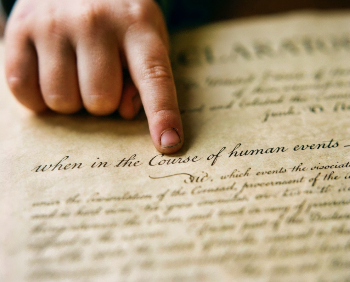
The Constitution’s Preamble works similarly. Have your child identify its stated purposes, ask which matter most, and consider whether current government actions serve them.
Create a simple activity: print a page from a founding document, highlight a key passage, and ask three questions: What does this say? What does it mean? How does this apply today?
Constitutional Literacy for Families
Constitutional literacy means understanding how the Constitution actually works, not what politicians claim it means. Most families rely on institutional interpretation instead of reading the document itself.
Make the Constitution accessible by printing or displaying the free public-domain text. Read it together section by section. Article I establishes Congress, Article II the President, Article III courts, and the Bill of Rights protects specific liberties.
Teaching founding principles through constitutional literacy shows your children that the Constitution limits government power rather than granting it. The Constitution tells government what it can do; everything else remains with the states or the people. This principle of limited government faces constant pressure from institutions benefiting from expanded power.
Have your child identify which powers belong to Congress, the President, and the states. Ask: Does the federal government have authority to do X? Show them where the Constitution gives that authority. This teaches them to evaluate government action against constitutional text.
Analyzing Founding Documents Together
Analyzing founding documents teaches your children to extract meaning from complex historical writing. The ideas remain clear when you work through the text carefully.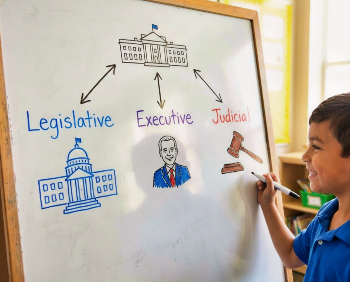
Start with the Declaration of Independence, which has three parts: the preamble stating principles, specific grievances against King George, and the conclusion announcing independence. Have your child identify these sections and ask why the founders grounded their argument in philosophy before listing grievances.
Examine specific grievances like “He has refused his Assent to Laws, the most wholesome and necessary for the public good.” Ask what this means, why a king would block desired laws, and what it reveals about ruler-ruled relationships. This teaches historical and philosophical thinking.
The Bill of Rights offers another starting point. Take the First Amendment and break it into parts. What does each clause protect? Why would the founders prioritize these specific freedoms? What happens when government violates them?
This analysis teaches your children that founding documents are arguments, not mystical texts. Understanding them means reading carefully and asking why the founders chose particular words.
Founding Principles Curriculum for Homeschool
A homeschool curriculum for teaching founding principles requires structure and consistency built around primary sources, constitutional analysis, and real-world application.
Month 1: Read the Declaration of Independence. Discuss “unalienable rights” and have your child write about what rights they believe are fundamental.
Month 2: Study the Constitution’s structure (Articles I, II, III). Create a chart showing which powers belong to each branch.
Month 3: Examine the Bill of Rights. Have your child identify what freedom each amendment protects and discuss modern situations testing these rights.
Month 4: Analyze separation of powers in a current news story. Have your child identify which branch is acting and whether they’re staying within constitutional limits.
Month 5: Study the Tenth Amendment and federalism. Have your child identify powers that should belong to states rather than the federal government.
Month 6: Have your child research a current policy issue and find its constitutional authority, or explain why none exists.
This curriculum teaches founding principles systematically while building understanding layer by layer.
Age-Appropriate Scaffolding Strategies
The most powerful approach is to teach the same principle at increasing levels of complexity across different ages, rather than teaching principles to different children. This builds family coherence and lets you reinforce ideas across conversations.
Teaching Liberty Across Ages: A Model
Take liberty as an example. You can teach this principle meaningfully to a 6-year-old, a 12-year-old, and a 16-year-old, each at their level.
Elementary (ages 6-8): Start with concrete personal freedom. “Liberty means you get to make choices about yourself. You choose what to wear, what games you like, what you believe. The government shouldn’t tell you these things. That’s what liberty means.” Use their own experience: “If the government said you had to wear the same clothes as everyone else, or you had to like the same games as everyone else, that would take away your liberty.” Ask: “What choices do you make every day? Should the government control those?” This age group understands liberty through personal autonomy.
Middle Grade (ages 9-12): Introduce the philosophical foundation.  “Liberty means people have natural rights that come from being human, not from government. The Declaration of Independence says we have the right to ‘life, liberty, and the pursuit of happiness.’ That means the government doesn’t give you these rights; you have them naturally. The government’s job is to protect them, not take them away.” Have them read the Declaration’s preamble together. Ask: “What does ‘unalienable’ mean? Why would the founders use that word?” Introduce the idea that government power should be limited: “If government could take away your liberty whenever it wanted, you wouldn’t really be free. So the Constitution limits what government can do.” This age group can grasp the relationship between natural rights and limited government.
High School (ages 14-18): Engage with competing philosophies and real-world tension. “The founders believed in natural rights, the idea that liberty comes from human nature, not government grant. But other political philosophies disagree. Some argue rights are whatever government decides to protect. Some argue liberty must be balanced against collective welfare.” Have them read Locke’s Second Treatise of Government (excerpts) alongside the Declaration to see the philosophical lineage. Introduce the tension: “If liberty is a natural right, does that mean government can never limit it? What about public health emergencies, or national security? Where do we draw the line?” Have them research a current policy debate- vaccine mandates, free speech on social media, religious liberty in schools- and identify which conception of liberty is at stake. This age group can handle genuine intellectual disagreement about what liberty means in practice.
The Scaffolding Principle: Depth, Not Breadth
Most families make the mistake of trying to cover all five founding principles at once, or teaching different principles to different children. Instead, pick one principle and teach it across your family’s age range over several months. Your 8-year-old learns liberty through personal autonomy. Your 13-year-old learns it through natural rights and limited government. Your 16-year-old learns it through philosophical debate and real-world application. When you all discuss current events at dinner, you’re all drawing on the same principle, just at different depths.
This approach builds parents’ confidence too. You don’t need to be an expert in five principles. You need to understand one principle deeply enough to answer “why?” questions at different levels. That’s manageable.
Readiness Signals, Not Age Cutoffs
Age ranges are guides, not rules. Some children are ready for complex primary source analysis at 11; others need more time at 14. Watch for readiness signals:
- Can they ask “why?” questions about ideas, not just facts? (Ready for deeper principle work)
- Can they hold two competing ideas in mind without needing one to be “right”? (Ready for philosophical tension)
- Can they apply an abstract principle to a new situation? (Ready to move to the next level)
- Do they ask follow-up questions or want to move on? (Signals whether to deepen or pause)
If your child isn’t ready for the next level, stay at the current one longer. Rushing creates confusion. A child who truly understands liberty at the middle-grade level will naturally progress to the high school level when they’re ready.
You don’t need to be a constitutional scholar. Read the primary source first, identify the main idea, prepare 2-3 thinking questions, and be honest when you don’t know something. Your child learns more from watching you engage seriously with ideas than from having all the answers.
Connecting History to Modern Citizenship
 Founding principles remain abstract unless your children see how they apply today. The challenge is connecting them to modern issues without teaching partisan politics. The solution is a framework-based approach: teach your children to evaluate policies against constitutional principles, not to adopt predetermined conclusions.
The Framework Approach: Principle First, Policy Second
Instead of starting with a policy and arguing for or against it, start with the constitutional principle and let your child apply it.
Example: The Commerce Clause
Principle: “The Constitution gives Congress power to regulate interstate commerce, trade between states. It does not give Congress power to regulate everything.” (This is the constitutional text, not a political opinion.)
Application: “Congress passed a law regulating how farmers grow wheat for their own use. Does the Constitution give Congress this power? Let’s check. The law affects interstate commerce how? If the farmer is growing wheat only for their own family, is that interstate commerce? What does the Constitution actually say Congress can regulate?
Your child learns to ask: Does the Constitution grant this power? If not, should government do it anyway? This is a constitutional question, not a partisan one. A child who learns this framework can evaluate any policy, whether it’s about agriculture, healthcare, education, or environmental regulation, by asking the same question.
Example: The First Amendment
Principle: “Congress shall make no law abridging the freedom of speech.” (Constitutional text.)
Application: “A social media company removed someone’s post. Does the First Amendment apply? Why or why not? What if the government pressured the company to remove it? Does that change anything?”
Your child learns the difference between private action (a company’s choice) and government action (what the Constitution limits). They learn that the First Amendment protects you from government censorship, not from consequences imposed by private entities. They also learn to recognize when the government uses private companies to do what it cannot do directly. This is constitutional literacy, not politics.
Example: Federalism and Education
Principle: “The Tenth Amendment says powers not given to the federal government are reserved to the states or the people. The Constitution does not mention education.” (Constitutional text.)
Application: “The federal government wants to set curriculum standards for all schools. Does the Constitution give it this power? Where would that power come from? If the Constitution doesn’t grant it, what does that suggest about whether the federal government should do it?”
Your child learns to distinguish between what government can do (what it has constitutional authority to do) and what it should do (a separate question). They learn that even well-intentioned policies can violate constitutional limits. This is different from saying “education policy is bad.” It’s saying “this policy exceeds constitutional authority.” A child who understands this can evaluate any federal education policy the same way.
The framework approach protects against bias by teaching your child to think, not to conclude. Start with constitutional text, not conclusions. Ask questions instead of making arguments. Acknowledge legitimate disagreement about constitutional interpretation. Separate constitutional questions from policy questions: the Constitution may not grant a power, but that’s separate from whether the policy itself is good.
Have your children identify a current issue where government power is questioned and research: What is the government doing? Where in the Constitution does it get authority? If they can’t find the authority, what does that suggest? Even if the Constitution doesn’t grant the power, might the policy be good for other reasons? If not, who should decide: the state, local government, or individuals? This teaches constitutional literacy without requiring you to argue for or against any policy.
Have your children compare how different sources describe the same constitutional question and ask: Which source is making an argument? Which is stating a fact? Which is acknowledging disagreement? This teaches critical reading and helps them recognize persuasion versus information.
When your children understand founding principles through a constitutional framework, they become citizens who can evaluate government action independently. They develop intellectual tools to form their own views based on constitutional principles. They learn that the Constitution is their tool for defending liberty, that constitutional limits matter regardless of which party is in power, and that they should ask, “Does government have constitutional authority?” before “Do I like this policy?” These habits of mind sustain a free society.
Conclusion
Teaching founding principles at home equips your family to understand and defend constitutional liberty. When your children read the actual documents, analyze the founders’ arguments, and connect these principles to modern citizenship, they develop intellectual tools that last a lifetime. They learn to question government overreach, to recognize when power exceeds constitutional limits, and to understand that they have a role in protecting American freedoms.
As you guide your family through this journey, resources that help you defend the American Family and understand how personal sovereignty is non-negotiablecan deepen your understanding of what’s at stake. These principles aren’t abstract; they’re the foundation for raising citizens who know their rights and can articulate why constitutional limits matter.
| Principle | Core Idea | Modern Application |
|---|---|---|
| Liberty | Individual freedom from government interference | Recognizing when government violates personal rights |
| Equality | Equal rights under law for all citizens | Evaluating whether laws apply uniformly |
| Self-Governance | Citizens retain power over their communities | Participating in local decision-making |
| Rule of Law | Government must follow the same laws as citizens | Holding government accountable to constitutional limits |
| Separation of Powers | Dividing authority among three branches | Identifying when one branch overreaches |

Frequently Asked Questions
What are the core founding principles of the United States?
The core founding principles include liberty, equality, self-governance, rule of law, separation of powers, and checks and balances. Liberty refers to individual freedom from government overreach. Equality means all people possess inherent rights. Self-governance allows citizens to participate in their own representation. Rule of law ensures no one is above the law. Separation of powers divides government into three branches, and checks and balances prevent any single branch from becoming too powerful. Teaching these principles gives families a foundation for understanding constitutional rights.
How can parents effectively teach constitutional literacy?
Start by reading the Constitution and Bill of Rights aloud together, then discuss what each amendment means in everyday language. Ask your children questions like ‘Why do you think the founders separated government power?’ rather than lecturing. Connect constitutional concepts to current events your family discusses. Consistency matters more than lengthy sessions, so brief weekly discussions build stronger understanding than occasional deep dives.
What are the best primary source documents for teaching founding principles?
The Declaration of Independence, U.S. Constitution, and Bill of Rights are essential. For younger learners, start with the Declaration of Independence because its language about ‘life, liberty, and the pursuit of happiness’ resonates immediately. The Constitution and Bill of Rights introduce specific governmental structures. Begin with shorter excerpts rather than full documents, then gradually increase complexity as your children demonstrate readiness.
How do I explain the separation of powers to children?
Use a family analogy: the President (executive) enforces rules, Congress (legislative) makes rules, and the Supreme Court (judicial) interprets rules. Explain that no single person or branch can make all decisions alone. For example, the President cannot declare war—Congress must approve it. Congress cannot create courts—the President appoints judges. The Supreme Court cannot spend money—Congress controls the budget. This system prevents tyranny by forcing cooperation. Have children identify which branch handles different scenarios: ‘Who decides if a law is constitutional?’ (Supreme Court). Practice with real examples from news stories your family discusses to make separation of powers concrete and relevant to their world.

