Last Updated: November 18, 2026
Quick Summary
A civic movement built on founding principles organizes around natural rights, consent of the governed, limited government, rule of law, and self-government. Turn those principles into a one-page charter, then convert them into a repeatable local ask with named owners and public results.
- A movement charter should fit on one page and answer four questions about principles, boundaries, decisions, and disputes.
- Draft the charter with a committee of three to five people and circulate it at least one meeting before the ratification vote.
- Ratify by recorded supermajority, commonly two-thirds of active members, and build in an amendment clause from the start.
- Measure movement health quarterly using participation depth, retention, message discipline, and verified outcomes.
- Compare retention cohort by cohort rather than as a blended rate, since rapid growth drags the ninety-day figure down.
Table of Contents
- Why Founding Principles Still Anchor a Modern Civic Movement
- The Founding Principles of the United States as an Organizing Framework
- Civic Virtues and Civic Responsibility That Sustain a Movement
- Translating Principles Into a Movement Charter
- Grassroots Movement Strategies That Turn Principles Into Action
- Constitutional Limits on Federal Agency Power
- Inclusive Participation and Managing Disagreement Without Fracture
- Measuring Movement Health and Impact
- Join the Movement and Put These Principles to Work
- Frequently Asked Questions
 Why Founding Principles Still Anchor a Modern Civic Movement
Most Americans say they know the founding documents, and most say they support the ideals inside them. That gap between familiarity and practice is where a civic movement either finds its footing or loses it. Civic movements that organize around founding principles tend to outlast movements built on personality or protest alone.
Founding principles give a movement a shared vocabulary that predates any leader, party, or election cycle. For the broader case for restoring America’s founding principles today, read our companion article.
Below, we break down what those principles are, how to turn them into a charter, and how to measure whether your movement is actually working. We also flag the legal limits every organizer should understand before acting. One note before you read further: we are not attorneys, and nothing here is legal advice.
The Founding Principles of the United States as an Organizing Framework
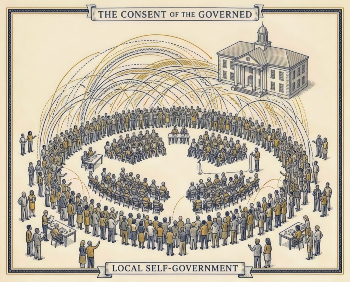
The founding principles of the United States are the core commitments expressed in the Declaration of Independence and the Constitution: natural rights, consent of the governed, limited government, rule of law, and self-government. A movement that organizes around these commitments inherits a framework that has survived every major political debate in American history.
Natural Rights, Human Dignity, and Consent of the Governed
Natural rights are freedoms that exist before government, and government’s job is to secure them, not grant them (Declaration of Independence: A Transcription). The Declaration states this plainly, and the Bill of Rights assumes it. Consent of the governed is the companion idea: authority flows upward from citizens, not downward from Washington.
For organizers, this means every campaign should first answer one question. What right is being threatened, and by what authority? If you cannot name both, you do not yet have a campaign. You have a complaint. For a deeper look at how natural rights and constitutional law differ, see our explanation of the key differences.
Limited Government, Rule of Law, and Self-Government
Limited government means the federal structure was designed to leave most decisions close to home. The rule of law means the same rules bind officials and citizens alike. Self-government means citizens govern through their states and communities, not only through distant agencies.
This trio is the practical core of states’ rights arguments. When a federal agency claims authority the statute never gave it, the response is not outrage. It is a citation. Our complete guide to states’ rights walks through how that authority is divided.
Civic Virtues and Civic Responsibility That Sustain a Movement
Civic virtues are the habits that keep a republic functioning: honesty in argument, respect for opponents, deliberation before decision, and accountability for outcomes. Civic responsibility is what those habits cost you in time and effort. Movements collapse when virtue is demanded of opponents but not of members.
A common mistake is treating civility as weakness. In practice, the opposite holds. Groups that deliberate openly recruit better and burn out less, because members trust the process even when they lose a vote.
Civic duty also includes showing up for the unglamorous work. Attending a school board meeting, reading a bill before opposing it, and verifying a claim before sharing it are all civic acts. They also build credibility with neighbors who are not yet on your side.
 Translating Principles Into a Movement Charter
A movement charter is a short written document that states a group’s principles, boundaries, and decision-making process. The best charters fit on one page and answer four questions: what we stand for, what we refuse to do, who decides, and how we resolve disputes. The harder work is writing one that members will actually follow, and that is where most volunteer groups go wrong.
Start with a drafting committee of three to five people, not the whole group. A committee can argue productively; a room of forty cannot. Give the committee a fixed deadline; two to three weeks is typical, and require it to circulate a draft at least one meeting before the ratification vote. The draft should be read aloud, line by line, at that meeting. Silent distribution invites the failure mode where nobody reads it, and everybody later claims they never agreed.
Here is a working template your group can adapt:
Charter Template
- Principle statement (2-3 sentences): We organize to secure [specific right] under [specific constitutional provision].
- Non-negotiables (3-5 bullets): We will not [tactic your group rejects], even when it would help short-term.
- Decision rule: Routine decisions by [role]; major decisions by [vote threshold] at [meeting cadence].
- Dispute process: Disagreements go to [named body] within [timeframe]; that body’s ruling stands for [period].
- Accountability clause: Leadership reports [what metric] at every [meeting frequency].
Ratification matters more than drafting. Set a threshold in advance; two-thirds of active members is a common choice, and record the vote in the minutes. A charter adopted by acclamation in a single meeting tends to be ignored within a quarter. A charter adopted by a recorded supermajority gives dissenters a reason to stay, because they can point to the process even when they lost the argument.
Build in an amendment clause from the start. Movements change, and a charter with no amendment path either becomes irrelevant or gets rewritten in a crisis. A workable rule: any member may propose an amendment in writing; the proposal is noticed to the full membership at least fourteen days before a vote; adoption requires the same threshold as ratification. That cadence is slow enough to prevent factional capture and fast enough to respond to real events.
Watch out: the most common charter failure is a principle statement so broad that it settles nothing. “We support the Constitution” is not a principle statement; it is a bumper sticker. “We oppose federal agencies exercising authority not granted by statute, and we will challenge such action through public comment, state legislation, and litigation where standing exists” is a principle statement, because it tells members what the group will and will not do.
The charter does more work than most members expect. It prevents the two failure modes that kill volunteer groups: drift, where the mission quietly changes, and fracture, where a single argument splits the room. Write it before you need it, and revisit it on a fixed schedule, annually is typical, so that amendment is routine rather than a sign of crisis. Nothing in this section is legal advice; consult a licensed attorney in your state before adopting language that could be read as a contract or a filing obligation.
 Grassroots Movement Strategies That Turn Principles Into Action
Grassroots movement strategies work when they convert principle into a repeatable ask. A simple loop can help groups turn principle into action: educate on the constitutional basis, identify one achievable local objective, assign named owners, and report results publicly.
Start with the smallest unit that can act. A precinct, a school district, a city council ward. A win at that level teaches your volunteers the mechanics of civic pressure before you scale.
Then build the boring infrastructure. A contact list you own, a meeting schedule that does not move, and a single person responsible for verifying facts before the group repeats them. For a fuller set of organizing steps, see our practical steps for constitutional activism.
Watch out: the fastest way to lose a new volunteer is to hand them a vague assignment like “help spread the word.” Give every person one task with a deadline and a named result.
Constitutional Limits on Federal Agency Power
Constitutional limits on federal agency power rest on three foundations: enumerated authority, separation of powers, and judicial review. An agency can do only what Congress authorizes by statute, and courts can strike down action that exceeds that grant.
This is where principle becomes procedure. When a rule exceeds statutory authority, the challenge is filed in court, not settled on social media. Organizers who understand this sequence waste less energy and win more often.
Inclusive Participation and Managing Disagreement Without Fracture
Inclusive participation is not a slogan. It is a retention strategy. Groups that bring in members from different backgrounds, ages, and party histories argue more but adapt faster, because they hear objections before those objections become defections.
Managing disagreement starts with separating tactics from principles. Two members can disagree about a sign, a speaker, or a strategy and still share the same constitutional commitment. Name that shared ground out loud, in the meeting, before the argument starts.
Adopt a simple rule. Debate tactics freely. Require evidence for factual claims. Never question a member’s patriotism for disagreeing with a plan.
 Measuring Movement Health and Impact
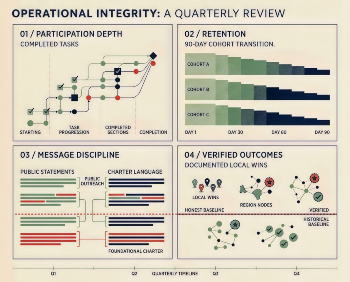
Movement health is measured by four indicators: participation depth, retention, message discipline, and verified outcomes. Track them quarterly, and track them honestly. The indicators themselves are not the hard part; the hard part is setting a baseline, choosing a cadence, and deciding in advance what you will do when a number moves the wrong way.
Set a baseline in your first month, before you have anything to brag about. A baseline is simply the number as of a fixed date, recorded in writing and shared with the group. Without it, every later report becomes an argument about whether things are better or worse than before. With it, the argument becomes a comparison.
| Indicator | What to Measure | Warning Sign | Corrective Action |
|---|---|---|---|
| Participation depth | Members completing a task, not just attending | Attendance high, task completion low | Assign named roles with deadlines |
| Retention | Members active 90 days after joining | Sharp drop after first meeting | Add a structured onboarding step |
| Message discipline | Public statements matching the charter | Members contradicting the charter | Re-run the charter briefing |
| Verified outcomes | Objectives met and documented | Activity without results | Narrow to one achievable goal |
A worked example makes the table usable. Suppose a county group has forty people on its contact list and twenty-five at a typical meeting. Participation depth is not twenty-five; it is the number who completed a task in the last quarter, say, eight who made public comment, wrote a letter, or staffed an event. Retention is the share of members who joined ninety days ago and are still active today; if twelve joined and five remain active, retention is roughly forty percent. Message discipline is a judgment call, but you can make it concrete: review public statements and social posts against the charter’s principle statement, and count the ones that contradict it. Verified outcomes are the objectives the group set and met, documented in the minutes.
 Report on a fixed cadence; quarterly is typical, monthly for active campaigns, and report the same four numbers every time. Changing the metrics between reports is the most common way groups fool themselves. If a metric stops being useful, retire it at the end of a reporting cycle and say so in the minutes, rather than quietly swapping it out mid-quarter.
Watch out: retention numbers can mislead when a group grows quickly. A wave of new members will drag the ninety-day retention rate down even if the group is healthier than before, because new members have not had time to become active. Compare retention cohort by cohort, members who joined in the same month, rather than as a single blended rate.
Vanity metrics will mislead you. A large email list with low task completion is not a movement. It is an audience. Measure what people do, not what they say they support. And when a number is ambiguous, write down the interpretation you are using in the minutes, so the next report is comparable. This is general information and not legal advice; if your measurement involves member data, consult a licensed attorney about privacy and record keeping obligations in your state. See our attorney disclaimer at this location: Click Here.
Join the Movement and Put These Principles to Work
The challenge is not understanding founding principles. It is building the structure that carries them into your state, your county, and your city hall.
Texas Journal is a resource for citizens who want to assert their rights under the Constitution and focus on states’ rights and constitutional education. Explore our membership options to learn more about the resources available.
Get started with Texas Journal and put founding principles to work where you actually have use.
Founding principles are only as durable as the citizens who organize around them. That work starts locally, with a charter, a task list, and a verified set of facts. Texas Journal gives you the constitutional grounding, the states’ rights focus, and the Patriot Pool community to make that work count. Join us and turn principle into action in your own state.
Stay in Touch – Click Here!
Dave
Questions? Call!
940-353-1398

Frequently Asked Questions
What are the five founding principles of the United States?
Most civic educators group them into five core ideas: natural rights, equality, consent of the governed (popular sovereignty), limited government, and the rule of law. Some lists add republican self-government and justice as separate entries, which is why you also see six- and seven-part versions. For a modern civic movement, the practical value is the same: each principle gives you a test for whether a policy, a campaign, or an internal decision actually honors the framework the country was built on.
What civic virtues help sustain a movement?
Civic virtues and civic responsibility are what keep a movement from collapsing into a single personality or a single grievance. The ones that matter most in practice are deliberation (arguing in good faith before deciding), accountability (publishing what you promised and what you delivered), respect for opponents as fellow citizens, and a willingness to do the unglamorous work of showing up. Movements that skip these tend to win a news cycle and lose the long game.
How can a civic movement hold government agencies accountable?
Start with the constitutional limits on federal agency power. Agencies act under authority delegated by statute, so the first question is whether the statute actually grants the authority they’re using. Practical steps include filing public records requests, attending and commenting at open meetings, tracking proposed rules during the comment period, and documenting decisions in writing. A movement that builds a shared records archive turns isolated complaints into a pattern that lawmakers and courts can act on. This is general information, not legal advice.
What is the difference between civic principles and political goals?
Principles are the durable standards you measure outcomes against; political goals are the specific, time-bound things you want to achieve. A principle might be equal protection under the law. A goal might be a particular ordinance passed by a particular council by a particular date. Movements get into trouble when they confuse the two, treating a legislative win as if it were the principle itself. Keep the charter short and principled, and let the campaign plan carry the dates and numbers.