Last Updated: October 24, 2026
Quick Summary
The self-defense right is not written into the Constitution as a standalone guarantee. The Supreme Court has treated the right to keep and bear arms for self-defense as protected by the Second Amendment. Still, it has never held that a general right to defend yourself exists as a freestanding constitutional guarantee.
- Heller (2008) described the right to keep and bear arms as premised on the inherent right of self-defense.
- McDonald (2010) applied the Second Amendment right against the states.
- Bruen (2022) held that may-issue permitting regimes unconstitutionally restricted public carry.
- Every valid self-defense claim rests on three elements: imminence, necessity, and proportionality.
- The National Conference of State Legislatures reports at least 23 states have enacted civil immunity laws for self-defense.
Table of Contents
- Is Self Defense a Constitutional Right? The Core Question
- Second Amendment Self-Defense Interpretation
- The Right to Keep and Bear Arms vs. the Right to Defend Yourself
- Duty to Retreat vs. Stand Your Ground: How States Split
- Castle Doctrine Laws by State
- The Legal Boundaries of Defensive Force
- Civil Immunity, Law Enforcement, and the Government’s Duty to Protect
- Non-Firearm Self-Defense and the Scope of the Question
- What to Do Next to Assert Your Self-Defense Rights
- Frequently Asked Questions
Is Self Defense a Constitutional Right? The Core Question
 The short answer: the Constitution does not list self-defense as a standalone guarantee. The Supreme Court has treated the right to keep and bear arms for self-defense as protected by the Second Amendment, but it has never held that a general right to defend yourself exists as a freestanding constitutional guarantee. That distinction matters more than most debates admit.
The gap between popular belief and actual doctrine is wide. The confusion is understandable. Self-defense sits at the intersection of natural law, state criminal codes, and constitutional text, and each of those sources says something different.
Below, we separate what the Constitution actually protects from what state law provides, and where the two overlap.
Natural Right vs. Constitutional Right
A natural right is a protection understood to exist before and apart from government, while a constitutional right is one the founding document specifically recognizes and enforces against government action. Self-defense is usually described as the former. The Declaration of Independence grounds rights in a creator, not a congress.
The Constitution’s text never names self-defense. As the Duke Center for Firearms Law has documented, the Supreme Court has recognized self-defense as a core component of the Second Amendment without ever declaring it a standalone constitutional right. State law fills that gap, which is why a valid self-defense claim depends on statute and case law in the state where force was used.
Readers working through this philosophical distinction often want foundational material; our guide to constitutional literacy resources for adults covers the primary documents and how to read them.
 What the Supreme Court Has Actually Said
The Court has been clear that the Second Amendment protects an individual right connected to self-defense. In District of Columbia v. Heller (2008), the majority described the right to keep and bear arms as premised on the “inherent right of self-defense.” That phrase did real work: it anchored an individual right in a purpose, not a privilege.
Justice Clarence Thomas later wrote that “the constitutional right to bear arms in public for self-defense is not a ‘second class right,'” as recorded in a Duane Morris legal alert on the Bruen decision. That language signals how the Court’s majority frames the issue.
What the Court has not done is create a general constitutional cause of action for self-defense. If you want a method for reading these rulings yourself, our step-by-step guide on how to interpret constitutional law walks through the analysis.
Second Amendment Self-Defense Interpretation
Second Amendment self-defense interpretation asks a narrow question: does the amendment protect a personal right to armed defense, and how far does that protection reach? The Court’s answer has evolved through three decisions, each changing the legal landscape for carry laws nationwide.
The through-line is that the amendment protects a right tied to self-defense, but the scope of that right, especially in public, remains contested in lower courts.
Heller, McDonald, and Bruen
Heller (2008) struck down a federal handgun ban in the home and recognized an individual right. McDonald (2010) applied that right against the states. Bruen (2022) held that “may-issue” permitting regimes unconstitutionally restricted public carry, as Duane Morris summarized.
The aftermath has been messy. According to the State Court Report, multiple courts in the past year have upheld state restrictions while struggling to apply Bruen‘s history-based test. That inconsistency is where most current litigation lives.
 The Right to Keep and Bear Arms vs. the Right to Defend Yourself
These are two different protections, and conflating them is the most common error in this debate. The right to keep and bear arms limits government power. The right to defend yourself is primarily a defense to criminal liability under state law.
You can lawfully own a firearm and still face prosecution for using it unlawfully. Self-defense statutes define when force is justified; the Second Amendment says nothing about whether a particular use of force was reasonable. That question belongs to juries applying state law.
Put differently: the Constitution protects your ability to possess arms for defense. State law decides whether your specific act of defense was lawful—both matter, and neither substitutes for the other.
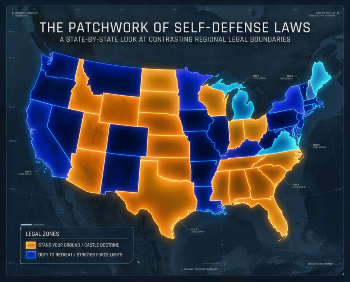
Duty to Retreat vs. Stand Your Ground: How States Split
Duty to retreat versus stand your ground is the sharpest state-level divide in self-defense law. A duty-to-retreat state generally requires you to avoid force if you can safely do so before using deadly force. A stand-your-ground state removes that requirement in places where you have a legal right to be.
The split is not binary. Many states apply stand-your-ground rules at home but require retreat elsewhere. Others impose a duty to retreat only when it can be done with complete safety.
The National Conference of State Legislatures reports that at least 23 states have enacted civil immunity laws protecting people who act in self-defense. That number reflects a broader legislative trend toward shielding defenders from lawsuits, not just prosecution.
Watch out: stand-your-ground protection is not a license to pursue. Most statutes still require that you reasonably believe force is necessary to prevent imminent harm. If your state or locality restricts defensive rights, our guide on defending individual freedom against local government rules explains how to push back.
Castle Doctrine Laws by State
Castle doctrine laws presume that a person threatened unlawfully inside their home or vehicle may use force, including deadly force, without retreating. The presumption varies by state in scope, in what locations it covers, and in whether it extends to vehicles and workplaces.
| State Approach | Retreat Required in Home? | Typical Scope | Key Limitation |
|---|---|---|---|
| Strong castle doctrine | No | Home, vehicle, workplace | Presumption rebuttable |
| Castle doctrine plus stand your ground | No, anywhere lawful | Home and public spaces | Must be lawful presence |
| Duty to retreat with home exception | No, only in home | Home only | Retreat required outside |
| Limited castle doctrine | Conditional | Home, narrow definitions | Force must be proportionate |
The practical takeaway: never assume your state’s rule matches a neighboring one. Verify the statute before relying on a presumption, because the burden of proof shifts depending on how the law is written.
 The Legal Boundaries of Defensive Force
Every valid self-defense claim rests on three elements: imminence, necessity, and proportionality. Miss any one of them and the claim fails, regardless of how sympathetic the facts are.
Imminence, Necessity, and Proportionality
Imminence means the threat is happening now or about to happen, not later. Necessity means force was required to stop the threat, with no safe alternative. Proportionality means the force used matched the threat faced.
A common mistake is treating self-defense as a justification for retaliation. It is not. As the Buffalo Law Review has analyzed, not all self-defense claims are legally valid, and state statutes impose specific requirements that courts enforce strictly.
Civil Immunity, Law Enforcement, and the Government’s Duty to Protect
Civil immunity statutes shield defenders from lawsuits, but they do not create a government duty to protect any individual. Courts have long held that law enforcement owes a duty to the public generally, not to specific persons, a principle that makes personal safety, legally speaking, a personal responsibility.
The anchor case is Warren v. District of Columbia (D.C. 1981), in which the court held that the police owe no specific duty to individual citizens and that the public-duty doctrine barred the plaintiffs’ claims. The same idea appears in DeShaney v. Winnebago County (1989), where the Supreme Court held that the Due Process Clause generally does not require the state to protect a person from private violence. Those decisions are why “the police had no duty to save me” is a real legal argument, not a rhetorical one.
That distinction has two sides readers often blur:
- Constitutional rights protect against government action. The Second Amendment limits what the government may do to your ability to keep and bear arms.
- Protection by government is a service, not a constitutional guarantee. Police response times, patrol levels, and prioritization are policy choices, and courts generally will not second-guess them.
Civil immunity sits on top of that structure. The National Conference of State Legislatures reports that at least 23 states have enacted civil immunity laws protecting people who act in self-defense. Those statutes reduce the financial risk of defending yourself; they can bar suits by aggressors or their families and shift attorney’s fees, but they do not guarantee the state will intervene on your behalf, and they do not decide whether your use of force was justified in the first place.
The practical takeaway: the Constitution limits government interference with your defensive tools, state law decides whether a particular act of force was lawful, and neither source obligates police to protect you personally. Understanding all three is what separates a realistic self-defense plan from a hopeful one.
 Non-Firearm Self-Defense and the Scope of the Question
The right to self-defense does not depend on a firearm. Self-defense law applies to force generally, whether that means empty-hand defense, a less-lethal tool, or a weapon. This is where the constitutional debate and the practical question diverge most sharply.
The Second Amendment frames the firearm question. State criminal codes frame the actual justification question, and they apply the same imminence, necessity, and proportionality tests regardless of the tool used. A person defending themselves without a gun still needs a lawful claim under state law.
That distinction matters for readers who do not own firearms but want to understand their rights. The constitutional right to bear arms is not the source of your right to defend yourself. It is a separate protection with a separate history.
What to Do Next to Assert Your Self-Defense Rights
Knowing the doctrine is step one. For a curated guide to constitutional liberty resources you can access now, see Get Access to Constitutional Liberty Resources. Acting on it requires knowing your state’s statute, your state’s case law, and their limits. Start with the three elements, then read your own state’s code rather than relying on summaries.
The evidence on expanded self-defense laws is mixed, and honest readers should weigh it. A University of Michigan systematic review found that existing evidence contradicts claims that expanding these laws deters violent crime. Everytown for Gun Safety Support Fund (2026) associates Shoot First laws with up to an 11 percent increase in gun homicides nationally, more than 700 additional deaths each year. Those findings are contested, but they are part of the public record.
At Texas Journal, we believe citizens should understand both the constitutional protections they hold and the legal boundaries that apply to force. If you want to go further, Defend the American Family is for readers who treat personal safety and sovereignty as responsibilities, not abstractions. Knowing the law is on your side is the first move.
Dave
Questions? Call!
940-353-1398

Frequently Asked Questions
Which amendment talks about self-defense?
The Second Amendment is often tied to self-defense, but it doesn’t use that term. It protects the right to keep and bear arms. The Supreme Court in District of Columbia v. Heller (2008) and McDonald v. City of Chicago (2010) read the amendment as protecting an individual right connected to lawful self-defense, especially in the home. Self-defense itself is mostly governed by state criminal law, not by an explicit constitutional clause. That is why the self-defense right looks different depending on where you live.
Is self-defense explicitly mentioned in the Constitution?
No. The U.S. Constitution does not contain the phrase self-defense. The Supreme Court has treated self-defense as a core purpose behind the Second Amendment, and Justice Clarence Thomas wrote that the right to bear arms in public for self-defense is not a second-class right. But the Court has never held that self-defense is a standalone constitutional right with its own text. Under state criminal law, not all claims of self-defense are valid. The self-defense right is real, but statutes, court decisions, and the facts of each case shape it.
Do states have the authority to limit self-defense rights?
Yes, within limits. States define when defensive force is justified through criminal statutes, including duty-to-retreat vs. stand-your-ground rules and state Castle Doctrine laws. Courts have upheld many state restrictions on carrying firearms, even as recent Supreme Court precedents have reshaped the landscape. At least 23 states have enacted civil immunity laws protecting people who act in self-defense. A state can set the legal boundaries of defensive force, but it cannot ignore the Supreme Court’s Second Amendment self-defense interpretation.
What is the Castle Doctrine and how does it apply to self-defense?
The Castle Doctrine is a legal principle that provides stronger protection to people defending themselves in their home or another protected space. Many states with Castle Doctrine laws remove or reduce the duty to retreat before using force against an intruder. The rules vary widely: some states extend the doctrine to vehicles and workplaces, others limit it to the home. State Castle Doctrine laws differ on who is protected, what force is allowed, and whether civil immunity applies. Check your state statute before relying on it.
The doctrine is complex, but the path forward is not: learn your state’s rule, understand the three elements, and stop relying on secondhand summaries. Texas Journal gives you the constitutional education and state-focused analysis to do exactly that, with resources built for citizens who want to assert their rights rather than wait for permission. Get started with Texas Journal and turn constitutional knowledge into action.