Table of Contents
- Why State Legislatures Are the Front Line Against Globalist Policy
- What You’ll Need Before You Start Pushing Back
- How to Lobby State Representatives Effectively
- Monitoring State Agency Rulemaking: The Overlooked Lever
- Tenth Amendment State Rights as a Legal Shield
- Building Local Supply Chain Resilience Against Economic Globalization
- Common Mistakes That Kill State-Level Efforts
- How to Measure Whether Your Pushback Is Working
- Frequently Asked Questions
Last Updated: September 10, 2026
Why State Legislatures Are the Front Line Against Globalist Policy
The most effective way to stop globalist policy in states is to understand where it actually gets implemented: not in Washington, but in your statehouse. Federal gridlock gets the headlines, yet state legislatures pass the laws that reshape your schools, energy grid, and local economy. The real battle for sovereignty has moved to capitals closer to home.
Globalist policy is the push to hand domestic decisions to international institutions, trade bodies, and unaccountable regulatory networks rather than elected state officials. The practical effect is a slow centralization of power, where decisions that once belonged to your community get made elsewhere. That’s why the statehouse, not the Capitol, is where citizens can still win.
The five strategies below show you exactly how to push back, from lobbying your representative to monitoring the rules that quietly rewrite your state’s economy.
How Centralization of Power Moves From Washington to Your Statehouse
Centralization rarely arrives as one dramatic law. It comes through a thousand small alignments: model legislation drafted by outside groups, grant conditions that tie state funding to federal priorities, and agency rules that adopt international standards by reference. Each step looks minor. Together, they transfer authority away from the sovereign state.
The mechanism is predictable. A trade agreement or global governance framework sets a target, then federal agencies condition funding on state compliance. Your legislature ratifies it without realizing the trade-off.
What You’ll Need Before You Start Pushing Back
Before you lobby anyone, gather the basic tools that make your effort credible. Preparation separates a citizen who gets a meeting from one who gets ignored.
 You will need:
- Your state representative’s and senator’s district office contact information
- The current legislative session calendar and bill filing deadlines
- An account on your state legislature’s official bill-tracking website
- A folder of two or three local examples showing how a policy affects your district
- A one-page summary you can leave behind after any meeting
Build a simple tracking sheet so your effort stays organized. The table below maps each tool to its purpose.
| Tool | Purpose | Where to Get It |
|---|---|---|
| Bill tracker account | Follow legislation in real time | State legislature website |
| District contact list | Reach the right staffer fast | Legislator’s official page |
| One-page summary | Leave a clear ask behind | You write it |
| Local impact examples | Make the issue concrete | Your own district |
How to Lobby State Representatives Effectively
Learning how to lobby state representatives effectively comes down to preparation, brevity, and a specific ask. Legislators and their staff are overwhelmed during session, so the citizen who arrives with a clear, local, one-sentence request wins the room.
Follow these steps:
- Request a meeting with the district office, not the capitol office, whenever possible
- State your district and the bill number within the first thirty seconds
- Explain the local impact in plain terms, using one concrete example
- Make a single, specific ask, such as a vote or a committee referral
- Leave your one-page summary and follow up within one week
Scripting Your First Meeting With a Legislator
A short script keeps you on message when nerves hit. Adapt this template to your issue.
“Representative [Name], I’m [Your Name] from District [Number]. I’m here about [Bill Number], which would [one-line impact]. In our district, this means [specific local effect]. I’m asking you to [specific action]. May I leave this one-page summary and follow up next week?”
Keep the whole meeting under fifteen minutes. The follow-up matters more than the meeting itself.
Tracking Bills and Committee Votes in Real Time
A bill can die or advance in a single committee vote, often with little notice. Set alerts on your state’s bill-tracking system for any measure touching trade, energy, education, or agency authority. When a bill reaches committee, that is your window to act. Call committee members, not just your own representative.
Monitoring State Agency Rulemaking: The Overlooked Lever
Monitoring state agency rulemaking is where most citizens lose without ever noticing. Agencies write the detailed rules that turn a broad statute into binding requirements, and those rules often adopt international or federal standards wholesale.
The public comment period is your use. Every proposed rule must be published, and citizens can submit formal comments that become part of the record. A well-argued comment can force an agency to justify its authority or revise a rule. Track the register where your state publishes proposed rules, and comment on anything that expands agency power without clear legislative authorization.
 Tenth Amendment State Rights as a Legal Shield
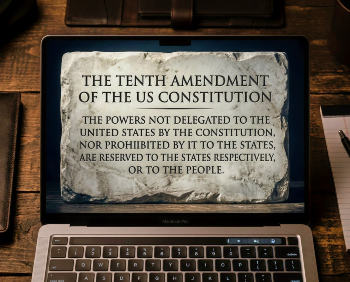
The Tenth Amendment is the constitutional backstop for state sovereignty: “The powers not delegated to the United States by the Constitution, nor prohibited by it to the States, are reserved to the States respectively, or to the people.” That single sentence is the legal foundation for resisting federal mandates that reach beyond enumerated authority, and it is the argument state legislators and attorneys general actually use.
The amendment does not give states a veto over federal law. The Supremacy Clause still controls where federal power is validly exercised. What the Tenth Amendment does is force the federal government to show its authority. When it cannot, states have real room to push back. The text of the Tenth Amendment is short; the case law interpreting it is not.
The Legal Doctrines That Actually Decide These Fights
Four doctrines do most of the work in state-versus-federal disputes:
- Anti-commandeering. Under New York v. United States (1992) and Printz v. United States (1997), the federal government cannot force state legislatures or state executive officers to carry out federal programs (supreme.justia.com). States can refuse to administer a federal mandate, though they may lose the accompanying funding.
- Spending Clause limits. Under South Dakota v. Dole (1987) and NFIB v. Sebelius (2012), Congress may attach conditions to federal funds, but the conditions must be related to the spending’s purpose and cannot cross the line from pressure into coercion (supreme.justia.com). The 2012 Medicaid expansion holding is the leading example of a condition that went too far.
- Commerce Clause limits. Under United States v. Lopez (1995) and United States v. Morrison (2000), Congress’s commerce power is broad but not unlimited. States have used these cases to challenge federal statutes that regulate non-economic activity.
- Non-delegation and major questions. Courts increasingly require Congress to speak clearly before agencies claim authority over major economic or political questions. West Virginia v. EPA (2022) is the modern anchor.
These are not abstract. They are the arguments your attorney general files and your legislature cites in resolutions.
Constitutional Mechanisms States Can Actually Use
- Anti-commandeering legislation. A state can pass a law barring state agencies and employees from enforcing a specified federal program. This is the mechanism behind state-level resistance to various federal gun, health, and environmental mandates.
- Attorney general litigation. The state AG can sue the federal government directly. Multi-state coalitions filed under this authority have repeatedly reached the Supreme Court.
- Interstate compacts. With congressional consent where required under the Compact Clause, states can coordinate policy across borders, on professional licensing, water, energy, and emergency response.
- Refusal to fund. State legislatures can decline to appropriate state dollars to implement a federal program, forcing the federal government to fund and run it directly.
- Constitutional resolutions and memorials. Non-binding, but they build the record that supports later litigation and legislation.
- State constitutional amendments. Some states have added provisions explicitly reserving rights or barring certain federal mandates from being enforced with state resources.
How to Put This to Work in Your Statehouse
When a bill or rule implicates federal authority, ask three questions in writing to your legislator and attorney general:
- What enumerated power authorizes the federal action?
- Does the action commandeer state officers or coerce state spending?
- Has Congress spoken clearly enough to satisfy the major questions doctrine?
A one-page memo answering those three questions is more persuasive to a committee than a general speech about sovereignty. Most practitioners find that attaching a short legal memo to testimony dramatically raises the odds that a bill gets a hearing rather than a polite dismissal.
Building Local Supply Chain Resilience Against Economic Globalization
Local supply chain resilience is the practical answer to economic globalization, and it is where state legislatures have the most unilateral power. States cannot rewrite trade agreements, but they can reshape what their own economies depend on. That is the angle most national coverage misses: the tools are already in the statehouse.
The core problem is concentration. When a critical input, a pharmaceutical precursor, a semiconductor component, a transformer, a fertilizer, comes from one region or one supplier, a single disruption empties shelves and idles factories. States that map and diversify those dependencies insulate themselves from decisions made abroad.
Step 1: Map Critical Goods and Their Origins
Before incentives, do the inventory. A state can direct its economic development office, university system, or a public-private council to produce a critical-goods assessment covering:
- Essential medicines and precursors consumed by state hospitals and pharmacies
- Grid and utility components, transformers, switchgear, specialty steel
- Agricultural inputs, fertilizer, seed stock, feed additives
- Defense-adjacent manufacturing tied to in-state employers
- Semiconductor and electronics inputs used by in-state manufacturers
The assessment should record, for each item, the top source countries, the number of qualified domestic suppliers, and the lead time to replace a lost source. That document becomes the factual basis for every incentive bill that follows.
Step 2: Use State Procurement as a Demand Signal
State purchasing power is the fastest lever. States spend billions annually on goods and services, and procurement rules can be rewritten without waiting on Washington.
- Domestic content preferences. Many states already apply in-state or domestic preferences to certain contracts. Extending them to critical goods creates guaranteed demand that justifies new domestic capacity.
- Supplier diversification requirements. Require state contractors to disclose single-source dependencies and, where feasible, qualify a second supplier.
- Long-term offtake agreements. A multi-year state purchase commitment is often what a manufacturer needs to finance a new line.
- Buy American-style state statutes. These exist at the state level and can be tightened without federal action.
Step 3: Target Incentives at Bottlenecks, Not Headlines
The mistake is chasing a marquee plant. The better play is filling the specific gap the mapping exercise identified.
- Equipment and workforce credits tied to producing a named critical good
- Site readiness grants so a qualified manufacturer can break ground in months, not years
- Apprenticeship and community college pipelines aligned to the specific processes involved
- Utility and permitting fast lanes for facilities that close an identified gap
Step 4: Measure Resilience, Not Just Jobs
Job counts alone do not tell you whether a supply chain is resilient. Track the same indicators every year:
| Metric | What It Shows | Direction of Travel |
|---|---|---|
| Number of qualified domestic suppliers per critical good | Concentration risk | Rising |
| Average lead time for top 20 critical inputs | Vulnerability to disruption | Falling |
| Share of state procurement sourced domestically for critical goods | Demand signal strength | Rising |
| In-state manufacturing employment in target sectors | Capacity build-out | Rising |
| Number of single-source dependencies disclosed by major contractors | Transparency | Falling |
Step 5: Coordinate Regionally Where It Helps
Some critical goods, grid equipment, water infrastructure, agricultural inputs, are better addressed through interstate compacts or multi-state purchasing cooperatives. Pooled demand across three or four states can justify a domestic supplier that no single state could support alone. This is the same compact mechanism discussed above, applied to economic resilience rather than regulation.
Common Mistakes That Kill State-Level Efforts
The biggest mistake is showing up alone. One angry call is easy to ignore; a coordinated district is not. Build a small group before you build a movement, and assign clear roles.
Other mistakes that stall progress:
- Focusing only on federal politics while state bills pass unnoticed
- Contacting legislators without a specific ask
- Ignoring agency rulemaking entirely
- Using emotional arguments with no local data
- Giving up after a single lost vote
A common mistake is treating a loss as final. Bills return, agencies reopen comment periods, and new sessions bring new chances.
How to Measure Whether Your Pushback Is Working
Measure progress with concrete indicators, not feelings. Track the same metrics every month so you can see momentum.
| Metric | What It Shows | Target Signal |
|---|---|---|
| Bills stopped or amended | Direct legislative impact | Any blocked overreach |
| Public comments filed | Agency-level pressure | Consistent submissions |
| Meetings held | Access and relationships | Growing count |
| Coalition size | Force multiplier | Steady growth |
When a bill you opposed dies in committee, or an agency revises a rule after your comment, that is a win. Document it. Wins build the credibility that makes the next fight easier.
Stopping globalist policy in states is a long campaign, not a single vote, and it demands the kind of constitutional knowledge and coordination that most citizens never receive. Texas Journal exists to close that gap, teaching citizens how to assert their rights and use the mechanisms the Constitution provides. With resources like the Patriot Pool to multiply your effort, our guides on Control Washington From Your State, and a focus on Restore US Sovereignty, the platform gives you what you need to act. Get started with Texas Journal and turn your state into a firewall for founding principles.

Frequently Asked Questions
What are the primary concerns regarding globalist policy in state government?
The main concerns center on how international frameworks and trade agreements filter into state law through agency rulemaking, procurement rules, and grant conditions. Citizens often point to centralization of power, loss of economic autonomy, and regulatory frameworks adopted without direct voter input. Because most of this happens at the agency level rather than through visible votes, monitoring state agency rulemaking is the fastest way to catch it early, before rules become final and harder to reverse.
How does the Tenth Amendment protect states from federal or international overreach?
The Tenth Amendment reserves powers not delegated to the federal government to the states or the people. In practice, Tenth Amendment state rights arguments are used to challenge federal mandates that lack a clear constitutional basis and to push back on state agencies that adopt international standards as if they were binding law. Courts weigh these claims case by case, so the amendment is a starting point for litigation and legislation, not an automatic block.
How can citizens effectively communicate with state representatives about policy concerns?
Learning how to lobby state representatives starts with specificity. Reference the exact bill number, the committee it sits in, and the specific clause you oppose. Request a short meeting, bring one page of talking points, and follow up in writing within 48 hours. Legislators respond to constituents who show they have read the text. Repeat contact across a session matters more than a single email, and coordinated neighbors carry more weight than isolated calls.
What is the difference between international trade and globalist policy influence?
International trade covers the exchange of goods and services across borders, usually governed by tariffs, market access rules, and trade agreements. Globalist policy influence goes further: it is the push to align domestic law, regulation, and governance with transnational institutions and corporate globalization priorities. A state can support trade while rejecting rules that transfer decision-making authority away from elected officials. Separating the two keeps the argument focused on sovereignty and self-governance rather than on commerce itself.