Last Updated: November 4, 2026
Quick Summary
The best constitutional law books for beginners are short overviews that need no legal training, starting with The U.S. Constitution: A Very Short Introduction and About Law. Read the Constitution itself first, then add one case-focused book once you understand its structure.
- The U.S. Constitution: A Very Short Introduction costs $11.95 and suits absolute beginners.
- About Law costs $24.95 and explains legal concepts in plain English for non-lawyers.
- Standard casebooks like Chemerinsky’s seventh edition cost $283.00 and assume prior legal reading skill.
- Check the copyright date and table of cases, since books before 2022 miss Dobbs.
Table of Contents
- Why Most Beginners Start With the Wrong Constitutional Law Book
- How We Evaluated These Constitutional Law Books
- How to Study the Constitution for Beginners
- Quick Comparison: Price, Depth and Best Reader
- Best Overview Books for Absolute Beginners
- Constitutional Law Study Guide for Non-Lawyers: Books That Explain Without Jargon
- Best Books on States’ Rights and Constitutional Structure
- Where the Popular Picks Fall Short: Trade-offs and Strong Opinions
- Choosing Your First Book and Where to Go Next
- Frequently Asked Questions
 Why Most Beginners Start With the Wrong Constitutional Law Book
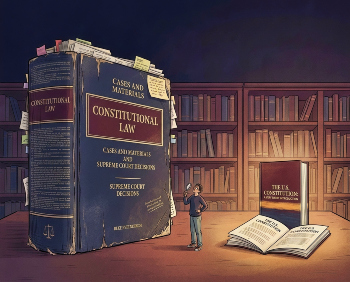
Most people who decide to learn the Constitution pick up the first thick casebook of constitutional law books they find. That’s a mistake. A standard law school text is priced at $283.00 for the seventh edition of Erwin Chemerinsky’s Constitutional Law, and it assumes you already know how to read a court opinion. Texas Journal has seen readers give up within a few chapters because the book was written for students in a classroom, not for a citizen trying to understand their own rights.
The problem is usually not intelligence. It’s fit. A beginner needs a book that explains the structure of the government, the major clauses, and how the courts arrived at their rulings, without drowning them in footnotes. Choosing the right starting point saves months of frustration.
How We Evaluated These Constitutional Law Books
We looked at five things: price, depth, readability for someone without legal training, how well the book explains the structure of the Constitution, and whether it still reflects current case law. We did not rank books by how loudly their authors argue a political position. Our goal is to help you understand the document itself.
How to Study the Constitution for Beginners
Start with the text. Read the Constitution itself, all seven articles and the amendments, before reading any commentary. It is short enough to finish in an afternoon, and every later argument refers back to it.
Next, read a short overview. A compact introduction gives you the history and vocabulary you need. Then move to a book that covers specific cases, such as the Bill of Rights or the separation of powers, and read the summaries before the full opinions.
Studying the Constitution is easier with a plan. Work through one topic at a time and write down the question each Supreme Court case answered. Many readers find that resources built around problems, rather than long chronological histories, are easier to follow. Academic libraries increasingly curate problem-oriented study guides for this reason. If you want to go further, our guide on anchor: whether formal constitutional education is worth it walks through the cost and time involved. For a broader list of free and low-cost starting points, see our constitutional literacy resources for adults. Once you are ready to put the basics to work, you can also register with Protect Our Traditions to follow the constitutional questions that matter most to your community.
Quick Comparison: Price, Depth and Best Reader
| Book | Price | Depth | Best Reader |
|---|---|---|---|
| The U.S. Constitution: A Very Short Introduction | $11.95 | Light | Absolute beginners |
| About Law | $24.95 | Light to moderate | Non-lawyers |
| The Rule of Law | $17.00 | Moderate | Readers wanting philosophy |
| The Dynamic Constitution | $44.99 | Moderate to deep | Undergraduates |
| Modern Constitutional Law (2026 Edition) | Contact for pricing | Deep | Law and college students |
 Best Overview Books for Absolute Beginners
These two books are the easiest entry points. Neither requires legal training, and both fit a weekend of reading.
The U.S. Constitution: A Very Short Introduction
David J. Bodenhamer covers how the document was written, how it has changed, and why its history still matters. It is a reasonable book to read first if you want context before anything else.
About Law
About Law explains legal concepts in plain English and discusses how law relates to justice. It suits readers who want to understand what law is before studying the Constitution specifically.
Constitutional Law Study Guide for Non-Lawyers: Books That Explain Without Jargon
Non-lawyers need books that define their terms and explain why each doctrine exists.
The Rule of Law by Tom Bingham lays out the principles behind any legal system and gives you a foundation for reading constitutional cases. It is clear and authoritative, though it is not a technical constitutional manual.
Best Books on States’ Rights and Constitutional Structure
Federalism is the part of the Constitution most beginners find confusing, because it asks how power is divided between Washington and the states, and the answer has changed repeatedly over two centuries. Books that focus on structure make that division easier to follow, but only if they show you the actual clauses and tests rather than just narrating history.
Before you buy a book on this topic, know the four textual hooks that do most of the work. Article I, Section 8 lists Congress’s enumerated powers and ends with the Necessary and Proper Clause. Article VI contains the Supremacy Clause, which makes federal law control over conflicting state law (Supremacy Clause | Wex | US Law). The Tenth Amendment reserves powers not delegated to the federal government to the states or the people (The Bill of Rights: What Does it Say?). And the Fourteenth Amendment’s Equal Protection and Due Process Clauses, added in 1868, gave the federal government a tool to police state conduct. A good structure book will tie each doctrine back to one of these provisions.
 The doctrinal spine you should expect a book to cover runs roughly like this: McCulloch v. Maryland (1819) established that Congress may use implied powers and that a state cannot tax a federal instrumentality. Gibbons v. Ogden (1824) read the Commerce Clause broadly. United States v. Lopez (1995) and United States v. Morrison (2000) marked the first limits the Supreme Court had placed on the commerce power in nearly sixty years. NFIB v. Sebelius (2012) upheld the individual mandate as a tax while limiting the Spending Clause condition on Medicaid expansion. Gonzales v. Raich (2005) allowed federal enforcement against locally grown marijuana. If a book does not walk through at least most of these, it is not teaching structure, it is telling a story.
With that frame, here is how the leading structure-focused titles compare.
The Second Founding by Eric Foner examines how the Civil War and Reconstruction reshaped the document through the 13th, 14th, and 15th Amendments. It is the strongest historical account of how federal power grew, and it explains why so many modern state-federal disputes trace back to Reconstruction. Its limitation is that it concentrates on three amendments rather than the whole structure, so it will not teach you the Commerce Clause line of cases.
Supremacy takes a sharper view of judicial power and the balance between the branches. It is provocative and openly opinionated, so read it alongside a more neutral source. Use it to see how an author builds an argument from the text, not as your only map of the doctrine.
 The Dynamic Constitution by Richard H. Fallon Jr. is a strong single volume for a reader who wants structure plus case law in one place. It is written for undergraduates and non-specialists, covers the major clauses, and explains how the Supreme Court’s interpretation has shifted over time.
Constitutional Law For Dummies is a structured introduction for readers starting from zero. Treat it as a vocabulary builder, not a doctrinal reference.
Watch out: federalism books age quickly. A title published before 2022 will not reflect Dobbs v. Jackson Women’s Health Organization (2022), which overruled Roe and returned the abortion question to the states, and it may not reflect the Court’s recent major questions doctrine decisions. Check the copyright page and the table of cases before you buy, and prefer a title with a supplement or a recent edition.
A practical reading order for this section: read the four clauses above in the Constitution itself, then read The Second Founding for the historical arc, then The Dynamic Constitution for the doctrine, then add Supremacy once you can tell where the author’s argument departs from the text.
Where the Popular Picks Fall Short: Trade-offs and Strong Opinions
Our honest view: the most famous names are not always the best first purchase. A bestselling title can be a weak starting point if it assumes too much background, and a book with a strong thesis can be a poor first read if you cannot yet tell where the thesis ends and the law begins. Most beginner guides skip this problem entirely. This section gives you a repeatable method for spotting it before you spend money.
The first trade-off is price versus coverage. A standard law school casebook such as Erwin Chemerinsky’s Constitutional Law runs $283.00 for the seventh edition and assumes you already know how to read a judicial opinion. It is an excellent reference and a terrible first book. Neither is wrong to own later; both are wrong to buy first.
The second trade-off is currency. Constitutional law moves with each Supreme Court term, and a book that was accurate in 2020 may now misstate the law. Before buying any title, check three things: the copyright date, whether the publisher offers a supplement, and whether the table of cases includes recent decisions. A book that discusses Obergefell v. Hodges (2015) but not Dobbs v. Jackson Women’s Health Organization (2022) is telling you its cutoff. That is not automatically disqualifying for a history book, but it is disqualifying for a book you plan to use as a doctrinal reference.
 The third trade-off is argument versus exposition. Supremacy ($28.00) is openly opinionated about judicial power, and that is useful once you can test its claims against the text. Skip it until you have the basics. The pattern to watch for is a book that presents a single interpretation as settled law. Start with a neutral overview, then add opinionated works so you can see the seams.
The fourth trade-off is format. A physical reference book is easier to annotate; an ebook is cheaper and searchable; a library copy costs nothing and lets you test a title before committing. A library copy costs nothing and lets you test a title before committing, if your local library offers it.
Watch out: reviews on retail sites are a weak signal for legal books, because a five-star review often reflects whether the reader agreed with the author’s politics rather than whether the book explains the doctrine correctly. Read the sample chapter and the table of contents instead, and check whether the book cites the cases it discusses.
For researching how international agreements interact with constitutional questions, our step-by-step method for researching treaty impacts is a useful next read. If you want to understand the cost and time of formal study before committing to a shelf of books, our guide on anchor: whether formal constitutional education is worth it walks through the trade-offs.
Choosing Your First Book and Where to Go Next
If you are starting from zero, The U.S. Constitution: A Very Short Introduction is a reasonable first read. Then read the Constitution itself and add one case-focused book, such as The Second Founding, once you are comfortable with the structure.
Once you have the basics, move to a fuller text. Read widely, check every claim against the primary document, and treat any author’s conclusions as a starting point for your own reasoning.
Dave
Questions? Call!
940-353-1398

Frequently Asked Questions
What are the best books to learn about the United States Constitution for beginners?
For a short start, The U.S. Constitution: A Very Short Introduction by David J. Bodenhamer covers the document’s history in accessible language. For a broader grounding without legal jargon, About Law explains legal concepts in plain English. Readers who want a deeper foundation can move to The Dynamic Constitution once the basics feel familiar. Check the publisher’s page for current pricing before buying.
Do I need a law degree to understand constitutional law?
No. Many constitutional law books are written for general readers and avoid technical casebook structure. Start with a history or overview text, then read a plain-English book on legal reasoning such as Letters to a Law Student. Casebooks are designed for law students and can be dense without prior background, so they are usually better as a second step rather than a first.
Are there introductory books on constitutional law for non-lawyers?
Yes. The Rule of Law by Tom Bingham explains the principles behind legal systems for a general audience and is a good companion to a constitutional overview. The Second Founding covers how the Civil War and Reconstruction reshaped the Constitution through the 13th, 14th and 15th Amendments. Both are readable without legal training, though neither is a technical manual.
Which constitutional law book is the most readable on the history of the Constitution?
The U.S. Constitution: A Very Short Introduction is the most compact option and is written for beginners. For a narrative treatment of one pivotal period, The Second Founding offers an engaging account of constitutional change after the Civil War. Your choice depends on whether you want a quick overview or a deeper look at a single turning point.