Last Updated: November 6, 2026
Quick Summary
Alternatives to federal judicial activism include judicial restraint, textualism and originalism, ending statutory deference, institutional reforms such as 18-year term limits and ethics rules, and congressional and state-level checks. Interpretive methods change outcomes case by case, while institutional and state-level checks change the balance of power over time, so the strongest approach combines them.
- Judicial restraint keeps courts deferring to elected branches and deciding only the case before them.
- Textualism and originalism constrain discretion by anchoring judges to statutory and constitutional text.
- The 2024 Loper Bright decision ended Chevron deference and moved statutory interpretation power to judges.
- The Brennan Center lists six reforms, including 18-year term limits and higher ethical standards.
- Congress sets lower federal court jurisdiction, controls judgeship numbers, and can propose amendments.
Table of Contents
- What Judicial Activism Means in Federal Courts
- Judicial Restraint: The Founding-Era Counterweight
- Judicial Activism vs Judicial Restraint in Practice
- Textualism and Originalism as Interpretive Alternatives
- Judicial Activism Examples That Shaped Federal Power
- Statutory Deference and the End of Chevron
- Institutional Reforms: Term Limits, Ethics, and the Shadow Docket
- Congressional and State-Level Checks on Federal Rulings
- Comparing the Alternatives: Trade-Offs and Limitations
- What Citizens Can Do to Assert Constitutional Limits
- Join the Movement to Restore Constitutional Government
- Frequently Asked Questions
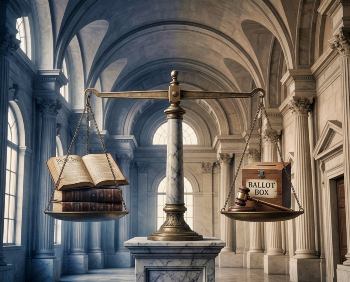 What Judicial Activism Means in Federal Courts
Judicial activism is the practice of judges deciding cases based on their own policy preferences rather than a faithful reading of the law, and it sits at the center of nearly every fight over the federal judiciary. The term describes rulings that stretch or bend constitutional and statutory text to reach an outcome the judge prefers. Cornell Law School’s legal reference defines judicial activism as rulings based on judges’ policy views rather than their honest interpretation of current law (Wex legal definition of judicial activism).
That definition matters because it frames the debate. Critics say activist judges expand judicial power at the expense of the political branches. Defenders say some intervention is a legitimate response to legislative or executive overreach. This guide walks through the main alternatives to federal judicial activism, from interpretive philosophies to institutional reforms, and weighs the trade-offs of each.
Judicial Restraint: The Founding-Era Counterweight
Judicial restraint is the philosophy that courts should defer to the elected branches whenever the Constitution and statutes allow, deciding only the case before them and nothing more. It treats the judicial role as narrow by design. Judges apply the law; they do not make policy.
The doctrine traces to the founding structure of separated powers. Federal courts hold neither the purse nor the sword, and restraint keeps them from claiming either through rulings. A restrained judge upholds federal legislation unless it plainly conflicts with the Constitution, respects precedent, and avoids sweeping remedies where a narrow one will do. In practice, this means more cases resolved on procedural grounds and fewer landmark opinions that redraw public policy. It also means the American people settle contested questions through their legislatures, where they have a vote.
Judicial Activism vs Judicial Restraint in Practice
The difference between judicial activism and judicial restraint shows up in how a court treats a challenged law, not in the outcome alone. A restrained court asks whether the law is permitted. An activist court asks whether the law is wise.
That distinction is contested, and honest observers should say so. A 2015 study from Northwestern University School of Law examined the common empirical measures of judicial activism, including how often courts strike down federal legislation, invalidate state and local laws, and reverse executive actions (empirical study of judicial activism in the federal courts). Those measures give us something concrete to compare, but they also show why the label gets thrown around so freely.
Judicial discretion is where the two philosophies collide. Restraint treats discretion as a hazard to be minimized. Activism treats it as a tool. A judge who relies on personal beliefs to invalidate a statute is exercising discretion in the way restraint warns against, and the political accountability that should attach to policy choices disappears.
 Textualism and Originalism as Interpretive Alternatives
Textualism and originalism are the two interpretive methods most often proposed as fixes for judicial activism, and they attack the problem at its root: how a judge reads the law. Textualism holds that statutes mean what their words meant to the people who enacted them. Originalism applies the same logic to the Constitution, reading its provisions as the public understood them at ratification.
These methods constrain judicial discretion because they give a judge something outside personal preference to anchor to. They also produce real limits. Originalism can be hard to apply to modern technology the framers never imagined, and textualism can yield results a judge finds unreasonable. Neither method eliminates interpretation; both narrow it. For readers who want to read the actual text being interpreted, the US Constitution and its amendments are the place to start.
Judicial Activism Examples That Shaped Federal Power
Concrete cases do more than abstract theory to show what judicial activism looks like in the federal courts, but a single example proves little. The more useful approach is to pair cases where different interpretive methods produced different outcomes, then ask which method the critic would have preferred. That comparison is the angle most treatments of judicial activism skip.
Pair one: agency deference. The clearest modern example is the Supreme Court’s 2024 decision in Loper Bright, which ended the Chevron deference doctrine and changed how courts review federal agency interpretations (Judicial Activism in the Loper Bright Era). Under Chevron, courts deferred to an agency’s reasonable reading of an ambiguous statute; under Loper Bright, courts exercise independent judgment. Critics of the decision argue that ending deference strips expertise from agency decision-making and limits the federal government’s ability to carry out its work (Center for American Progress analysis of Loper Bright). Supporters say it restores the judicial role and reins in unelected agency power. Notice that both sides describe the same ruling as either activism or its correction, depending on whether they think independent judicial judgment or agency expertise is the greater danger.
Pair two: invalidating federal legislation. Cases that strike down acts of Congress are the classic empirical measure of activism. A 2015 study from Northwestern University School of Law examined the common measures, including how often courts strike down federal legislation, invalidate state and local laws, and reverse executive actions (empirical study of judicial activism in the federal courts). The study’s value is that it separates the label from the outcome: a court can invalidate a statute on textual grounds and be called activist by the law’s defenders, or uphold the same statute on deferential grounds and be called activist by its opponents.
 Pair three: rights-expanding and rights-restricting rulings. Landmark decisions in both directions have been labeled activist. Critics call a ruling that recognizes an unenumerated right judicial legislation; supporters call a ruling that overturns a long-standing precedent activism, and supporters call a ruling that overturns a long-standing precedent a return to original meaning. The pattern is consistent: the activist label tracks disagreement with the result more reliably than it tracks method.
That inconsistency is why the term needs a definition before it can be a criticism. A neutral evaluation framework helps. Ask five questions of any contested ruling: Does the opinion anchor to constitutional or statutory text? Does it follow or overturn precedent, and does it explain why? Does it leave the policy choice to the elected branches where the Constitution permits? Does it protect a right the text secures, or create one the text does not? And would the same method produce consistent results across cases the judge dislikes? A ruling that fails several of these tests is a stronger candidate for the activist label than one that merely reaches an unpopular outcome.
Watch out: the most common error is to apply the label only to rulings you oppose. The framework above is only useful if you apply it to outcomes you favor as well.
Statutory Deference and the End of Chevron
Statutory deference was the doctrine that courts should defer to a federal agency’s reasonable interpretation of an ambiguous statute it administers. Chevron gave agency experts room to run government programs, and for four decades it shaped how federal courts handled statutory interpretation.
Loper Bright ended that. Courts now exercise independent judgment on statutory meaning, shifting power from agencies to judges. The trade-off is genuine. Deference let agencies act quickly and consistently; independent review gives courts more say over government authority and creates less predictability for regulated industries. For citizens worried about the administrative state, the end of Chevron is a meaningful check. For those who want government to function, it is a new source of friction. Either way, the interpretive ground has moved, and the next round of fights will be about how far courts take their new role.
Institutional Reforms: Term Limits, Ethics, and the Shadow Docket
Institutional reforms are a second family of alternatives, separate from interpretive philosophy. Where textualism and originalism change how a judge reads the law, institutional reforms change who sits on the bench, how long they stay, and how the Court conducts its business. That distinction matters: a reform can succeed on its own terms even if no justice’s philosophy changes.
The Brennan Center lists six proposed reforms, including 18-year term limits for justices, higher ethical standards, and curbs on shadow-docket abuses (Six Solutions to Fix the Supreme Court). Each proposal works through a different mechanism, and each carries a distinct cost.
Term limits. The leading proposal sets a single 18-year term, with a vacancy opening every two years so each presidential term produces two appointments. The stated goal is to regularize turnover and reduce the stakes of any single confirmation fight. The obstacle is Article III: justices hold office during good behavior, so a binding term limit requires a constitutional amendment. Some scholars argue that a statute could convert life tenure into a guaranteed seat followed by senior status, but that approach is contested and would almost certainly be litigated.
 Ethics rules. Proposals here range from a binding code of conduct enforced by an independent body to disclosure requirements for travel, gifts, and outside income. Congress has power to regulate the federal courts’ administration, but enforcement against justices raises separation-of-powers questions, and critics warn that a Congress able to discipline justices could also intimidate them.
Shadow-docket limits. The shadow docket refers to emergency orders and summary decisions issued without full briefing or oral argument. Reform proposals would require reasoned opinions, set time limits for emergency relief, and narrow the categories of cases eligible for expedited treatment. The trade-off is speed: emergency relief exists precisely because some disputes cannot wait for the normal calendar, and procedural limits can leave parties without timely protection.
Jurisdiction and court-size rules. Congress sets the jurisdiction of the lower federal courts, controls the number of judgeships, and can create or abolish lower courts. These tools are powerful but blunt, and using them to punish unpopular rulings invites retaliation when control of Congress changes hands.
A neutral way to compare these proposals is to ask three questions: What mechanism does it use (amendment, statute, or internal rule)? What does it actually change (personnel, conduct, or procedure)? And what is the failure mode if it works too well? Institutional reform is powerful precisely because it does not depend on any single justice’s philosophy, but that same independence from case outcomes is why each proposal must be judged on structural grounds rather than on whether it would have changed a particular ruling.
 Congressional and State-Level Checks on Federal Rulings
Congress and the states hold constitutional tools to check federal court decisions, and those tools are the most direct alternatives available to citizens who distrust judicial activism. Congress sets the jurisdiction of the lower federal courts, controls the size of the judiciary, and can propose constitutional amendments. States can push back through legislation, their own constitutional amendments, and coordinated resistance to federal overreach.
The Tenth Amendment reserves to the states and the people all powers not delegated to the federal government, which makes it the natural anchor for state-level checks. Readers who want to act on that argument can assert the Tenth Amendment directly, and those who want a playbook for state action can read the statehouse strategy for reclaiming sovereignty. These are slow tools, but they are durable ones, and they keep political accountability where the Constitution placed it.
Comparing the Alternatives: Trade-Offs and Limitations
No single alternative solves judicial activism, and anyone selling one as a cure is overselling. The table below compares the main options on what they actually change, where they fall short, and who they serve.
| Alternative | What It Changes | Main Limitation | Best For |
|---|---|---|---|
| Judicial restraint | How judges decide cases | Relies on judicial self-discipline | Restoring the judicial role |
| Textualism and originalism | How judges read the law | Hard to apply to modern issues | Constraining judicial discretion |
| Ending statutory deference | Who interprets ambiguous statutes | Less predictable agency action | Reining in agency authority |
| Institutional reforms | Court structure and ethics | Requires amendment or legislation | Long-term accountability |
| Congressional and state checks | Balance between branches | Slow and politically difficult | Citizen-driven pushback |
The honest read: interpretive methods change outcomes case by case, while institutional and state-level checks change the balance of power over time. The strongest approach combines them.
 What Citizens Can Do to Assert Constitutional Limits
Citizens are not spectators in this fight. The Constitution gives the American people tools that do not require a law degree, and using them is the most practical answer to federal judicial activism. Start with the text, then organize locally, then hold elected officials accountable for the courts they confirm and the laws they pass.
Here is a practical checklist we recommend:
- Read the constitutional provision at issue before you argue about it
- Track the cases in your circuit and state courts, not just the Supreme Court
- Attend local government meetings where federal overreach lands first
- Contact your state legislators about Tenth Amendment resolutions
- Ask your senators how they evaluate judicial nominees on interpretive method
- Join a civic organization that educates rather than merely complains
Texas Journal publishes a guide on the constitutional tools citizens can use to defend the Republic, and a companion piece on how to assert your constitutional rights if you are ready to act. Watch out: the most common mistake is treating constitutional education as a one-time read. The law moves, and so should you.
Join the Movement to Restore Constitutional Government
The fight over the federal judiciary will not be settled by one ruling or one election. Citizens who understand the Constitution and use it will settle it. Texas Journal exists to provide the critical insight and discernment that helps you do exactly that, from constitutional education to state-level strategy. We teach citizens how to assert their rights, focus on states’ rights as the path back to founding principles, and offer the Patriot Pool as a force multiplier for the movement.
Get started with Texas Journal and turn your concern about judicial overreach into informed action.
Dave
Questions? Call!
940-353-1398

Frequently Asked Questions
What is the opposite of judicial activism?
Judicial restraint is the standard counterweight. A judge practicing restraint defers to the elected branches where the Constitution is silent, decides only the case in front of the court, and avoids striking down statutes on policy grounds. The Northwestern University School of Law’s empirical work measures activism partly by how often courts invalidate federal legislation, state laws, and executive actions, which gives restraint a measurable benchmark rather than a slogan.
How does judicial restraint differ from judicial activism?
The distinction turns on who decides. Judicial activism, as Cornell’s Wex defines it, means rulings grounded in a judge’s policy preferences rather than an honest reading of current law. Judicial restraint pushes the opposite way: uphold the legislature’s work unless it plainly conflicts with the Constitution, and leave policy choices to the political branches. In practice the line blurs, which is why critics on both sides accuse the other of activism while claiming restraint for themselves.
What is the difference between textualism and judicial restraint?
Textualism is an interpretive method; judicial restraint is a posture toward the other branches. A textualist reads statutes by their ordinary public meaning and declines to import legislative intent that the text does not support. Restraint asks whether the court should intervene at all. A judge can be a committed textualist and still strike down a law, so the two work together rather than as synonyms. Originalism applies the same discipline to constitutional text.
How can Congress respond to a federal court ruling?
Congress has several tools short of a constitutional amendment. It can rewrite the statute the court interpreted, strip or limit jurisdiction in specific categories of cases, attach conditions to federal funding, or pursue a constitutional amendment for a durable fix. Each carries trade-offs: jurisdiction limits invite separation-of-powers fights, and amendments require two-thirds of both chambers plus three-quarters of the states.
What are some examples of judicial activism?
The 2024 Loper Bright decision ending Chevron deference is the most consequential recent case, and both sides call the other activist over it. Critics of the ruling say it removes agency expertise; supporters say it restores the judicial role of saying what the law is. Earlier flashpoints include courts striking down federal legislation and reversing executive actions, the measures scholars use to count activism empirically. The label usually reveals the speaker’s position more than the ruling’s.