Last Updated: November 7, 2026
Quick Summary
Legal protections for peaceful advocacy begin with the First Amendment, which shields speech, assembly, and petition as three separate rights. Government may regulate the time, place, and manner of a protest, but only through content-neutral rules that leave other channels for your message open.
- You often do not need a permit for a peaceful protest on public property, but marches and large gatherings may require one.
- A valid permit scheme must have published standards, fixed deadlines, narrow fees, written denials, and an appeal route.
- Protesting becomes illegal when conduct crosses into trespassing, blocking traffic, damaging property, assault, or ignoring a lawful dispersal order.
- You have the right to remain silent, refuse consent to a search, and ask whether you are free to leave.
- Document any incident the same day and request body-camera footage early, before retention periods run out.
Table of Contents
- The First Amendment Grounds Every Legal Protection for Peaceful Advocacy
- How to Organize a Protest Legally Without Inviting Liability
- Do You Need a Permit to Protest on Public Property?
- Time, Place, and Manner Restrictions: What Government Officials Can and Cannot Do
- When Does Protesting Become Illegal?
- Police Encounters: Your Rights When Stopped, Questioned, or Arrested
- Legal Protections for Peaceful Advocacy Examples You Can Point To
- Digital Privacy, Accessibility, and Safety Planning for Demonstrations
- Documenting an Incident and Filing a Rights Violation Complaint
- Put Your Constitutional Rights to Work With Texas Journal
- Frequently Asked Questions
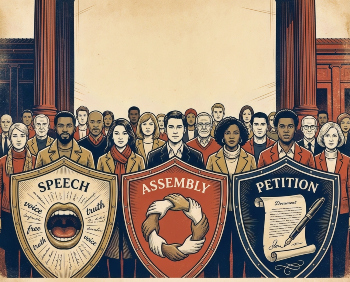 The First Amendment Grounds Every Legal Protection for Peaceful Advocacy
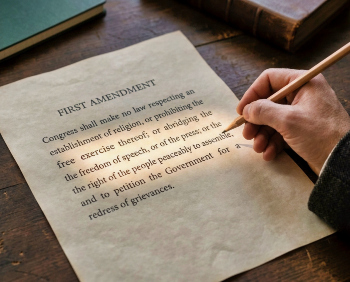
Legal protections for peaceful advocacy begin with five words in the Constitution that most Americans can recite but few can apply: “the right of the people peaceably to assemble.” Knowing these protections is the difference between exercising a right and losing it.
The First Amendment is not one shield. It is three, and each one works differently in court.
Speech, Assembly, and Petition: Three Separate Shields
Freedom of speech covers what you say and how you say it, including on a sign or in a chant. Freedom of assembly protects the act of gathering itself, even when the gathering says nothing at all. The right to petition protects your demand that government fixes a wrong.
Courts treat each shield separately. A city that can lawfully limit where you march may not lawfully limit what your sign says. Understanding which shield applies to your situation is the first practical skill of advocacy.
What Expressive Conduct Covers
Expressive conduct is action meant to send a message. Marching, kneeling, holding a sign, wearing a symbol, and staging a sit-in all qualify. Courts have long recognized that conduct with an expressive purpose can carry speech protection, though not always the same level as pure speech.
For anyone who wants to go deeper, a solid reading list helps: see which constitutional law books beginners should read first for a starting point.
 How to Organize a Protest Legally Without Inviting Liability
Organizers carry more legal exposure than attendees, and most of it is avoidable with preparation. The organizer’s job is to plan for problems before they happen, not react after.
The Organizer’s Preparation Checklist
- Write down the event’s purpose and keep all messaging peaceful
- Confirm the exact location and whether a permit is required
- Contact the local police department about the plan in advance
- Recruit trained marshals to guide the crowd and spot problems
- Line up legal observers and a lawyer’s phone number
- Arrange water, medical supplies, and an accessible route
- Draft a dispersal plan for weather or emergency
- Save copies of every permit and communication
Keep instructions to attendees simple: stay on public ground, follow marshal directions, and do not respond to provocation. A common mistake is treating the permit as the whole job. It is not. The crowd plan protects the organizer.
Do You Need a Permit to Protest on Public Property?
You often do not need a permit for a peaceful protest on public property, but you may need one for a march, a large gathering, amplified sound, or the use of structures such as a stage or tents. The permit question depends on what you plan to do, not on the message you carry.
Start With the Right Rulebook
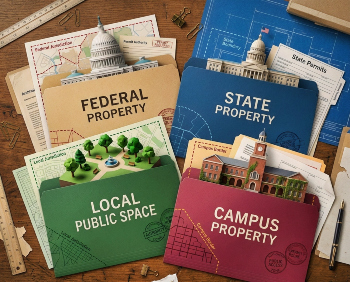
Before you rely on general constitutional principles, identify which set of rules governs your event. The answer changes the permit process, the appeal path, and the officials you deal with.
- Federal property, National parks, federal buildings, and federal courthouses have their own permit systems. Federal parkland generally has its own permit rules, which are published in the Code of Federal Regulations.
- State property, State capitols, and state office complexes often have rules set by statute or by the state agency that manages the grounds.
- Local property, City sidewalks, parks, and plazas are governed by municipal ordinances and park rules. This is where most protests happen and where most permit disputes arise.
- Campus property: Public colleges and universities usually have their own speech and assembly policies, and private colleges are not bound by the First Amendment the same way.
- Private property: A shopping center, parking lot, or private building can ask you to leave, and refusing can lead to a trespassing charge. The First Amendment does not give you a right to demonstrate on private land.
A common pattern is for organizers to read the Constitution and skip the ordinance. The ordinance is what the officer on the ground will enforce.
 Public Forums and What They Mean in Practice
Public sidewalks and parks are traditional public forums, the places where assembly protection is strongest. Government buildings may be open to the public but are not always open to demonstration. A plaza in front of a courthouse may be a designated public forum with posted rules, or it may be a nonpublic forum where the government has more room to restrict activity.
Watch out: a space that looks public can be a limited forum with its own permit requirement. Check the posted rules or the agency website before you announce a location.
How Permit Rules Must Work
A permit requirement is lawful only when it is content-neutral. Officials cannot charge your group more, delay you longer, or deny you because they dislike your cause. A permit process that gives an official open-ended discretion is vulnerable to challenge.
Most valid permit schemes share these features:
- Published standards, the criteria are written down, not invented at the counter
- Fixed deadlines, the agency must decide within a set number of days
- Narrow fees, charges cover actual administrative costs, not the cost of policing the message
- Written denials: a denial states the reason and the appeal path
- An appeal route, a prompt review, often to a superior or a board, before the event date
Ask for the written policy and the fee schedule. If the agency cannot produce them, document that.
Fees, Insurance, and Other Conditions
Some jurisdictions charge application fees, require liability insurance, or impose cleanup deposits for larger events. These conditions are lawful only if they are applied evenly and do not price one viewpoint out of the forum. A fee that is waived for some groups and enforced against yours is a content-based problem.
Watch out: an insurance requirement that appears neutral can still be applied selectively. Keep every quote, waiver request, and response.
If Your Permit Is Denied or Delayed
- Get the denial in writing, with the stated reason.
- Ask for the appeal process and the deadline to file.
- Preserve every application, email, and phone log.
- Contact a legal observer or attorney before the event date, not after.
- Consider whether an alternate location or time would let the event proceed while you challenge the denial.
A documented pattern of unequal treatment is the strongest evidence for a rights claim. The paperwork matters as much as the protest.
Time, Place, and Manner Restrictions: What Government Officials Can and Cannot Do
Government officials may regulate when, where, and how you assemble, but not why. This is the core of the time, place, and manner doctrine, and it is the rule that decides most protest disputes.
A valid restriction must meet three tests:
- Content-neutral: it applies the same way to every group
- Narrowly tailored: it serves a real safety or traffic interest
- Leaves alternatives open: other channels for your message remain
So a city can require a parade to keep a lane open for traffic. It cannot ban all signs because it finds them offensive. A curfew imposed to silence one viewpoint is not a neutral rule, and courts have struck down restrictions built to target disfavored speakers.
Watch out: a rule that looks neutral on paper can be applied selectively. If your group is held to a standard no other group faces, document it.
 When Does Protesting Become Illegal?
Protesting becomes illegal when conduct crosses from protected expression into a crime: trespassing, blocking traffic, damaging property, assaulting a person, or ignoring a lawful dispersal order. The message stays protected. The conduct does not.
Civil disobedience is a deliberate choice to break a law for a cause, and the legal consequence is part of that choice. That differs from an accidental violation and from lawful assembly.
Students face extra layers of rules. School officials have more authority over campus activity than police have on a public street. For families navigating that, see understanding constitutional rights in Texas schools.
Police Encounters: Your Rights When Stopped, Questioned, or Arrested
You have the right to remain silent, the right to refuse consent to a search, and the right to ask whether you are free to leave. Say these things out loud, calmly, and then stop talking. The goal is to preserve your rights and your record, not to win the argument on the street.
Know Which Encounter You Are In
The rules differ depending on whether you are stopped, questioned, or arrested.
- Consensual encounter: an officer approaches and talks to you. You are free to leave. Ask, “Am I free to leave?” If the answer is yes, leave.
- Investigative stop: an officer has reasonable suspicion and briefly detains you. You are not free to leave, but you are not under arrest. You still do not have to answer questions beyond identifying yourself if your state requires it.
- Arrest: you are taken into custody. Give your name if required, then ask for a lawyer and stop talking.
A common pattern is for people to treat a consensual encounter as an arrest and panic, or to treat an arrest as a conversation and keep talking. Ask the question and listen to the answer.
The Phrases That Matter
- Stopped: “Am I free to leave?”
- Questioned: “I am not answering questions without a lawyer.”
- Search requested: “I do not consent to a search.”
- Arrested: give your name if required, then “I want a lawyer.”
Say each phrase once, clearly, and then stop. Repeating it is fine; arguing is not.
Recording Police in Public
In public, you generally may record police performing their duties, and courts have protected that right (Recording and Documenting Police and Federal Agents). Keep your phone steady, stay back, and do not interfere with the officer’s movement. Announce that you are recording if it helps, but you are not required to.
Watch out: recording rules can vary on private property and in some sensitive locations. If an officer orders you to stop recording, state that you are recording from a public place and ask whether you are being detained. Do not physically resist.
 Searches, Phones, and Devices
You can refuse consent to a search of your bag, car, or phone. If an officer says they have a warrant, ask to see it. Do not grab the phone back or block the officer; note what happened and challenge it later.
For digital privacy before an event, turn off location history, review app permissions, and use encrypted messaging for coordination. An unlocked phone that hands over location data is a record you did not mean to create.
If You Are Arrested
- Give your name if required by state law.
- Ask for a lawyer and stop answering questions.
- Do not physically resist, even an arrest you believe is unlawful.
- Ask a friend or marshal to note the time, place, officers’ names or badge numbers, and witnesses.
- Request a phone call and use it to reach a lawyer or a legal-support contact.
- Write down everything you remember the same day.
Challenge an unlawful arrest later, in court, with a record. The street is not the place to litigate it.
After the Encounter
Document the incident the same day: time, place, officers’ names or badge numbers, exact words, and witness contacts. Request body-camera footage early, before retention periods run out. File a written complaint with the agency’s internal affairs office, and send copies to a civil liberties organization and, if needed, an attorney. A clear record is what turns a grievance into a case.
The rules differ depending on which kind of encounter you are in, so here is how each one works and what to say.
| Encounter | What it means | What to say |
|---|---|---|
| Consensual encounter | Officer approaches and talks to you; you are free to leave | “Am I free to leave?” |
| Investigative stop | Reasonable suspicion; briefly detained, not under arrest | “I am not answering questions without a lawyer.” |
| Search requested | Officer asks to search bag, car, or phone | “I do not consent to a search.” |
| Arrest | You are taken into custody | Give your name if required, then “I want a lawyer.” |
Legal Protections for Peaceful Advocacy Examples You Can Point To
Examples of legal protections for peaceful advocacy show how these rules play out in real disputes. Courts have repeatedly protected marches and rallies where the government’s real objection was the message.
The pattern repeats: a city imposes a fee, a route limit, or a permit delay that falls hardest on one group, and a court finds the rule content-based. The lesson for organizers is that the paperwork matters. Keep every application, denial, and email. A documented pattern of unequal treatment is the strongest evidence for a rights claim.
Digital Privacy, Accessibility, and Safety Planning for Demonstrations
Plan the digital and physical sides together, because both shape who can safely show up. Most organizers focus on the street and forget the phone in their pocket.
- Turn off location history and review app permissions before the event
- Use encrypted messaging for coordination, not group texts
- Agree on a check-in plan and a meeting point if the crowd scatters
- Designate a medic and carry water and any personal medication
- Choose a route that works for wheelchairs, strollers, and older attendees
- Provide a quiet exit for anyone who needs to leave early
For the digital steps, see how to assert privacy rights online and our guide to the best encrypted messaging apps for patriot groups.
 Documenting an Incident and Filing a Rights Violation Complaint
Document an incident the same day, while details are fresh, and file the complaint in writing. Memory fades fast, and a clear record is what turns a grievance into a case.
- Write down the time, place, officers’ names or badge numbers, and exact words
- Collect photos, video, and contact info from witnesses
- Request body camera footage early, before retention periods run out
- File a complaint with the agency’s internal affairs office
- Send copies to a civil liberties organization and, if needed, an attorney
If you plan to pursue a constitutional claim without a lawyer, our pro se litigation guide for constitutional claims walks through the filing steps.
Put Your Constitutional Rights to Work With Texas Journal
Rights you never use are rights you slowly lose. The protections above only matter if citizens know them, practice them, and hold officials to them when they overreach.
Constitutional education can help you understand how to assert your rights in plain terms and how the Constitution’s protections apply to everyday civic activity.
The challenge is simple: learn the rules, document everything, and show up prepared. Turn your constitutional rights from a phrase you recite into a tool you actually use. Visit Texas Journal’s website for current information about its resources.
Dave
Questions? Call!
940-353-1398

Frequently Asked Questions
What law protects peaceful protests?
The First Amendment to the U.S. Constitution protects freedom of speech, freedom of assembly, and the right to petition the government for redress of grievances. These protections apply to peaceful advocacy on public property and constrain how government officials can restrict demonstrations. State constitutions often add parallel protections, and federal courts have consistently held that content-neutral time, place, and manner restrictions must leave open ample alternative channels of communication. That means a city can regulate when and where you gather, but it cannot silence your message because officials disagree with it.
Do you need a permit to protest on public property?
Not always. Small gatherings on public sidewalks and in traditional public forums generally do not require a permit. A permit requirement typically applies when a march will block streets, use amplified sound, or involve large crowds that need crowd control and emergency access. Permit rules must be content-neutral, narrowly tailored, and applied without favoritism. Ask your local government for the written ordinance, apply early, and keep a copy of the approved permit on hand during the event. If a permit is denied, request the denial in writing and note the stated reason.
When does protesting become illegal?
Protesting becomes illegal when actions move beyond protected expression into trespassing on private property, blocking building entrances, damaging property, assaulting others, or ignoring a lawful dispersal order. Civil disobedience is deliberately unlawful and carries legal consequences, so participants should understand that risk in advance. A police order to disperse must generally be clear and give a reasonable opportunity to comply. If you believe an order is unlawful, comply first and challenge it later through legal channels, documentation, and a complaint rather than a confrontation at the scene.
What are examples of legal protections for peaceful advocacy?
Practical examples include the right to record police performing duties in public, the requirement that permit schemes be content-neutral, and the protection against prior restraint, meaning the government generally cannot stop speech before it happens. Courts have also upheld the right to distribute leaflets in public forums and to hold counterprotests. At the state level, many constitutions grant broader speech protections than federal law. Knowing these examples helps you recognize a rights violation when it happens and document it clearly for a later complaint or legal consultation.