Table of Contents
- Step 1: Define Your Mission and Meeting Format
- Step 2: Secure a Venue for Your Liberty Meetings
- Step 3: Build a Liberty Activist Meeting Agenda Template
- Step 4: Promote Your Meeting and Manage RSVPs
- Step 5: Use Tools for Managing Local Liberty Events
- Step 6: Facilitate Discussions That Stay on Constitutional Principles
- Step 7: How to Verify Local School Board Budget Transparency for Parents
- Step 8: Digital Security and Legal Considerations for Organizers
- Conclusion: Turn Meetings into Momentum
- Frequently Asked Questions
Last Updated: September 17, 2026
Step 1: Define Your Mission and Meeting Format
Learning how to organize local liberty meetings starts with one clear purpose. Liberty meetings are gatherings where neighbors discuss constitutional rights, local policy, and ways to hold officials accountable. This guide walks you through the full process, from picking a mission to running the room.
A focused mission keeps people coming back. Groups that try to cover everything burn out fast.
Pick one goal for your first few meetings:
- Track a single school board or city council vote
- Teach one constitutional principle per session
- Build a phone and email list of local officials
- Recruit volunteers for a specific campaign
Next, choose your format. In-person gatherings build trust, virtual events reach those who can’t drive, and hybrid setups accommodate diverse group sizes and needs, ensuring everyone stays engaged.
The most common mistake is skipping this step. Groups that never define their mission drift into complaint sessions. Complaint sessions don’t change policy.
Write your mission clearly in one sentence. Repeating it before every meeting helps everyone stay aligned and confident in your purpose.
Step 2: Secure a Venue for Your Liberty Meetings
Public space is your friend, and the law is on your side more than most new organizers realize.  Libraries, community centers, and municipal buildings rent meeting rooms cheaply, and many waive fees entirely for civic groups. Start your search with city-owned and county-owned facilities, then work outward.
Here’s what to check before you book:
- Venue capacity: Does the room hold your expected crowd plus 20%? Fire code occupancy limits are posted near the door; read them.
- Layout: Can you rearrange chairs into a circle or small groups? Fixed auditorium seating kills discussion.
- Parking and access: Is there free parking? Is the entrance easy to find after dark?
- AV equipment: Do you need a microphone or projector? Ask whether the room has a built-in system or whether you bring your own.
- Cost and deposit: What’s the total, including any cleanup fee, security deposit, or staff time charge?
- Food and drink rules: Many public rooms ban outside food. Plan accordingly.
Most facilities require a reservation application, often with a certificate of insurance. Submit it early. Popular rooms book weeks out, and school district facilities are often booked months in advance by athletic and PTA groups.
Know the Rules That Protect Your Access
Public facilities funded by taxpayers generally cannot reject a group just because officials dislike its viewpoint. A common pattern is that a city will rent to a book club but stall on a liberty group, that inconsistency is the tell. Ask for the written facility use policy and the fee schedule. If the policy has a content-neutral standard (first-come, first-served, proof of insurance, cleanup deposit), hold them to it.
For outdoor gatherings, public parks and sidewalks are traditional public forums. A permit is often required above a certain headcount, but the permit process itself must be viewpoint-neutral. Keep a copy of every application and every response.
Private venues work too, but read the rules first. Some businesses restrict political gatherings, and some HOAs prohibit them outright. Get any agreement in writing,  including the cancellation terms.
Match the Room to the Meeting Type
A 30-person discussion group and a 150-person town hall need different spaces. For working sessions, a library conference room with movable tables beats a hotel ballroom every time. For public forums where you expect press or officials, look for a room with a raised dais, a working PA, and a separate entrance so late arrivals don’t disrupt the speaker.
If you cannot find a free or cheap public room, consider a rotation: meet at a member’s church hall one month, a coffee shop back room the next, a park pavilion in good weather. Rotation spreads the cost and the visibility, and it keeps any single landlord from becoming a single point of failure.
Step 3: Build a Liberty Activist Meeting Agenda Template
A strong agenda template is the backbone of every good meeting. Liberty activist meeting agenda templates follow a simple rule: short, timed, and action-focused. Every item should end with a decision or a task.
A workable template looks like this:
- Welcome and mission read (5 min) – Open with your one-sentence mission
- Minutes and updates (5 min) – Review what happened since last time
- Main topic (30 min) – One issue, one speaker, open discussion
- Action items (15 min) – Assign tasks to named people
- Announcements and close (5 min) – Next meeting date and location
Print copies. Hand them out at the door. People stay engaged when they can see where the meeting is going.
Essential Agenda Sections for Liberty Groups
Every agenda needs three fixed blocks: education, action, and accountability.
Education teaches the constitutional principle behind the issue. Action turns discussion into a task. Accountability reviews last meeting’s tasks before adding new ones.
Skip any of the three and the group stalls. Education without action becomes a lecture series. Action without education becomes noise.
Step 4: Promote Your Meeting and Manage RSVPs
Promotion starts with a simple event page. Include the date, time, address, and a one-line description of the topic. Then push it everywhere your people already are.
A basic marketing strategy for local groups:
- Post in neighborhood and church Facebook groups
- Send a short email to your existing list
- Ask five members to each invite two friends
- Print a flyer for local bulletin boards
- Post on Nextdoor and community forums
RSVP tracking matters more than most organizers think. It tells you how many chairs to set up and how much food to buy. Use a free event tool or a simple sign-up sheet.
Send a reminder 48 hours before the meeting. Send a second one the morning of. Attendance jumps when people get a same-day nudge.
For attendee communication, keep it short—one paragraph, one link, one clear ask.
The single biggest driver of turnout is a personal invite, not a mass post. Five members each texting two people beats a hundred-person email blast every time.
Step 5: Use Tools for Managing Local Liberty Events
Good tools for managing local liberty events save hours every month, but for liberty groups, the tool choice is also a privacy decision. Member lists, RSVP records, and internal discussions are exactly the kind of data that gets subpoenaed, leaked, or scraped. Pick tools that keep your people safe, not just organized.
You don’t need expensive software. A few free or low-cost options cover almost everything.
| Tool Type What | t It Does | Privacy Consideration |
|---|---|---|
| Event pages | Host RSVPs and send reminders | Prefer platforms that let you hide the guest list from attendees |
| Group messaging | Coordinate the core team | Use end-to-end encrypted apps for anything sensitive |
| Shared docs | Draft agendas and minutes | Keep one canonical folder; restrict edit access |
| Email platforms | Send updates and calls to action | Use a separate organizer address, not a personal one |
| Cloud storage | Store files and records | Turn on two-factor authentication on the account |
| Password manager | Share credentials safely | Never text passwords or email them to new volunteers |
Separate the Public Layer from the Private Layer
A common pattern among experienced organizers is a two-layer stack. The public layer is what the world sees: an event page, a public email address, a social media account. The private layer is where the actual coordination happens: an encrypted group chat for the core team, a password-protected folder for minutes and records, and a member list that lives in exactly one place.
Mixing the two layers is the most common mistake. If your RSVP form collects home addresses and phone numbers, that data should not sit in the same spreadsheet you share with a dozen volunteers. Collect the minimum you need, store it in one secure location, and delete what you no longer use.
RSVP Without Handing Over Your Member List
Many popular event platforms default to showing every attendee who has RSVP’d. For a liberty group, that public guest list is a gift to anyone who wants to map your membership. Look for a setting that hides the attendee list, or use a simple sign-up form that only the organizer can see.
For higher-trust meetings, consider a two-step RSVP: a public event page that points to a private form, and a confirmation email that goes out only to confirmed attendees. This filters out casual clickers and keeps the real list small.
Track Three Numbers, Nothing More
Event analytics help, but don’t drown in dashboards. Track how many people RSVP, how many show up, and how many take action. Those three numbers tell you if your outreach is working. A 50% show rate is normal for free public events; a 70% show rate usually means your list is warm and your reminders are landing.
Resource allocation follows the same logic. Put your strongest volunteer on promotion, not on paperwork. The organizer who is best at talking to strangers should be the one making personal invites, not the one formatting the minutes.
Step 6: Facilitate Discussions That Stay on Constitutional Principles
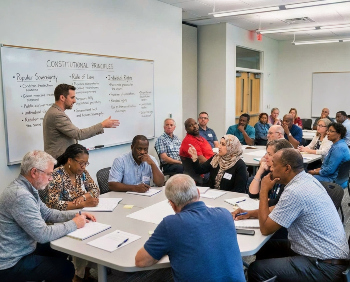
 Facilitation is where most groups either shine or fall apart. A good facilitator keeps the room on topic, on time, and on principle.
Start every discussion by naming the constitutional issue. Is this about free speech, due process, states’ rights, or property rights? Naming the principle anchors the conversation.
Then use these facilitation techniques:
- Round-robin: Everyone speaks once before anyone speaks twice
- Parking lot: Write off-topic points on a board and return to them later
- Timeboxing: Give each speaker a set limit
- Consensus building: Look for the point everyone agrees on, then build from there
The thing nobody tells you about liberty groups is this: the loudest voice rarely has the best argument. Good facilitation protects the quiet members.
Keep meeting minutes. Record decisions and task owners. Minutes stop the same debate from restarting every month.
Step 7: How to Verify Local School Board Budget Transparency for Parents
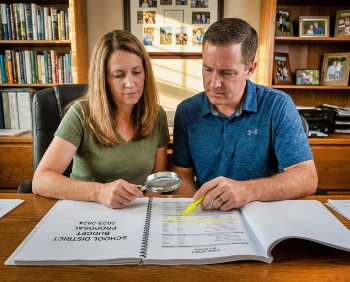
Parents have a legal right to see how school boards spend public money. Learning how to verify local school board budget transparency for parents is one of the most concrete wins a liberty group can deliver.
Here’s the process:
- Request the current adopted budget from the district office
- Ask for the line-item detail, not just the summary
- Compare the budget to the prior year
- Check board meeting minutes for approved changes
- Attend a public board meeting and ask questions on the record
Most states require public bodies to post budgets and meeting records. If a district stalls, submit a formal public records request. Put the request in writing and keep a copy.
Bring two people to the board meeting. One asks the question. One takes notes. Notes become the record you share with the wider group.
This is slow work. It also works. Districts change spending when enough parents show up and ask the same question month after month.
Step 8: Digital Security and Legal Considerations for Organizers
Organizing in public invites attention. Basic digital security and legal awareness protect your group and your members.
On the digital side:
- Use a password manager for shared accounts
- Turn on two-factor authentication everywhere
- Keep member lists in one secure place, not scattered across phones
- Avoid discussing sensitive plans in public group chats
On the legal side, know the basics. Public meetings have rules about signs, speaking time, and recording. Follow them. Groups that break the rules hand officials an easy excuse to shut them out.
The First Amendment protections outlined by the U.S. Courts cover peaceful assembly and free speech. Know your rights before you need them.
Liability matters too. If your group rents a space, check who carries insurance for injuries on site. If you collect money, keep clean records.
Guidance from the U.S. Department of Justice on civil rights explains how public bodies must treat citizens who speak at their meetings. Read it once. Keep it handy.
Conclusion: Turn Meetings into Momentum
A single meeting changes nothing. A group that meets every month, tracks one issue, and holds officials accountable changes everything. The work is steady and often slow, but it compounds.
Texas Journal exists to support that work. Our platform teaches citizens how to use the abilities the U.S. Constitution gives them, with a focus on states’ rights and constitutional education. Members get critical insight on policy, guidance on asserting rights, and access to the Patriot Pool as a force multiplier for the movement. If your group’s mission is to Control Washington From Your State or simply to Defend the American Family at the school board level, the same steady, local pressure is how it gets done.

Frequently Asked Questions
What are the legal requirements for hosting public meetings in my area?
Public meetings held in government buildings or that qualify as open meetings under state law may require advance notice and minutes. Private gatherings in homes, churches, or rented private spaces usually need no permit. Check local ordinances for occupancy limits and any rules on signage. If you use a public park, you may need a reservation application. Always confirm with the facility and keep a copy of any approval.
How do I find a venue for a grassroots liberty meeting?
Start with free or low-cost options: public libraries, community centers, church halls, and coffee shop back rooms. For larger crowds, look at hotel meeting rooms or rented event spaces. Check venue capacity and layout to ensure everyone can see and hear. Ask about parking, accessibility, and any fees. Reserve early, especially for weekday evenings, and confirm the reservation in writing.
What is the best way to structure a liberty meeting agenda?
A strong agenda balances education, discussion, and action. Start with a clear call to order and a brief mission reminder. Allocate time for a guest speaker or constitutional topic, then open the floor for moderated discussion. Include a segment on upcoming events and volunteer sign-ups. End with specific action items and assign owners. Keep total meeting time to 90 minutes or less to respect attendees’ schedules.
How can I effectively promote a local liberty meeting to like-minded citizens?
Use a mix of digital and physical outreach. Post in local Facebook groups, Nextdoor, and patriot forums. Send email invitations to your existing contacts and ask them to forward. Print flyers for libraries, gun shops, and community bulletin boards. Partner with nearby groups to cross-promote. Track RSVPs with a free tool so you know how many chairs to set up. Follow up with reminders 48 hours before the event.