Table of Contents
- Why 2026 Is a Pivotal Year for Constitutional Law
- 2026 Ballot Measures and Proposed Constitutional Amendments
- The Article V Convention Process: How States Can Bypass Congress
- Constitutional Limits on Federal Agency Power After Recent Rulings
- States’ Rights vs Federal Authority: The 2026 Battleground
- Key Dates and Deadlines for the 2026 Election Cycle
- How Citizens Influence Constitutional Law Changes
- The Economic and Regulatory Impact of 2026 Constitutional Shifts
- What to Watch Next: 2027 and Beyond
- Frequently Asked Questions
Last Updated: September 18, 2026
Why 2026 Is a Pivotal Year for Constitutional Law
The most consequential constitutional law changes in a generation are converging on a single election cycle. According to the National Conference of State Legislatures, state legislatures have referred a record number of constitutional amendments to the 2026 ballot, while federal courts continue reshaping the boundaries of agency authority. This guide from Texas Journal breaks down what those shifts mean for  ordinary citizens, not just lawyers.
Here’s the short version: constitutional law changes are the formal and informal shifts in how the founding document is interpreted, amended, or applied. In 2026, those shifts are arriving through three channels at once: ballot measures, the Article V convention process, and judicial rulings that limit federal power.
Most coverage treats these as separate stories. They aren’t. They’re the same story told in three venues, and the outcome determines how much control Washington keeps over your daily life.
Below, we’ll show you exactly how each channel works, what’s on the ballot, and what you can do before the deadlines hit.
2026 Ballot Measures and Proposed Constitutional Amendments
Voters in multiple states will decide constitutional amendments directly this cycle, and the subjects range from tax policy to individual rights. A ballot measure is a proposal placed before voters for approval, and when it amends a state constitution, it becomes binding constitutional text, not just a statute that the next legislature can undo.
The measures drawing the most attention fall into a few categories:
- Tax and fiscal limits: proposals capping property tax growth and requiring voter approval for major new levies
- Rights expansions: amendments addressing reproductive freedom and marriage equality in states where statutory protection is considered insufficient
- Election administration: changes to voter ID requirements, mail-ballot deadlines, and audit procedures
- Regulatory reform: measures limiting how state agencies can implement federal mandates
How a Measure Actually Reaches the Ballot
There are two routes, and the route determines who controls the wording. In a legislatively referred measure, the legislature passes a resolution and the secretary of state places it on the ballot; the legislature or attorney general drafts the title and caption. In a citizen-initiated measure, sponsors circulate a petition, gather a required number of valid signatures within a set window, and the measure qualifies only after the signatures are verified. Signature thresholds vary widely by state, and many states impose a geographic distribution requirement so that support cannot be concentrated in a single metro area.
That procedural difference matters because it decides who writes the summary voters actually read in the voting booth. A legislature that opposes a citizen initiative often controls the ballot title, and courts in several states have heard challenges arguing that a title was drafted to mislead. The operative text is what becomes law, but the title is what most voters see.
What Makes State Constitutional Amendments Different
What most guides miss is that state constitutional amendments are harder to reverse than ordinary laws. Once ratified, undoing them usually requires another statewide vote. That permanence is exactly why both sides fight so hard over ballot language and title wording, and why the same subject can appear on ballots in multiple states in the same cycle with different drafting.
A second difference is that state constitutions are amended far more often than the federal document. Many state constitutions run to tens of thousands of words and have been amended hundreds of times, which means a single cycle can carry dozens of consequential changes that never make national headlines.
How to Read Ballot Language Like a Lawyer
A practical method works in four steps. First, find the operative text, not the caption. Second, identify the verb: does the measure require, authorize, or prohibit? Third, look for the effective date and any sunset clause, because a measure that expires in a few years is a different proposition than a permanent one. Fourth, read the fiscal impact statement if your state provides one, since it estimates the cost to state and local government.
This is the gap most national coverage leaves open. Local outlets cover their own state’s measures in detail, and academic blogs cover doctrine, but very little synthesizes the cross-state pattern into a single comparative read. That comparative view is what lets a voter see whether a measure in one state mirrors a model being pushed in several others.
The Article V Convention Process: How States Can Bypass Congress
The Article V convention process is the constitutional mechanism that lets states propose amendments without waiting on Congress. Under Article V, two-thirds of state legislatures, currently 34 states, can demand a convention to propose amendments, and any proposals that emerge 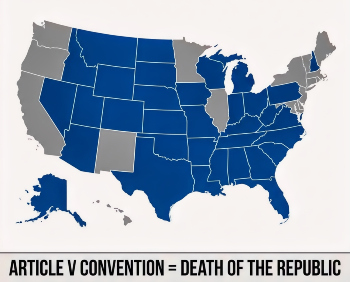 must then be ratified by three-fourths of the states, or 38.
That structure is the single most important fact in this entire debate. It means the states hold a veto-proof path around a gridlocked Congress, but only if they can agree on scope.
Two Paths to an Amendment: Congress vs. the States
There are exactly two ways to amend the Constitution, and they are not equal in practice.
| Path | Trigger | Proposals Come From | Ratification Threshold |
|---|---|---|---|
| Congressional route | Two-thirds vote in both chambers | Congress | 38 states |
| Article V convention | 34 state legislatures apply | Convention of states | 38 states |
The congressional route has produced all 27 existing amendments. The convention route has never been used and should never be. There was a time when we were a homogeneous nation. We are no longer. Think how easy it would be for a large money donor, either foreign or domestic to buy a state delegates vote. If there were an Article V Convention, for a brief moment billionaires from around the world could buy the country for a few billion dollars.
An Article V Convention has no restrictions. The entire United States Constitution would be destroyed and a few hundred state legislatures would live out their lives in luxury.
The risk is far too great.
The convention route has never been used, which is precisely why it generates so much argument. Critics are certain an Article V Convention would result in a “runaway convention” that would destroy the Republic. Would there be any repercussions for the corrupt legislators? No. Think Epstein files.
Where the 34-State Threshold Stands in 2026
The count sits close to but below the threshold, and it has for years. Applications have accumulated across a range of subjects, from a balanced budget to term limits. The sticking point isn’t enthusiasm; it’s aggregation. Applications must substantially agree on subject matter to be counted together, and states have filed them on different topics, which creates a genuine legal question about whether they can be tallied as one.
Constitutional Limits on Federal Agency Power After Recent Rulings
Federal courts have spent the last several terms tightening the constitutional limits on federal agency power, and the effect is now visible in everyday regulation. The core doctrine at issue is the separation of powers: agencies are part of the executive branch, and they cannot exercise  legislative or judicial authority that the Constitution assigns elsewhere.
Recent decisions have reinforced two principles. First, courts no longer defer automatically to an agency’s interpretation of an ambiguous statute; they interpret the statute themselves. Second, major policy questions with vast economic or political significance must be decided by Congress, not by agency rulemaking.
In practice, this means a federal rule that once survived review because the agency said so can now be struck down because Congress never clearly authorized it. For citizens and small businesses, that’s a meaningful shift in use.
States’ Rights vs Federal Authority: The 2026 Battleground
The 2026 fight over states’ rights vs federal authority is playing out in courtrooms and statehouses simultaneously, and it turns on a single question: where does federal power end? The legal framework rests on preemption, the doctrine that federal law overrides conflicting state law, but it applies only where Congress has constitutional authority to act.
Sovereignty, Preemption, and the Legal Framework
State sovereignty is the principle that states retain all powers not delegated to the federal government. When a state passes a law and Washington objects, the analysis runs in sequence:
- Does Congress have enumerated authority over this subject?
- If yes, did Congress intend to occupy the field entirely?
- If intent is unclear, does state law directly conflict with federal law?
- If there is no conflict and no clear intent, state law generally stands.
Courts apply this framework unevenly, which is why outcomes vary by circuit. That inconsistency is itself an argument for clearer statutory  drafting at both levels.
Key Dates and Deadlines for the 2026 Election Cycle
Deadlines matter more than most voters realize, because a missed registration date means a missed vote on a constitutional question. The dates below reflect the general pattern; verify exact deadlines with your state election office.
- Voter registration deadlines: typically 15 to 30 days before Election Day, with same-day options in some states
- Ballot measure certification: measures must be certified well before printing begins, often in late summer
- Mail-ballot request windows: open weeks ahead and close shortly before the election
- Early voting: generally begins two to three weeks before Election Day
- Election Day: the first Tuesday after the first Monday in November
How Citizens Influence Constitutional Law Changes
Ordinary citizens influence constitutional law changes through four concrete levers, and none of them require a law degree. The first is the ballot: state constitutional amendments are decided by voters directly. The second is the legislature: committee hearings and constituent contact shape which measures advance. The third is litigation: rights are enforced when someone challenges an overreach and the courts rule. The fourth is organized pressure: coordinated groups move issues from the margins to the agenda.
Texas Journal exists to support that fourth lever. Its mission centers on constitutional education and states’ rights, guiding citizens on how to use the abilities the Constitution actually provides rather than waiting for permission. For readers who want to go further than reading, the First Amendment protections for petitioning government guarantee the right to assemble, speak, and petition, which is the legal foundation for every organizing effort described here.
A common mistake is treating civic engagement as a one-time act. It’s a cycle: watch the docket, track the ballot, contact your representatives, and repeat.
The Economic and Regulatory Impact of 2026 Constitutional Shifts
The economic impact of these shifts is real but uneven, and it shows up in how businesses plan. When courts rein in agency authority, regulated industries face less uncertainty about unilateral rule changes, which tends to favor long-term capital investment. When states gain room to set their own rules, businesses operating across state lines face a patchwork of compliance requirements.
Consider a mid-sized manufacturer operating in several states. Under an expansive federal regime, one set of rules governs everywhere. Under a more decentralized framework, that same company may need to track different tax credits, pass-through entity rules, and licensing standards in each state it operates in. The compliance burden rises, but so does states’ ability to compete for that business by simplifying their own rules.
That trade-off, more uniformity versus more competition, is the central economic question of the 2026 cycle. There’s no neutral answer. States that lower their regulatory burden will attract investment; states that raise it will not.
What to Watch Next: 2027 and Beyond
Three things will determine whether 2026’s momentum continues. First, the state application count for an Article V convention: if applications converge on one subject, the 34-state threshold becomes reachable. Second, appellate rulings on agency authority: each decision clarifies how far the limits extend. Third, the 2027 legislative sessions: state lawmakers will respond to whatever voters approve, either implementing or resisting it.
The Historical Pattern Behind a 2026 Cycle
This is the angle most coverage skips. Constitutional change has never been linear. It arrives in bursts, usually after a period of institutional friction, and then consolidates. The current cycle looks like the early phase of one of those bursts.
A useful way to see the pattern is to look at how amendment activity has clustered historically. The first wave followed the founding and produced the Bill of Rights. A second wave followed the Civil War and produced the Reconstruction amendments, which fundamentally redefined citizenship and federal power. A third wave arrived during the Progressive era and expanded the electorate and the income tax. A fourth followed the New Deal and the civil rights movement, reshaping the relationship between the federal government and the states.
The common thread is not ideology. Each burst followed a period when the existing institutional arrangement could no longer absorb the pressure being placed on it. Courts, legislatures, and voters all reached for constitutional tools at roughly the same time because the ordinary statutory process had stopped producing durable answers.
Reading the Current Cycle Against That Pattern
Three signals suggest 2026 sits in the early phase of a burst rather than the middle of a quiet period. The volume of legislatively referred amendments is elevated. The federal courts are actively reworking the boundary between Congress and the agencies. And the Article V application count, while still short of the threshold, has been accumulating rather than receding.
History also suggests that the consolidation phase is slower than the burst. Amendments ratified in a burst often take a decade or more to be fully implemented through litigation and state legislation. That means the practical consequences of 2026 will keep arriving well after the ballots are counted.
Three Concrete Indicators to Track
For readers who want to follow this rather than just read about it, three indicators are worth watching on a recurring basis:
- The application ledger: track whether new Article V applications use identical or near-identical subject language, because convergence is what makes the count legally meaningful.
- The appellate docket: watch for circuit splits on agency authority, since a split is the most common path to Supreme Court review.
- State implementation bills: in the 2027 sessions, look for bills that either operationalize a newly ratified amendment or narrow it through definitions and funding.
For voters, the practical takeaway is simple: the window to influence this cycle is open now, and it closes on Election Day.

Frequently Asked Questions
What are the proposed constitutional amendments for 2026?
2026 ballot measures vary by state, but recurring themes include reproductive freedom, marriage equality, property tax credits, and limits on federal agency power. Some states are weighing amendments on pass-through entity taxes and voter ID. Because each state sets its own ballot, the exact list depends on where you vote. Check your secretary of state’s official voter guide for the certified text of every measure before Election Day.
How do constitutional changes impact states’ rights?
When a federal court reinterprets a constitutional limit, states often gain or lose room to legislate. The 2026 landscape shows states testing sovereignty through laws on energy, immigration enforcement, and education. If a state law conflicts with federal rules, courts apply preemption doctrine to decide which wins. That is why tracking constitutional law changes matters: a single ruling can shift the legal framework for dozens of state statutes overnight.
How can citizens influence constitutional law changes?
Voters influence constitutional law changes through ballot measures, primary elections, and direct advocacy to state legislators. In states with initiative processes, citizens can sign petitions to place amendments on the ballot. You can also testify at legislative hearings, contact your representative about Article V convention resolutions, and support legal advocacy groups that file amicus briefs. Turnout in off-year elections is low, so a small number of engaged voters often decides the outcome.
What role does the Supreme Court play in interpreting 2026 legal shifts?
The Supreme Court sets the final interpretation of constitutional language, and its 2026 docket includes cases on agency authority, interstate commerce, and civil rights. A ruling can invalidate a state law, revive a dormant one, or redefine what Congress may delegate to federal agencies. Lower federal courts then apply that precedent nationwide. Because justices serve lifetime terms, the composition of the Court shapes constitutional interpretation for decades beyond any single election cycle.