Last Updated: November 1, 2026
Quick Summary
Knowing your rights during police encounters in Texas starts with identifying the three levels of contact: voluntary encounters you may end, temporary detentions requiring reasonable suspicion, and arrests requiring probable cause. You can invoke your right to remain silent and refuse consent to searches by stating it clearly.
- Ask “Am I being detained, or am I free to go?” to clarify whether you can leave.
- Say “I am exercising my right to remain silent” plainly, then stop talking.
- Refuse searches with “I do not consent to this search” and never physically interfere.
- Drivers must show license, registration, and insurance; passengers generally need not.
- You generally may record officers performing public duties in public spaces.
Table of Contents
- Why Knowing Your Rights During Police Encounters Matters in Texas
- Voluntary Encounter vs. Detention: How to Tell the Difference
- What Reasonable Suspicion and Probable Cause Actually Mean
- The Right to Remain Silent During Police Questioning
- Miranda Rights, Custodial Interrogation, and the Right to an Attorney
- What to Do When Pulled Over in Texas
- Consent to Search: When Police Can Search and How to Refuse
- Texas Identification Rules: When You Must Identify Yourself
- Recording Police and Preserving Evidence
- Police Encounters Involving Minors, Disability, Language Barriers, and Immigration Concerns
- What Happens During an Arrest and What to Do
- What to Do After Misconduct or an Unlawful Stop
- Where Texas Journal Fits in Your Rights Education
- Frequently Asked Questions
 Why Knowing Your Rights During Police Encounters Matters in Texas
Most people learn the rules of a police encounter in the worst possible way: in the moment, with their heart pounding, guessing at what they are and are not allowed to do.
The stakes are not abstract. A single consent given in a moment of nerves can turn a routine traffic stop into a vehicle search. A volunteered answer can become evidence. Knowing your rights is not about hostility toward law enforcement.
Below, we walk through the three levels of police contact, what reasonable suspicion and probable cause actually mean, how to invoke your right to remain silent out loud, and what to do after a stop goes wrong. The core argument running through every section is simple: the law protects people who assert their rights clearly and calmly, and it offers very little to people who stay silent and hope for the best.
Voluntary Encounter vs. Detention: How to Tell the Difference
A voluntary encounter is a consensual conversation with an officer that you can end at any time; a detention is a stop you are not free to leave, and it requires the officer to have reasonable suspicion of criminal activity. The distinction matters because your legal obligations change dramatically between the two. In a voluntary encounter, you can walk away. In a detention, walking away can escalate into an arrest.
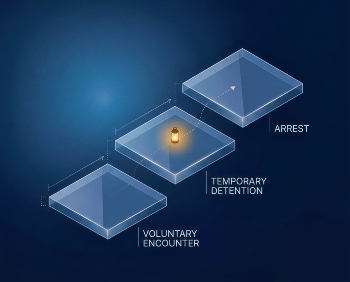
The Three Levels of Police Contact
Courts recognize three basic levels of police contact, each with its own legal standard.
- Voluntary encounter. The officer approaches and talks to you without showing authority or restricting your movement. You may decline to answer and leave.
- Temporary detention. The officer has reasonable suspicion that you are involved in criminal activity and briefly restricts your movement to investigate. This is the classic traffic stop or street stop.
- Arrest. The officer has probable cause to believe you committed an offense, and you are taken into custody. An arrest triggers the full weight of constitutional protections, including Miranda.
A common mistake is assuming that any interaction with an officer is automatically a detention. It is not. Many encounters begin as voluntary and only become detentions when the officer’s words or actions would make a reasonable person feel they could not leave.
How to Tell Whether You Are Free to Leave
The legal test is whether a reasonable person in your position would feel free to leave.
In practice, you can simply ask. A polite “Officer, am I being detained, or am I free to go?” forces the issue onto the record. If the answer is that you are free to go, you can end the encounter.
Courts recognize three levels of police contact, each with its own legal standard and your obligations.
| Level of contact | Legal standard | Your position |
|---|---|---|
| Voluntary encounter | No show of authority, no restriction on movement | May decline to answer and leave |
| Temporary detention | Reasonable suspicion of criminal activity | Movement briefly restricted to investigate |
| Arrest | Probable cause to believe you committed an offense | Taken into custody; Miranda applies |
 What Reasonable Suspicion and Probable Cause Actually Mean
Reasonable suspicion must rest on specific facts the officer can point to, such as a traffic violation, a matching description, or observed behavior. A gut feeling or a person’s presence in a high-crime area, standing alone, generally does not meet the bar.
The deeper context here is constitutional limits on government power, and understanding those limits is what makes the standards useful in a live encounter.
The Right to Remain Silent During Police Questioning
The right to remain silent during police questioning is protected by the Fifth Amendment and applies to any statement that could be used against you; you invoke it by saying so clearly and then stopping. Silence alone is not enough. Courts generally expect a clear, unambiguous statement that you are invoking the right.
You do not have to answer questions about where you are going, what you have been doing, or whether you have been drinking. You do not have to explain yourself.
How to Assert the Right to Remain Silent Out Loud
Say it in plain words. “I am exercising my right to remain silent.” Then stop talking. For a practical walkthrough of how to actually assert constitutional rights out loud, see How to Assert Constitutional Rights: A Practical Guide. Don’t fill the silence with nervous conversation, and don’t argue the point. A common mistake is announcing the right and then continuing to answer questions anyway, which can undercut the invocation.
Miranda Rights, Custodial Interrogation, and the Right to an Attorney
Custodial interrogation means questioning by law enforcement after a person has been taken into custody or otherwise deprived of freedom in a significant way. Once that line is crossed, the warnings must come before questioning.
You can invoke the right to counsel the same way you invoke silence: clearly and directly. “I want to speak with an attorney.” Then stop. Do not explain why, do not negotiate, and do not keep answering questions while you wait.
What to Do When Pulled Over in Texas
Reaching for your documents before the officer arrives can look like reaching for something else. Wait, keep your hands where they can be seen, and tell the officer where your license and registration are before you move to get them.
Documents, Passengers, and the Questions an Officer Will Ask
Have your driver’s license, registration, and proof of insurance ready when asked. Passengers generally have no obligation to produce identification, though the driver must. The officer will likely ask whether you know why you were stopped, where you are headed, and whether you have been drinking.
Watch out: arguing about the reason for the stop at the roadside rarely helps and can turn a citation into a more serious charge. Contest the stop later, in court, with a lawyer.
 Consent to Search: When Police Can Search and How to Refuse
Police may search your vehicle, phone, home, or belongings if they have a warrant, if a recognized exception to the warrant requirement applies, or if you consent; you can refuse consent, and saying “I do not consent to this search” preserves your objection. Consent must be voluntary, and refusing it is not an admission of guilt. The scenarios below are where the abstract rules become useful.
Vehicles
A vehicle stop is the most common search scenario and the one with the most exceptions.
When asked, say: “I do not consent to a search of my vehicle.” Then stay in or near the vehicle, keep your hands visible, and do not physically block the officer. If the officer searches anyway, note what was said and by whom; that record matters later.
Phones
A phone is not a car. Courts have generally required a warrant before officers search a cell phone’s digital contents, even incident to arrest. Do not unlock the phone, do not hand it over voluntarily, and do not consent to a “quick look.” If an officer asks for the passcode, you can decline. Say: “I do not consent to a search of my phone, and I will not provide the passcode.” Some legal questions about compelled biometric unlocks remain unsettled, so the safest course is not to volunteer either the code or your fingerprint.
Homes
The home carries the strongest protection. A warrant is the default, and the exceptions are narrow: consent, exigent circumstances, hot pursuit, and a few others. If officers knock, you are not required to open the door, though you should speak through it and ask whether they have a warrant. If they say they have one, ask them to slide it under the door or hold it up so you can read it.
Personal Belongings
A pat-down for weapons during a lawful stop is permitted if the officer has reasonable suspicion that you are armed. A full search of your pockets, bag, or backpack requires more: consent, arrest, or a warrant. If asked to empty your pockets, you can decline and say: “I do not consent to a search of my belongings.” Do not physically resist if the officer proceeds; the remedy is a motion to suppress later.
What Refusing Consent Does and Does Not Do
Refusing consent does not stop a search that is otherwise lawful. It preserves your objection and forces the government to justify the search under a warrant or a recognized exception. That is why the phrase matters: it shifts the burden onto the officer’s legal theory and creates a record for a suppression motion.
When asked for consent, answer clearly: “I do not consent to a search.” Then stay calm and do not physically interfere. If the officer searches anyway, the remedy is a legal challenge later, not resistance at the scene.
 Texas Identification Rules: When You Must Identify Yourself
Texas identification rules turn on who you are and why the officer is asking: a driver must produce a license on request, a passenger generally need not, a pedestrian not under arrest can usually decline, and a person lawfully arrested or detained on suspicion of a crime can be required to give their name under the state’s failure-to-identify statute. Most guides collapse these into one rule and get people into trouble. The distinctions below are the ones that actually decide encounters.
If You Are Driving
Texas law generally requires a driver to have a driver’s license available and to display it when demanded by a peace officer. Hand over the license, registration, and proof of insurance when asked. Refusing to identify as a driver is itself an offense and gives the officer an independent basis to extend the stop.
If You Are a Passenger
A passenger is not operating the vehicle, so the driver’s license statute does not apply. Texas has no general “stop and identify” law that compels a passenger to produce identification during a routine traffic stop. The passenger can politely decline to answer questions and can ask whether they are free to leave. In practice, officers sometimes ask passengers for ID anyway; a calm “I don’t have identification to provide, and I’m not answering questions” is generally sufficient, though the officer may still order the passenger out of the vehicle under controlling case law for officer safety.
If You Are on Foot and Not Detained
A pedestrian in a voluntary encounter has no obligation to identify themselves. You can ask, “Am I being detained, or am I free to go?” and, if free to go, walk away. Do not physically resist if the officer indicates you are being detained; the remedy for an unlawful detention is a later legal challenge, not a scene at the curb.
If You Are Lawfully Arrested or Detained on Suspicion
Texas has a failure-to-identify rule that can apply when a person has been lawfully arrested or lawfully detained on suspicion of involvement in a crime. In those situations, giving a false name or false information can create a separate legal problem, so check the current statute and consult an attorney before relying on any specific rule.
The key word is lawfully. If the detention itself is unlawful, Section 38.02 does not apply, but that is a question for a court, not for the roadside.
The Practical Script
- Driver: Hand over license, registration, and insurance. Then: “I’m not answering questions beyond my documents.”
- Passenger: “I don’t have identification to provide, and I’m not answering questions. Am I free to leave?”
- Pedestrian, voluntary encounter: “Am I being detained, or am I free to go?”
- Detained or arrested: Give name, address, and date of birth. Then: “I am exercising my right to remain silent, and I want to speak with an attorney.”
Some encounters involve statutes that require identification in specific situations, so check current Texas law for your circumstances.
 Recording Police and Preserving Evidence
You generally have the right to record police officers performing public duties in public spaces, and recording is one of the most effective ways to preserve evidence of what actually happened during an encounter. Keep your hands visible, narrate what you are doing, and do not let the phone become a reason for escalation.
Preservation matters as much as capture. Back up the footage immediately, note the date, time, and location, and write down the officers’ names and badge numbers if you can see them. If there are witnesses, get their contact information. Memory fades, and files get lost, so secure the record the same day.
Police Encounters Involving Minors, Disability, Language Barriers, and Immigration Concerns
Minors, people with disabilities, people with limited English proficiency, and non-citizens face the same core rules but often need additional accommodations, and the way an encounter unfolds can depend heavily on whether those needs are communicated clearly. A parent should teach a child early that they can ask for a parent and can decline to answer questions.
For people with disabilities, the Americans with Disabilities Act and related guidance support reasonable accommodations during interactions with law enforcement, and stating a need clearly can change the encounter. For people with limited English, requesting an interpreter is reasonable.
What Happens During an Arrest and What to Do
During an arrest, an officer takes you into custody based on probable cause, may handcuff and search you incident to the arrest, and must give Miranda warnings before any custodial interrogation; your job is to stay calm, keep your hands visible, and say nothing beyond invoking your rights. Do not resist, even if you believe the arrest is wrong.
Ask for a lawyer. State that you are invoking your right to remain silent. You will be booked, and you may be given the chance to make a phone call. Use it to reach counsel or a trusted contact, not to discuss the facts of the case.
What to Do After Misconduct or an Unlawful Stop
After alleged misconduct or an unlawful stop, document everything, preserve evidence, file a complaint through the department’s process, and consult a civil rights attorney about whether a federal civil rights claim is available. Write down what happened while it is fresh, including names, badge numbers, time, location, and exact words.
A federal civil rights claim under Section 1983 is the primary route for holding government actors accountable for constitutional violations. Readers who believe their stop was unlawful can find constitutional rights defense strategies against government overreach.
Where Texas Journal Fits in Your Rights Education
Rights you cannot articulate in the moment are rights you will not use. That is the gap Texas Journal exists to close. We publish constitutional education built for citizens who want to understand the limits on government power and hold them, not just read about them after the fact.
Our focus on states’ rights and founding principles is deliberate, and we aim to help citizens understand and assert their constitutional rights. If you want to go deeper, the Patriot Pool membership is where our community organizes, and Personal Sovereignty Is Non-Negotiable is the principle that anchors everything we teach.
Dave
Questions? Call!
940-353-1398

Frequently Asked Questions
What are my rights during a police encounter in Texas?
You have the right to remain silent, the right to refuse consent to a search, and the right to an attorney if you are in custody. You must provide your name and, during a traffic stop, your driver’s license, registration, and proof of insurance. You can ask whether you are free to leave, and if they say yes, you can end the encounter. Stay polite, keep your hands visible, and state your objections out loud so they are recorded.
How can I tell whether a police encounter is voluntary or a detention?
In a voluntary encounter, you can leave, and the officer has no legal authority to detain you. A detention begins when a reasonable person would not feel free to leave, usually because the officer blocks your path, orders you to stop, or takes your documents. Ask directly: Am I free to leave? If the officer says yes, you may walk away. If not, you are being detained, and the reasonable suspicion standard applies.
Do I have to answer a police officer’s questions?
No. Outside of identifying yourself when lawfully detained, you are not required to answer questions. You can say, I am exercising my right to remain silent. In Texas, you must give your name if you are lawfully arrested, and during a traffic stop, you must provide your license, registration, and proof of insurance. Beyond those requirements, declining to answer is not a crime and cannot be treated as one.
Can police search my car or belongings without my consent?
Police can search your vehicle without consent only if they have probable cause, a warrant, or a valid exception such as a search incident to arrest or an inventory search. Otherwise, they need your voluntary consent, and you can refuse. Say clearly, I do not consent to this search. Refusing consent is not an admission of guilt. If officers search anyway, do not physically resist; note the details and raise the issue later with an attorney.
What should I do if I am pulled over in Texas?
Pull over safely, turn off the engine, keep your hands on the steering wheel, and wait. Reach for your license, registration, and proof of insurance only after telling the officer where they are. You must provide those documents. You do not have to answer questions about where you are going or whether you have been drinking. You can decline a search request. Signing a citation is not an admission of guilt; it is a promise to appear.
Can I record police officers in public?
Yes. Under the First Amendment, you can record police officers performing public duties in public spaces. Texas law does not prohibit recording on-duty officers in public. Keep a safe distance, do not interfere with the stop, and do not block the officer’s movement. If an officer orders you to stop recording, state that you are recording and ask whether you are being detained. Preserve the original file and back it up before sharing.
The gap between knowing your rights and using them is usually a few well-practiced sentences. Texas Journal gives you the constitutional grounding to close that gap, with clear guidance on asserting your rights, understanding states’ rights, and joining a community that treats the Constitution as a tool rather than a museum piece. Get started with Texas Journal and turn what you know about your rights into something you can actually use.