Understanding 2026 Constitutional Law Changes

Table of Contents

Last Updated: September 18, 2026

Why 2026 Is a Pivotal Year for Constitutional Law

The most consequential constitutional law changes in a generation are converging on a single election cycle. According to the National Conference of State Legislatures, state legislatures have referred a record number of constitutional amendments to the 2026 ballot, while federal courts continue reshaping the boundaries of agency authority. This guide from Texas Journal breaks down what those shifts mean for Constitutional Law Changes.ordinary citizens, not just lawyers.

Here’s the short version: constitutional law changes are the formal and informal shifts in how the founding document is interpreted, amended, or applied. In 2026, those shifts are arriving through three channels at once: ballot measures, the Article V convention process, and judicial rulings that limit federal power.

Most coverage treats these as separate stories. They aren’t. They’re the same story told in three venues, and the outcome determines how much control Washington keeps over your daily life.

Below, we’ll show you exactly how each channel works, what’s on the ballot, and what you can do before the deadlines hit.

2026 Ballot Measures and Proposed Constitutional Amendments

Voters in multiple states will decide constitutional amendments directly this cycle, and the subjects range from tax policy to individual rights. A ballot measure is a proposal placed before voters for approval, and when it amends a state constitution, it becomes binding constitutional text, not just a statute that the next legislature can undo.

The measures drawing the most attention fall into a few categories:

  • Tax and fiscal limits: proposals capping property tax growth and requiring voter approval for major new levies
  • Rights expansions: amendments addressing reproductive freedom and marriage equality in states where statutory protection is considered insufficient
  • Election administration: changes to voter ID requirements, mail-ballot deadlines, and audit procedures
  • Regulatory reform: measures limiting how state agencies can implement federal mandates

How a Measure Actually Reaches the Ballot

There are two routes, and the route determines who controls the wording. In a legislatively referred measure, the legislature passes a resolution and the secretary of state places it on the ballot; the legislature or attorney general drafts the title and caption. In a citizen-initiated measure, sponsors circulate a petition, gather a required number of valid signatures within a set window, and the measure qualifies only after the signatures are verified. Signature thresholds vary widely by state, and many states impose a geographic distribution requirement so that support cannot be concentrated in a single metro area.

That procedural difference matters because it decides who writes the summary voters actually read in the voting booth. A legislature that opposes a citizen initiative often controls the ballot title, and courts in several states have heard challenges arguing that a title was drafted to mislead. The operative text is what becomes law, but the title is what most voters see.

What Makes State Constitutional Amendments Different

What most guides miss is that state constitutional amendments are harder to reverse than ordinary laws. Once ratified, undoing them usually requires another statewide vote. That permanence is exactly why both sides fight so hard over ballot language and title wording, and why the same subject can appear on ballots in multiple states in the same cycle with different drafting.

A second difference is that state constitutions are amended far more often than the federal document. Many state constitutions run to tens of thousands of words and have been amended hundreds of times, which means a single cycle can carry dozens of consequential changes that never make national headlines.

Pro TipRead the full text of any ballot measure, not the summary. The title and caption are written by the legislature or attorney general, and they can frame a measure very differently from what the operative text actually does. If your state mails a voter pamphlet, it usually includes the full text and the fiscal impact statement.

How to Read Ballot Language Like a Lawyer

A practical method works in four steps. First, find the operative text, not the caption. Second, identify the verb: does the measure require, authorize, or prohibit? Third, look for the effective date and any sunset clause, because a measure that expires in a few years is a different proposition than a permanent one. Fourth, read the fiscal impact statement if your state provides one, since it estimates the cost to state and local government.

This is the gap most national coverage leaves open. Local outlets cover their own state’s measures in detail, and academic blogs cover doctrine, but very little synthesizes the cross-state pattern into a single comparative read. That comparative view is what lets a voter see whether a measure in one state mirrors a model being pushed in several others.

The Article V Convention Process: How States Can Bypass Congress

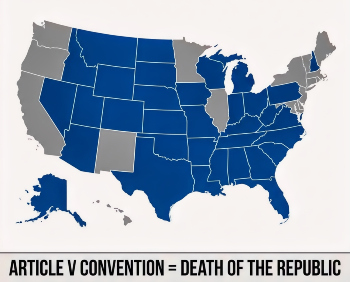
The Article V convention process is the constitutional mechanism that lets states propose amendments without waiting on Congress. Under Article V, two-thirds of state legislatures, currently 34 states, can demand a convention to propose amendments, and any proposals that emerge Constitutional Law Changes.must then be ratified by three-fourths of the states, or 38.

That structure is the single most important fact in this entire debate. It means the states hold a veto-proof path around a gridlocked Congress, but only if they can agree on scope.

Two Paths to an Amendment: Congress vs. the States

There are exactly two ways to amend the Constitution, and they are not equal in practice.

Path Trigger Proposals Come From Ratification Threshold
Congressional route Two-thirds vote in both chambers Congress 38 states
Article V convention 34 state legislatures apply Convention of states 38 states

The congressional route has produced all 27 existing amendments.  The convention route has never been used and should never be.  There was a time when we were a homogeneous nation.  We are no longer.  Think how easy it would be for a large money donor, either foreign or domestic to buy a state delegates vote.  If there were an Article V Convention, for a brief moment billionaires from around the world could buy the country for a few billion dollars.

An Article V Convention has no restrictions.  The entire United States Constitution would be destroyed and a few hundred state legislatures would live out their lives in luxury.

The risk is far too great.

The convention route has never been used, which is precisely why it generates so much argument. Critics are certain an Article V Convention would result in a “runaway convention” that would destroy the Republic.  Would there be any repercussions for the corrupt legislators?  No.  Think Epstein files.

Where the 34-State Threshold Stands in 2026

The count sits close to but below the threshold, and it has for years. Applications have accumulated across a range of subjects, from a balanced budget to term limits. The sticking point isn’t enthusiasm; it’s aggregation. Applications must substantially agree on subject matter to be counted together, and states have filed them on different topics, which creates a genuine legal question about whether they can be tallied as one.

Key TakeawayThe 34-state threshold is the whole ballgame. Until applications converge on a single subject, the convention route stays theoretical, no matter how many states pass resolutions.

Constitutional Limits on Federal Agency Power After Recent Rulings

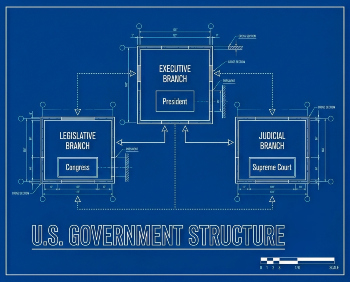
Federal courts have spent the last several terms tightening the constitutional limits on federal agency power, and the effect is now visible in everyday regulation. The core doctrine at issue is the separation of powers: agencies are part of the executive branch, and they cannot exercise Constitutional Law Changes.legislative or judicial authority that the Constitution assigns elsewhere.

Recent decisions have reinforced two principles. First, courts no longer defer automatically to an agency’s interpretation of an ambiguous statute; they interpret the statute themselves. Second, major policy questions with vast economic or political significance must be decided by Congress, not by agency rulemaking.

In practice, this means a federal rule that once survived review because the agency said so can now be struck down because Congress never clearly authorized it. For citizens and small businesses, that’s a meaningful shift in use.

Watch OutDon’t assume a rule is lawful just because it’s published in the Federal Register. Under current doctrine, an agency rule without clear congressional authorization is vulnerable, but you have to raise the challenge within the applicable deadline. Miss the window and you lose the argument permanently.

States’ Rights vs Federal Authority: The 2026 Battleground

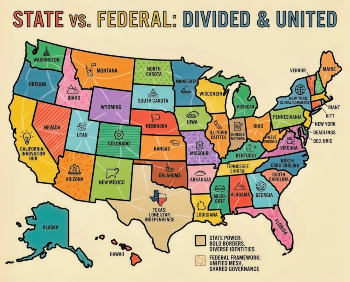
The 2026 fight over states’ rights vs federal authority is playing out in courtrooms and statehouses simultaneously, and it turns on a single question: where does federal power end? The legal framework rests on preemption, the doctrine that federal law overrides conflicting state law, but it applies only where Congress has constitutional authority to act.

Make a Difference Today →

State sovereignty is the principle that states retain all powers not delegated to the federal government. When a state passes a law and Washington objects, the analysis runs in sequence:

  1. Does Congress have enumerated authority over this subject?
  2. If yes, did Congress intend to occupy the field entirely?
  3. If intent is unclear, does state law directly conflict with federal law?
  4. If there is no conflict and no clear intent, state law generally stands.

Courts apply this framework unevenly, which is why outcomes vary by circuit. That inconsistency is itself an argument for clearer statutory Constitutional Law Changes.drafting at both levels.

Key Dates and Deadlines for the 2026 Election Cycle

Deadlines matter more than most voters realize, because a missed registration date means a missed vote on a constitutional question. The dates below reflect the general pattern; verify exact deadlines with your state election office.

  • Voter registration deadlines: typically 15 to 30 days before Election Day, with same-day options in some states
  • Ballot measure certification: measures must be certified well before printing begins, often in late summer
  • Mail-ballot request windows: open weeks ahead and close shortly before the election
  • Early voting: generally begins two to three weeks before Election Day
  • Election Day: the first Tuesday after the first Monday in November
Pro TipIf you’re voting on a constitutional amendment, request your ballot early and read the full text before you mark it. Ballot language is often condensed, and the operative text is what becomes law.

How Citizens Influence Constitutional Law Changes

Ordinary citizens influence constitutional law changes through four concrete levers, and none of them require a law degree. The first is the ballot: state constitutional amendments are decided by voters directly. The second is the legislature: committee hearings and constituent contact shape which measures advance. The third is litigation: rights are enforced when someone challenges an overreach and the courts rule. The fourth is organized pressure: coordinated groups move issues from the margins to the agenda.

Texas Journal exists to support that fourth lever. Its mission centers on constitutional education and states’ rights, guiding citizens on how to use the abilities the Constitution actually provides rather than waiting for permission. For readers who want to go further than reading, the First Amendment protections for petitioning government guarantee the right to assemble, speak, and petition, which is the legal foundation for every organizing effort described here.

A common mistake is treating civic engagement as a one-time act. It’s a cycle: watch the docket, track the ballot, contact your representatives, and repeat.

The Economic and Regulatory Impact of 2026 Constitutional Shifts

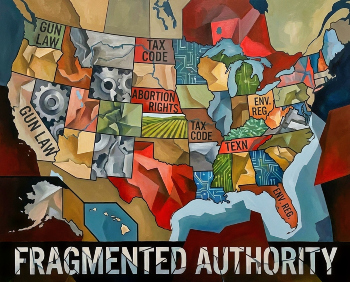
The economic impact of these shifts is real but uneven, and it shows up in how businesses plan. When courts rein in agency authority, regulated industries face less uncertainty about unilateral rule changes, which tends to favor long-term capital investment. When states gain room to set their own rules, businesses operating across state lines face a patchwork of compliance requirements.

Consider a mid-sized manufacturer operating in several states. Under an expansive federal regime, one set of rules governs everywhere. Under a more decentralized framework, that same company may need to track different tax credits, pass-through entity rules, and licensing standards in each state it operates in. The compliance burden rises, but so does states’ ability to compete for that business by simplifying their own rules.

That trade-off, more uniformity versus more competition, is the central economic question of the 2026 cycle. There’s no neutral answer. States that lower their regulatory burden will attract investment; states that raise it will not.

What to Watch Next: 2027 and Beyond

Three things will determine whether 2026’s momentum continues. First, the state application count for an Article V convention: if applications converge on one subject, the 34-state threshold becomes reachable. Second, appellate rulings on agency authority: each decision clarifies how far the limits extend. Third, the 2027 legislative sessions: state lawmakers will respond to whatever voters approve, either implementing or resisting it.

The Historical Pattern Behind a 2026 Cycle

This is the angle most coverage skips. Constitutional change has never been linear. It arrives in bursts, usually after a period of institutional friction, and then consolidates. The current cycle looks like the early phase of one of those bursts.

A useful way to see the pattern is to look at how amendment activity has clustered historically. The first wave followed the founding and produced the Bill of Rights. A second wave followed the Civil War and produced the Reconstruction amendments, which fundamentally redefined citizenship and federal power. A third wave arrived during the Progressive era and expanded the electorate and the income tax. A fourth followed the New Deal and the civil rights movement, reshaping the relationship between the federal government and the states.

The common thread is not ideology. Each burst followed a period when the existing institutional arrangement could no longer absorb the pressure being placed on it. Courts, legislatures, and voters all reached for constitutional tools at roughly the same time because the ordinary statutory process had stopped producing durable answers.

Reading the Current Cycle Against That Pattern

Three signals suggest 2026 sits in the early phase of a burst rather than the middle of a quiet period. The volume of legislatively referred amendments is elevated. The federal courts are actively reworking the boundary between Congress and the agencies. And the Article V application count, while still short of the threshold, has been accumulating rather than receding.

History also suggests that the consolidation phase is slower than the burst. Amendments ratified in a burst often take a decade or more to be fully implemented through litigation and state legislation. That means the practical consequences of 2026 will keep arriving well after the ballots are counted.

Three Concrete Indicators to Track

For readers who want to follow this rather than just read about it, three indicators are worth watching on a recurring basis:

  • The application ledger: track whether new Article V applications use identical or near-identical subject language, because convergence is what makes the count legally meaningful.
  • The appellate docket: watch for circuit splits on agency authority, since a split is the most common path to Supreme Court review.
  • State implementation bills: in the 2027 sessions, look for bills that either operationalize a newly ratified amendment or narrow it through definitions and funding.
Key TakeawayA burst of constitutional activity is not a settled outcome. The amendments and rulings that arrive in 2026 will be interpreted, narrowed, or expanded for years afterward. The window to influence the direction is open now, and it closes on Election Day.

For voters, the practical takeaway is simple: the window to influence this cycle is open now, and it closes on Election Day.

Frequently Asked Questions

What are the proposed constitutional amendments for 2026?

2026 ballot measures vary by state, but recurring themes include reproductive freedom, marriage equality, property tax credits, and limits on federal agency power. Some states are weighing amendments on pass-through entity taxes and voter ID. Because each state sets its own ballot, the exact list depends on where you vote. Check your secretary of state’s official voter guide for the certified text of every measure before Election Day.

How do constitutional changes impact states’ rights?

When a federal court reinterprets a constitutional limit, states often gain or lose room to legislate. The 2026 landscape shows states testing sovereignty through laws on energy, immigration enforcement, and education. If a state law conflicts with federal rules, courts apply preemption doctrine to decide which wins. That is why tracking constitutional law changes matters: a single ruling can shift the legal framework for dozens of state statutes overnight.

How can citizens influence constitutional law changes?

Voters influence constitutional law changes through ballot measures, primary elections, and direct advocacy to state legislators. In states with initiative processes, citizens can sign petitions to place amendments on the ballot. You can also testify at legislative hearings, contact your representative about Article V convention resolutions, and support legal advocacy groups that file amicus briefs. Turnout in off-year elections is low, so a small number of engaged voters often decides the outcome.

What role does the Supreme Court play in interpreting 2026 legal shifts?

The Supreme Court sets the final interpretation of constitutional language, and its 2026 docket includes cases on agency authority, interstate commerce, and civil rights. A ruling can invalidate a state law, revive a dormant one, or redefine what Congress may delegate to federal agencies. Lower federal courts then apply that precedent nationwide. Because justices serve lifetime terms, the composition of the Court shapes constitutional interpretation for decades beyond any single election cycle.

Restoring America: Founding Principles Today

Table of Contents

Last Updated: September 6, 2026

The Blueprint We Stopped Reading

The conversation about restoring America founding principles today usually starts with an argument about politics, but the real problem is memory. Most citizens have never read the documents that define republican self-government, let alone studied the constitutional framework that limits federal power. This guide from Texas Journal provides a practical restoration manual for ordinary Americans who want to understand their rights and act on them.

The founding era produced more than a declaration and a constitution. It produced a coherent philosophy of government built on a specific assumption: that power corrupts and must be checked. The founders did not trust human nature, and they designed institutions accordingly. The National Archives guide to the founding documents preserves these texts for exactly this purpose.

The 5 restoration strategies covered here have helped citizens reassert their sovereignty at the local level. But first, here is what most guides get wrong: they treat the founding principles as abstract ideals rather than operational rules for governance.

Key TakeawayThe founding principles are not museum pieces. They are a working system of limits, checks, and balances that citizens must enforce through civic engagement.

Defining the Founding Principles That Built the Republic

The founding principles are the core political commitments embedded in the Declaration of Independence and the Constitution: inalienable rights, popular sovereignty, limited government, and the rule of law. These four commitments form the foundation of American constitutionalism.

Historical integrity matters here. The founders debated fiercely over the proper scope of federal authority, and the Constitution they produced reflects those compromises. The Federalist Papers remain the best window into their intentions, particularly regarding the separation of powers and the dangers of concentrated authority.

What distinguishes the American experiment is its insistence on written limits. Unlike unwritten constitutions, the U.S. system gives citizens a concrete text to appeal to when government oversteps. That text is your first line of defense.

The Core Doctrine: Life, Liberty, and Property Rights

The Declaration identifies three inalienable rights: life, liberty, and the pursuit of happiness. The Constitution translates “pursuit of happiness” into more specific protections, including property rights and economic freedom. This connection is essential to understanding the founders’ vision of human dignity.

Property rights are not merely about ownership. They are the material foundation of individual responsibility and entrepreneurship. When government respects property, it respects the labor and innovation that produce it. When it does not, every other right becomes vulnerable.

The founders believed that protecting property was inseparable from protecting liberty itself. This is why the Constitution includes specific prohibitions on government taking property without due process, and why the Fifth Amendment guards against uncompensated seizures.

Watch OutTreating property rights as a lesser concern than “civil” rights misunderstands the founders completely. They saw economic freedom as the bulwark of all other freedoms.

Constitutional Limits on Federal Agency Power: A Restoration Guide

The constitutional limits on federal agency power are found primarily in Article I, which grants Congress enumerated powers, and in the Bill of Rights, which reserves the rest to the states and the people. Understanding this structure is the first step toward restoration.

The problem is that federal agencies now exercise legislative, executive, and judicial functions simultaneously, a combination the founders explicitly warned against. When an agency writes its own rules, enforces them, and adjudicates disputes, it violates the separation of powers in practice if not in name.

Restoring constitutional limits requires returning to first principles: Congress must legislate, the President must execute, and the courts must interpret. The Congressional Research Service reports on the separation of powers provides detailed analysis of how these boundaries have eroded over time.

Federal Overreach Examples: Where the Balance Broke

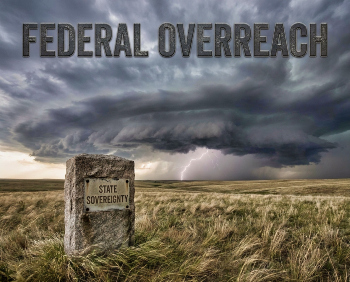
Federal overreach examples are not hard to find once you know what to look for. The pattern is consistent: an agency claims authority Congress never granted, and the courts defer rather than enforce the limits. But naming the specific statutes, cases, and administrative actions makes the problem concrete rather than theoretical.

The Commerce Clause Expansion. The most cited example is the shift in interstate commerce jurisprudence. In 1937, the Supreme Court began deferring to Congress under the Commerce Clause in cases like NLRB v. Jones & Laughlin Steel, upholding the National Labor Relations Act. That deference reached its high-water mark in 1942 with Wickard v. Filburn, where growing wheat for personal use was deemed interstate commerce. The cumulative effect was that nearly any activity could be regulated. The Court did not begin reining this in until United States v. Lopez in 1995 and United States v. Morrison in 2000, but the doctrine remains far broader than the founders’ understanding of “commerce among the several states.”

Administrative Agency Rulemaking. The administrative state exercises powers the founders never anticipated. The Clean Air Act, first passed in 1970 and amended in 1990, delegates to the Environmental Protection Agency the authority to set air quality standards. The EPA then enforces those standards and adjudicates disputes through its own administrative law judges. This combination of legislative, executive, and judicial power in a single agency is precisely what the founders warned against in Federalist No. 47, where James Madison wrote that “the accumulation of all powers, legislative, executive, and judiciary, in the same hands… may justly be pronounced the very definition of tyranny.”

Spending Clause Coercion. The federal government has also used its spending power to pressure states into policy changes it cannot mandate directly. The clearest modern example is the National Minimum Drinking Age Act of 1984, which withheld 10 percent of federal highway funds from states that did not raise their drinking age to 21. The Supreme Court upheld this in South Dakota v. Dole (1987), but the Court later signaled limits in NFIB v. Sebelius (2012), where it held that threatening to withdraw all Medicaid funding was “a gun to the head.” The pattern remains: Washington uses conditional grants to achieve what the Constitution’s enumerated powers do not authorize.

The Pattern of Erosion. The erosion of federalism did not happen overnight. It accelerated during the New Deal, expanded through the Great Society, and continues today through administrative rulemaking. Each step seemed reasonable at the time, but the cumulative effect has been a fundamental shift in the balance of power between Washington and the states. The restoration task is not to relitigate every case but to understand the mechanisms by which power was consolidated so citizens can identify and resist the next incremental expansion.

Make a Difference Today →

Watch OutThe problem is not any single law or agency. It is the structural drift toward centralized authority that the founders designed the Constitution to prevent. Recognizing the pattern is the first step to reversing it.

States’ Rights and the Tenth Amendment as the First Line of Defense

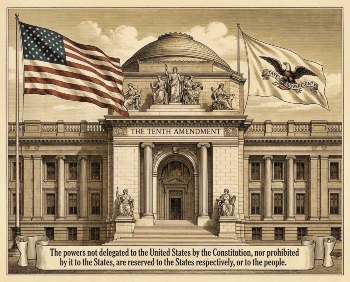
States’ rights and the Tenth Amendment are the constitutional mechanism for resisting federal overreach. The Tenth Amendment states plainly that powers not delegated to the federal government are reserved to the states or the people.

This is not a loophole or a technicality. It is the structural design of the Constitution. The founders understood that federal power would expand if not checked, and they made the states the primary check. State legislatures, governors, and attorneys general all have tools to resist unconstitutional federal action.

State sovereignty is the first line of defense because it is the closest to the people. Local officials are more accountable, more accessible, and more responsive to citizen concerns than distant federal bureaucrats. The Library of Congress resources on federalism and the Tenth Amendment traces this legal foundation through American history.

Pro TipStart with your state legislature. Introduce a resolution affirming state sovereignty under the Tenth Amendment. Even symbolic resolutions build momentum and educate fellow citizens.

From Founding Ideals to Civic Action: Your Role in Restoration

The founding ideals become real only through civic action. Passive agreement changes nothing. Restoration requires citizens who understand the constitutional framework and are willing to act on it at every level of government. What most guides miss is that the most effective levers are not in Washington, they are in your own city hall, county commission, and state legislature.

The Local Governance Gap. Most content on restoring founding principles is abstract or federal-level. But the Tenth Amendment reserves most governing power to the states, and states delegate much of that to local bodies. Your city council decides zoning, property taxes, and police budgets. Your school board sets curriculum and spending priorities. Your county commission administers elections and land use. These are the arenas where the social contract is actually enforced, and where citizen voices carry the most weight.

A Practical Framework for Local Action. Here is a concrete sequence for turning constitutional knowledge into local influence:

  1. Audit your local code. Most city and county codes are available online. Look for ordinances that exceed state law or delegate legislative authority to staff. Flag them for public comment.
  2. Attend budget hearings. Budgets are policy in numbers. When a city council votes on a budget, it is deciding which rights to protect and which to deprioritize. Show up and ask questions about line items that fund federal grant-matching programs.
  3. Use the public comment period. Every city council and school board meeting includes a public comment period. Prepare a three-minute statement that ties a local issue to a constitutional principle. Do this monthly.
  4. Run for a local office. School board, water district, and city council seats are often uncontested. A single citizen with a clear constitutional framework can win a seat with a few hundred votes in many districts.
  5. Petition your state legislature. State legislatures are the primary check on federal overreach under the Tenth Amendment. Introduce or support resolutions affirming state sovereignty, such as the model legislation promoted by the American Legislative Exchange Council.

Cross-Generational Dialogue. Restoration also requires bridging the gap between generations. Older citizens remember a different relationship between the states and the federal government. Younger citizens are learning these principles for the first time, often through polarized social media rather than primary documents. Organize a monthly reading group that pairs a Federalist Paper with a current event. Invite a high school civics teacher, a veteran, and a college student. The founding imagination must be passed down, not rediscovered every generation.

Comparative Document Study. Reading the Articles of Confederation alongside the Constitution reveals why the founders made the choices they did. The Articles created a weak central government that could not raise revenue or enforce treaties. The Constitution corrected those defects but added explicit limits on federal power. State constitutions offer another layer of comparison, many contain protections that go beyond the federal Bill of Rights. Understanding this layered structure helps citizens know which level of government to petition for which issue.

Here is a practical framework for turning knowledge into action:

Restoration Step

Time Required

Frequency

Primary Target

Study founding documents

30 minutes weekly

Ongoing

Personal understanding

Audit local code and ordinances

1 hour monthly

Monthly

City and county governments

Attend local government meetings

2 hours monthly

Monthly

City and county councils

Contact state legislators

15 minutes weekly

Weekly

State sovereignty resolutions

Engage in civic education

1 hour monthly

Monthly

Youth and community groups

Monitor federal agency rules

20 minutes weekly

Weekly

Comment periods and hearings

The republican self-government the founders envisioned depends on an informed and active citizenry. Civic virtue is not inherited. It is practiced, or it is lost.

Key TakeawayRestoration is not a spectator sport. The most effective entry point is not Washington, it is your local school board, city council, and state legislature. Start there, and build outward.

Conclusion: The Republic Is Ours to Restore


The task of restoration is urgent, but it is far from hopeless. The constitutional framework remains intact, waiting for citizens to use it. The founding principles are not obsolete. They are the only proven alternative to the administrative state that now governs so much of American life.

Texas Journal exists to provide the critical insight and discernment needed to assert your rights and defend national values. Through constitutional education and a focus on states’ rights, our resources help citizens understand the unique abilities provided by the U.S. Constitution. The Patriot Pool offers a force multiplier for those ready to organize and act. Control Washington from your state by joining the mission that matters.

Get started with Texas Journal and learn how to turn your constitutional knowledge into effective civic action.

Frequently Asked Questions

What are the five founding principles that anchor American governance?

The five core founding principles are natural rights (life, liberty, and property), republicanism, constitutionalism, the rule of law, and the social contract. These ideas flow directly from the Declaration of Independence and the Constitution. They establish that government derives its authority from the consent of the governed and exists to protect individual rights. When federal agencies or courts ignore these limits, they break the constitutional framework the Founders designed. Restoring them starts with understanding that elected officials serve the people, not the administrative state.

How do constitutional limits on federal agency power protect individual liberty?

Constitutional limits on federal agency power protect liberty by keeping authority divided and bounded. The Constitution grants Congress specific enumerated powers, not a blanket license to regulate every aspect of life. When agencies create rules with the force of law without congressional vote, they bypass the checks and balances that safeguard freedom. Citizens can push back by demanding legislative review of agency rules, supporting the nondelegation doctrine, and using the courts to challenge overreach. Every regulation stopped at the agency level is a liberty preserved for the individual.

What role do states’ rights and the Tenth Amendment play in restoring the founding framework?

The Tenth Amendment reserves all powers not delegated to the federal government for the states or the people. This makes states’ rights a structural check on Washington, not just a political slogan. States can refuse to enforce unconstitutional federal mandates, pass laws under their own police powers, and file lawsuits challenging federal overreach. For citizens, this means state legislatures are often the most effective venue to defend property rights and personal sovereignty. The Founders intended states to act as laboratories of self-government and guardians against centralized power.

What are the most common federal overreach examples ordinary citizens face today?

Common federal overreach examples include executive agencies imposing workplace vaccine mandates, the EPA regulating private land under the Commerce Clause, and the ATF reclassifying firearm components without congressional approval. In each case, the agency acts beyond the statutory authority Congress delegated. Citizens fight back by documenting how the rule exceeds the agency’s charter, testifying at state legislative hearings, and supporting state nullification bills. The first step is recognizing that agency action is not law unless it aligns with the constitutional framework and a specific congressional grant of authority.

Constitutional Interpretation Without Political Bias: A 2026 Guide

Table of Contents

Last Updated: September 14, 2026

Why the Question of Bias in Constitutional Interpretation Matters Now

Constitutional interpretation without political bias is the ongoing effort to read the Constitution according to its text, structure, and history rather than the policy preferences of the judge applying it. Every nomination fight, every blockbuster Supreme Court term, and every state ballot measure touching rights and agency power turns on this question. This guide from Texas Journal breaks down the major interpretive theories, the structural forces that pull judges off course, and a practical framework for spotting bias in any ruling. The stakes are not academic: the way courts read founding documents decides how much power Washington holds over your state, your property, and your rights.

The debate matters because judicial review gives unelected judges the final word on what the Constitution means. When interpretation drifts from the document’s text and structure, the legal system loses predictability, and citizens lose the ability to know their rights in advance. That is why the fight over interpretive theories is really a fight over who governs.

The core disagreement in American constitutional theory is between originalism and living constitutionalism, and it shapes nearly every major ruling. Originalism holds that the Constitution’s meaning was fixed at ratification; living constitutionalism holds that meaning evolves with the times. Both camps claim fidelity to the document, but they define fidelity in opposite ways, and the disagreement is not merely academic, because it determines which evidence a court is even willing to look at.

What Originalism Claims About Founding Documents

Originalism argues that the Constitution’s words carry the public meaning they held when ratified. Under this view, judges who substitute their own normative values for the text are legislating, not adjudicating. The modern originalist family splits into several distinct methods, and the split matters in close cases:

  • Original public meaning looks to how a reasonable person at ratification would have understood the words, using dictionaries, ratification debates, and contemporaneous usage.
  • Original intent looks to what the drafters subjectively meant to accomplish, a method critics say is unworkable because a multi-member convention has no single intent.
  • Textualism looks to the plain meaning of the words as an ordinary reader would understand them, often setting aside legislative history entirely.
  • Structural reasoning reads a clause in light of the architecture of the document, federalism, separation of powers, and the relationship between enumerated and reserved powers.

A well-known illustration is the debate over the Second Amendment. In District of Columbia v. Heller (2008), the Court’s majority relied heavily on original public meaning and historical usage to conclude the amendment protects an individual right (supreme.justia.com). Justice Scalia’s opinion is a template for how originalist method is actually applied: it works through founding-era dictionaries, state constitutions, and pre-ratification commentary before reaching a holding. Justice Stevens’s dissent used much of the same historical record to reach the opposite conclusion, a reminder that originalist materials can be contested even when both sides accept them as relevant.

What Living Constitutionalism Claims About Constitutional Text

Living constitutionalism treats the constitutional text as a framework whose meaning adapts to modern conditions. Its defenders say a document written in the eighteenth century cannot resolve questions its authors never imagined, so judges must apply its broad principles to new facts. The classic statement of this view is the idea of a “living” document whose broad clauses, due process, equal protection, cruel and unusual punishment, draw their content from evolving social standards.

Critics respond that this flexibility is exactly how personal politics enter legal reasoning. If the meaning of a clause changes with the times, then whoever decides what the times require is effectively writing new law. Defenders counter that the alternative, freezing eighteenth-century assumptions into the text, is itself a political choice, and often a regressive one.

The two theories also differ in how they treat precedent. Originalists tend to distinguish between the original meaning of the text and the accumulated gloss of case law, and some argue that wrongly decided precedents should be overruled rather than extended. Living constitutionalists tend to treat precedent as a source of meaning in its own right, because a doctrine that has been relied on for generations becomes part of the constitutional fabric.

Theory Basis of Meaning Primary Evidence Strength Weakness
Original public meaning Fixed meaning at ratification Dictionaries, ratification debates, contemporaneous usage Predictability, restraint Hard cases with new technology
Original intent Framers’ subjective purpose Convention records, private letters Historical grounding Whose intent counts?
Textualism Plain meaning of words Statutory text, ordinary usage Objective analysis Ambiguity in sparse text
Structural reasoning Architecture of the document Federalism, separation of powers Coherence across clauses Indeterminate in hard cases
Living Constitution Evolving standards Social change, precedent, moral philosophy Adaptability Invites judicial discretion
Pragmatism Practical consequences Workability, institutional effects Real-world outcomes Weak anchor to text

Where the Theories Actually Collide

The disagreement is sharpest in cases the founding generation could not have anticipated. Electronic surveillance, data privacy, and the scope of congressional power over a national economy are all areas where the text supplies a principle but not a rule. In those cases, the choice of method often determines the outcome before the facts are even argued.

A useful discipline is to ask which method the court actually used, not which method it claimed. An opinion that announces a textualist approach but then relies on policy consequences to resolve the hard question has told you something important about how the result was really reached. That gap between stated method and applied method is one of the most reliable signals of bias in constitutional interpretation.

Pro TipWhen you read a constitutional opinion, underline every sentence that cites the text, structure, or history, and every sentence that cites consequences, fairness, or social change. The ratio tells you more about the court’s method than the introduction does.

Textualism, Intentionalism, and the Limits of Judicial Discretion

Textualism and intentionalism are related but distinct tools for constraining judicial discretion. Textualism asks what the words of a statute or constitutional clause mean to an ordinary reader; intentionalism asks what the drafters meant to accomplish. The two overlap often, but they diverge in close cases, and that gap is where interpretation gets contested.

Judicial discretion is unavoidable at the margins. A common mistake is assuming that any theory eliminates it. What a disciplined method does is shrink the space where a judge’s politics can operate. Textualism constrains by anchoring to language; intentionalism constrains by anchoring to historical record. When courts abandon both, statutory construction becomes a vehicle for policy, and legal doctrine loses its moorings.

The practical test is simple: can the judge explain the ruling using the text and structure alone? If the answer requires importing outside values, discretion has taken over.

Constitutional Limits on Federal Agency Power: Where Interpretation Meets Reality

Few areas expose the stakes of constitutional interpretation like the constitutional limits on federal agency power. When agencies write rules that carry the force of law, courts must decide whether Congress actually delegated that authority and whether the structure of the Constitution permits it. This is where interpretive theories stop being abstract and start deciding what the government can do to you.

The nondelegation doctrine, the major questions doctrine, and limits rooted in Article I and the Tenth Amendment all bear on how much power agencies may wield (supreme.justia.com). A court that reads those limits broadly restrains the administrative state; a court that reads them narrowly lets agencies fill the gap. Interpretation, in other words, is the lever that moves the whole machine.

How Judicial Review Shapes Agency Authority

Judicial review is the mechanism courts use to strike down agency action that exceeds constitutional or statutory authority (5 U.S. Code § 706 – Scope of review | U.S. Code | US Law). When a court applies a text-and-structure method, agency rules face a harder test; when it defers to the agency’s own reading, federal power expands by default. The difference is not rhetorical. It determines whether a rule issued in Washington can override the choices your state and its legislature have made.

The Inevitability of Judicial Values in Constitutional Theory

Some scholars argue that judicial values are inevitable, that no interpretive method fully removes a judge’s moral reasoning from the bench. That claim deserves a fair hearing, because it is the strongest argument against the possibility of fully neutral interpretation. Judges are human, and hard cases often require judgment about purpose and consequence.

The intellectual roots of this position run back to the Enlightenment. Enlightenment political philosophy, Locke on natural rights, Montesquieu on separated powers, and the Scottish moralists on the role of sentiment in judgment, supplied the founding generation with the vocabulary of rights and limited government. But it also supplied a tension that never resolved: if rights are grounded in reason and nature, who is authorized to say what reason and nature require? That question is the seed of every modern debate about judicial values.

The Moral Reasoning Problem in Jurisprudence

Moral reasoning enters constitutional law in at least three distinct ways, and conflating them makes the debate incoherent:

Make a Difference Today →

  1. Interpretive moral reasoning, deciding what a broad clause like “due process” or “cruel and unusual punishment” requires, given that the text states a principle rather than a rule.
  2. Construction moral reasoning, resolving a case the text does not directly address, where a court must build a rule rather than find one.
  3. Remedial moral reasoning, deciding what remedy follows from a rights violation, which often requires weighing institutional consequences.

A judge who insists that moral reasoning plays no role at all is usually describing the first category only. The honest position is that values cannot be eliminated, only disciplined. A judge who admits the pull of personal preference and then anchors the ruling in text, structure, and history is doing the job. A judge who treats the Constitution as a mirror for their own politics has abandoned it. The question is never whether values exist; it is whether the legal reasoning constrains them.

How to Tell Disciplined Judgment from Raw Politics

The line between the two is not always obvious, but it leaves fingerprints. A few patterns recur:

  • Selective deference. A court that defers to the political branches when it likes the outcome and intervenes when it does not is applying a double standard, regardless of the doctrine it cites.
  • Result-driven distinctions. When a precedent is distinguished only in cases where the result requires it, the reasoning is doing less work than the outcome.
  • Asymmetric scrutiny. If the same legal test produces rigorous review for one set of litigants and deferential review for another, the test is not being applied neutrally.
  • Scope creep. A ruling that resolves more than the case requires often signals that the court is reaching for a policy outcome rather than a legal one.
  • Unstated premises. When the decisive move in an opinion appears in a footnote or a single sentence, the court may be avoiding the scrutiny that a full argument would invite.

None of these patterns proves bad faith. Each is a reason to read the reasoning more carefully, and together they form the practical core of evaluating whether a ruling reflects law or preference.

Watch OutThe most dangerous mistake in this debate is treating “values are inevitable” as proof that all interpretation is politics. That conclusion hands the Constitution to whoever holds the gavel and destroys the predictability the rule of law depends on. The inevitability of values is an argument for discipline, not an argument for surrender.

If values cannot be removed, the goal shifts from purity to constraint. Predictability and legal stability come from methods that narrow the range of defensible outcomes, clear text, settled precedent, and structural reasoning that can be checked by anyone reading the same sources. A system that admits values are present but insists they be disciplined produces more stable law than one that pretends they are absent and then applies them without acknowledgment.

That is the practical case for interpretive restraint, and it does not require anyone to believe that judges are or can be perfectly neutral. It requires only that the reasoning be transparent enough that citizens can see the method, predict the result, and hold the court accountable when the method and the outcome diverge.

Structural Bias, Political Bias, and the Myth of the Neutral Judge

The myth of the perfectly neutral judge obscures two different problems: structural bias built into institutions, and political bias carried by individuals. Structural bias lives in the design of courts, the selection process, and the incentives that reward certain outcomes. Political bias lives in the person. Conflating them makes reform impossible, because the fixes are different.

Structural bias shows up in how cases reach the docket, how precedent locks in past errors, and how agency deference tilts the field toward the federal government. Political bias shows up when a ruling’s reasoning does not match its result. A judge can be personally impartial yet still operate inside a structure that skews outcomes. Naming both is the first step toward a legal system that earns public trust.

A Practical Framework for Identifying Bias in Judicial Outcomes

Bias in a ruling is detectable if you know what to look for, and a structured set of questions beats a gut reaction. Most commentary either defends or attacks a decision without examining the reasoning. A framework forces you to separate the outcome you dislike from the method the court actually used.

Five Questions to Ask About Any Ruling

  1. Does the opinion anchor its holding in the constitutional text, or does it lean on policy preferences?
  2. Does the court follow precedent consistently, or does it distinguish cases only when the result requires it?
  3. Would the same reasoning produce the opposite outcome if the parties were swapped?
  4. Does the ruling expand federal agency authority beyond what Congress plainly authorized?
  5. Is the decision’s scope narrow and grounded, or does it reach issues the case did not require?

Use this checklist on any opinion, state or federal. If a ruling fails three or more of these tests, the reasoning, not just the result, deserves scrutiny.

Pro TipRead the dissent first. A well-argued dissent often exposes the majority’s weakest structural move faster than any commentary, because it has to engage the same text and precedent on the court’s own terms.

Artificial intelligence is now part of legal research, and it cuts both ways for objectivity. AI tools can scan thousands of pages of founding documents, historical records, and precedent in seconds, surfacing original meanings and patterns a human researcher might miss. That capacity supports more disciplined textual and historical analysis.


The risk is subtler. An AI model trained on a skewed corpus will reproduce that skew, and a judge or clerk who trusts the output without checking it imports hidden bias into the legal reasoning. Technology does not manufacture objectivity; it amplifies whatever method feeds it. The courts that use AI well will treat it as a research assistant, not an oracle, and verify every citation against the primary source.

What Other Democracies Teach About Constitutional Interpretation Without Political Bias

Other democracies offer useful comparisons, though no system has solved the problem of judicial values. Some countries route constitutional questions to specialized courts with limited jurisdiction; others build in legislative override mechanisms that let elected bodies respond to judicial rulings. Each design trades one risk for another.

The lesson for American constitutional law is not to copy a foreign model wholesale. It is that institutional design shapes how much room judges have to impose personal politics. Systems with narrower jurisdiction and clearer textual anchors tend to produce more predictable outcomes. That is a structural insight, and it applies to debates over court reform and states’ rights here at home.

Key TakeawayNo democracy has eliminated judicial values. The systems that come closest constrain them through narrow jurisdiction, clear text, and mechanisms that keep courts accountable to the document and to the people.

Legal predictability and democratic legitimacy both depend on courts that interpret the Constitution rather than rewrite it. When interpretation follows text, structure, and history, citizens can know their rights in advance and states can defend their authority against federal overreach. When it does not, the legal system becomes a political game played with other people’s freedoms.

Texas Journal exists to help citizens understand the abilities the Constitution gives them and to push back against the usurpation of those freedoms from Washington.

Frequently Asked Questions

What are the primary methods of constitutional interpretation?

The main methods include originalism (focusing on original intent or public meaning at ratification), textualism (relying on the plain meaning of constitutional text), intentionalism (seeking the framers’ specific intentions), and living constitutionalism (treating the Constitution as evolving with societal norms). Structural analysis examines how branches interact, while pragmatism weighs practical consequences. Each method carries assumptions about judicial discretion and the role of normative values, so no single approach eliminates political bias entirely.

What is the difference between originalism and living constitutionalism?

Originalism holds that constitutional interpretation should be anchored to the meaning of the text at the time it was ratified, limiting judicial discretion. Living constitutionalism argues that the Constitution’s meaning adapts to changing circumstances, allowing judges to consider contemporary values. The originalism vs living constitution debate often centers on democratic legitimacy and legal predictability. Originalists fear judicial activism; living constitutionalists fear rigid adherence to outdated norms. Both approaches can be influenced by political bias, but they offer different guardrails.

Can constitutional interpretation ever be truly free of political bias?

Complete neutrality is likely impossible because judges are human and bring normative values to the bench. However, constitutional interpretation without political bias can be approximated through transparent legal reasoning, adherence to precedent, and methods like textualism that constrain discretion. Structural biases, such as docket selection and political appointment, still influence outcomes. The goal is not purity but a system of checks that makes bias visible and contestable, preserving legal predictability and democratic legitimacy.

How do constitutional limits on federal agency power relate to judicial bias?

When courts review agency actions, they must decide whether an agency exceeded its statutory authority or violated constitutional limits on federal agency power. This involves interpretive choices: does the statute clearly authorize the action? Does the major questions doctrine apply? Judges’ philosophies on judicial restraint or deference to agencies can shape outcomes. A judge who favors expansive federal power may uphold agency rules, while one who prioritizes states’ rights may strike them down. Recognizing these patterns helps citizens spot political bias in adjudication.

Current Federalism Policies Review: 2026 Balance of Power

Table of Contents

Last Updated: September 9, 2026

The balance of power between Washington and the states has shifted more dramatically in the last five years than in any comparable period since the New Deal. This review of current federalism policies examines how the Supreme Court, Congress, and the executive branch have redrawn the lines of authority, and what that means for your state. Texas Journal provides critical insight and discernment designed to help citizens assert their rights and restore the country to its founding principles. The outcome of these constitutional battles determines whether your rights are protected by your state legislature or preempted by federal agencies.

The central tension running through every policy dispute today is straightforward: federalism policies are no longer abstract legal theory. They are the battleground where questions of vaccine mandates, environmental regulation, and even data privacy are decided. Understanding who holds the power to regulate your daily life is the first step to asserting your sovereignty.


How Federalism Shifted in the Last Five Years

The most significant shift in recent federalism policies is the judiciary’s willingness to restrain federal agency power. The Supreme Court has systematically dismantled the deference that executive agencies once enjoyed, returning interpretive authority to the courts and, by extension, to the states.

A common mistake is to view this shift as purely partisan. In practice, the Court’s federalism revival has drawn support across ideological lines when the question is structural rather than political. The practical effect has been to slow the flow of new federal regulations and to give state attorneys general more use in challenging rules they view as overreach.

This judicial shift did not happen in isolation. It responded to a decade of aggressive executive action that left states feeling sidelined. The political science literature on intergovernmental relations and administrative presidency documents how the modern executive branch consolidated power in ways that the Founders did not anticipate.

The 2026 Policy Landscape: Key Areas of Tension

Federalism policies in 2026 are defined by several high-stakes conflicts. The most visible battlegrounds involve environmental governance, where states have pushed back against federal emissions standards, and social policy, where state autonomy clashes with national uniformity.

The pattern across these disputes is consistent: states are experimenting with policies that diverge from federal preferences, and the courts are increasingly willing to let those experiments stand. This represents a revival of the “laboratories of democracy” ideal, though it has produced a fragmented regulatory framework that businesses must navigate carefully.

For citizens, the stakes are concrete. Whether your state can enforce its own data privacy rules, set its own energy standards, or regulate firearms differently from its neighbors depends on the outcome of these federalism battles. The Congressional Research Service reports on federalism and preemption provide a useful map of where these jurisdictional disputes currently stand.

Constitutional Limits on Federal Agency Power: Where the Lines Are Drawn

The constitutional limits on federal agency power have become the defining legal question of this era. The Constitution grants Congress enumerated powers, and the 10th Amendment reserves everything else to the states. But the administrative state grew by stretching the commerce clause and the necessary and proper clause beyond their original meanings.

The current Court has responded by reviving structural limits on federal authority. This is not a return to pre-1937 jurisprudence, but it does represent a meaningful check on legislative authority delegated to unelected bureaucrats. The doctrine of nondelegation, long dormant, has re-entered the legal conversation.

The Major Questions Doctrine and Its Effect on Agency Action

The major questions doctrine requires Congress to speak clearly when it intends to delegate authority over issues of vast economic and political significance. This doctrine has become the primary judicial tool for limiting federal agency power in recent years.

For state governments, the doctrine is a shield. When federal agencies attempt to impose sweeping rules without clear congressional authorization, states can challenge them in court with a strong chance of success. This has already reshaped policy implementation in areas ranging from pandemic response to student loan forgiveness.

State Sovereignty vs Federal Authority: Recent Court Decisions

Recent Supreme Court decisions have consistently favored state sovereignty vs federal authority in cases involving the administrative state. The Court has struck down or limited federal actions on the grounds that they exceeded statutory authority, without necessarily reaching the harder constitutional questions.

State sovereignty vs federal authority is not a binary choice in practice. The reality of intergovernmental relations involves constant negotiation, with states implementing federal programs while asserting their own policy preferences where permitted. The doctrine of preemption, however, remains a powerful federal tool that can override state choices.

The practical result is a legal environment where outcomes depend heavily on the specific statutory text at issue. This is why constitutional interpretation matters: the same federal statute can be read narrowly or broadly, and the courts’ choice determines whether states retain autonomy.

10th Amendment Rights in Practice: From Mandates to Block Grants

The 10th Amendment rights in practice are most visible in the fiscal relationship between Washington and the states. Congress cannot commandeer state legislatures to implement federal programs, but it can attach conditions to federal funding. This is where the battle over unfunded mandates and block grants plays out.

Make a Difference Today →

The Supreme Court has held that Congress may not use the spending power to coerce states into adopting federal policies, but the line between encouragement and coercion remains contested. States have won important victories challenging conditions that amount to a gun to the head, but many federal mandates remain in place.

Watch OutThe most common mistake citizens make is assuming their state is powerless against federal funding conditions. In fact, states have successfully rejected federal money to maintain policy autonomy, and the courts have backed them when the coercion is clear.

10th Amendment rights in practice also extend to the refusal to enforce federal immigration law and the legalization of substances still prohibited federally. These areas demonstrate that state autonomy is not merely defensive but can be a positive assertion of different policy priorities.

The Impact on Your State: Fiscal Policy and Unfunded Mandates

The fiscal impact of federalism policies on your state is substantial, but the scale is often misunderstood. When Congress imposes requirements without providing funding, states must either raise revenue or cut other programs. These unfunded mandates shift costs to state taxpayers while federal policymakers claim credit for the policy.

The most cited example remains the Real ID Act of 2005, which the National Governors Association estimated would cost states over $11 billion to implement over a decade, costs that fell directly on state DMV budgets. More recently, the 2021 American Rescue Plan’s Medicaid continuous enrollment requirement forced states to keep individuals enrolled in exchange for enhanced matching funds, creating a fiscal trap: states that complied bore administrative costs, while states that terminated enrollment early (as 14 states did by mid-2023) faced clawbacks of enhanced funding. The Congressional Budget Office has documented that federal mandates imposed between 2010 and 2020 shifted an estimated $28 billion in cumulative costs to state and local governments, with education and environmental compliance representing the largest categories.

Block grants offer an alternative model, but the trade-offs are sharper than the theory suggests. Instead of dictating how funds must be spent, the federal government provides a fixed sum and allows states to set priorities. The Temporary Assistance for Needy Families (TANF) program, created in 1996, replaced the open-ended Aid to Families with Dependent Children entitlement with a fixed $16.5 billion annual block grant. That amount has not been adjusted for inflation in nearly three decades, meaning its real value has declined by roughly 40 percent. States gained flexibility but lost a reliable safety-net funding stream, a trade-off that plays out differently in every statehouse.

The tension between these models reflects a deeper disagreement about the proper role of the federal government. Those who favor national uniformity prefer mandates; those who value state autonomy prefer block grants and revenue sharing. The Government Accountability Office reports on federal grants and state fiscal effects document how these choices play out across states, but the pattern is consistent: states that accept federal dollars with conditions often discover that the conditions outlive the political moment that produced them.

Watch OutA common mistake is assuming that rejecting federal funds is always a viable option. In practice, states that refuse funds for programs like Medicaid expansion or highway infrastructure must find alternative revenue sources or forgo services entirely. The Supreme Court’s 2012 ruling in NFIB v. Sebelius made Medicaid expansion optional, but the 90/10 federal match rate created an economic incentive that 40 states ultimately accepted, a reminder that fiscal federalism is as much about incentives as it is about coercion.

For state legislators, the practical question is not whether to accept federal money but how to structure state budgets to survive federal funding volatility. States that built rainy-day funds during the 2021-2022 surplus years are better positioned to absorb federal funding cliffs, while states that expanded recurring obligations against one-time federal dollars now face structural deficits. The National Association of State Budget Officers fiscal survey tracks these dynamics annually, and the 2025 edition shows that federal funds still account for roughly 36 percent of total state spending, a figure that has remained stubbornly high despite decades of rhetoric about devolution.

Where Federalism Goes From Here

The next frontier of federalism is not fiscal or environmental, it is digital. As the federal government has failed to pass comprehensive privacy legislation, states have enacted their own regimes, creating a patchwork that mirrors the early days of environmental regulation. The administrative state’s retreat has created a vacuum that states are filling with unprecedented speed.

The numbers tell the story. California’s Consumer Privacy Act (CCPA), effective 2020, was followed by Virginia’s Consumer Data Protection Act (2023), Colorado’s Privacy Act (2023), and Connecticut’s Data Privacy Act (2023). By early 2026, 19 states had enacted comprehensive data privacy laws, covering roughly 45 percent of the U.S. population. None of these laws are identical. California grants consumers a private right of action; Virginia and Colorado do not. California defines “sale” of data broadly; Texas and Florida have carved out exceptions for specific industries. A company operating nationally must now comply with 19 different definitions of “sensitive data,” 19 different consent standards, and 19 different enforcement mechanisms.

The AI regulatory landscape is even more fragmented. Colorado’s 2024 AI Act imposes obligations on developers and deployers of high-risk AI systems, while California’s 2025 AI transparency law requires disclosure when AI generates certain content. Texas created its own AI advisory council in 2023, and at least 12 other states have introduced AI bills that remain in committee. Meanwhile, the federal government has issued executive orders and agency guidance, but no comprehensive statute. The result is that a startup building an AI product must navigate a maze of state-level obligations that did not exist three years ago.



Key TakeawayThe trajectory is clear: states are reclaiming authority in domains where Congress has failed to act, and the courts are largely letting them. For businesses, this means compliance is no longer a federal question, it is a state-by-state question. For citizens, it means your data privacy rights depend on your ZIP code.

This digital federalism creates a new set of legal questions that the Supreme Court has only begun to address. The dormant commerce clause, long used to strike down state laws that burden interstate commerce, could become the battleground. When California requires national companies to comply with its privacy standards, does that impose an undue burden on commerce in states with weaker protections? The Court has not squarely answered this question, and the lower courts are split. In 2025, the Ninth Circuit upheld California’s right to enforce its privacy law against a national data broker, while the Fifth Circuit signaled skepticism about Texas’s approach to regulating out-of-state AI developers.

For citizens seeking to understand and assert their rights, the practical implication is that state-level engagement matters more than ever. Whether the issue is data privacy, AI regulation, or the next technological frontier, the levers of power are increasingly located in your state government, and the federal government shows no sign of reclaiming that ground. The question for the next decade is not whether decentralization continues, but whether states can build the administrative capacity to regulate complex digital markets effectively, or whether the patchwork becomes so burdensome that Congress is finally forced to act.

Frequently Asked Questions

What is a current issue of federalism?

A central issue is the expanding scope of federal agency power versus state legislative authority. Recent Supreme Court rulings, such as those invoking the Major Questions Doctrine, have started to curb this expansion. This creates uncertainty about the regulatory framework for environmental governance and social policy. States are testing their 10th Amendment rights by passing laws that directly conflict with federal mandates, leading to jurisdictional disputes that often require judicial review to resolve.

How has the balance of power between states and the federal government shifted recently?

The balance has shifted toward state autonomy in several key areas. The Supreme Court has used the Major Questions Doctrine to limit executive power, requiring Congress to provide clear legislative authority for major regulations. This has strengthened the position of subnational governments in policy implementation. However, the federal government still holds significant power through preemption and the spending clause, often using block grants and financial incentives to influence state policy, creating ongoing tension over democratic accountability.

What role does the Supreme Court play in defining modern federalism?

The Supreme Court acts as the primary arbiter of constitutional law regarding federalism. Through judicial review, it defines the boundaries of the commerce clause, the 10th Amendment, and the doctrine of state sovereignty. Recent decisions have rolled back the administrative presidency’s reach, reinforcing the need for explicit congressional approval for major agency actions. This has a direct impact on intergovernmental relations, as states gain more room to legislate without the threat of immediate federal preemption.

What is the difference between cooperative and coercive federalism?

Cooperative federalism involves shared responsibility and collaboration between the national and state governments, often using grants-in-aid to achieve common goals. Coercive federalism, in contrast, relies on direct orders or preemption to force states to comply with national standards. Current federalism policies show a trend away from coercive models, with states challenging unfunded mandates and fighting for more control over policy areas like environmental governance and public health, citing constitutional limits on federal agency power.