Table of Contents
- Why Founding Principles Still Shape Modern American Life
- The Seven Principles of the Constitution and What They Mean
- From the Declaration to the Constitution: How Founding Ideals Developed
- Liberty, Equality, and Dignity: The Core Ideals Explained
- The Rule of Law and Consent of the Governed
- Constitutional Rights in Everyday Life: What They Look Like in Practice
- Protecting Individual Liberties From Government Overreach
- States’ Rights and Federalism: Where Power Actually Belongs
- Tensions and Trade-Offs Among Founding Principles
- The Gap Between Founding Ideals and Historical Practice
- How to Evaluate Claims About Founding Principles
- Civic Duty, Civic Virtue, and Self-Government in 2026
- Conclusion: Carrying Founding Principles Into the Future
- Frequently Asked Questions
Last Updated: October 16, 2026
 Why Founding Principles Still Shape Modern American Life
The founding principles of the American republic are not dusty relics confined to a museum case. They are the operating system of self-government, and they still govern how power is claimed, limited, and contested in modern American life. This guide from Texas Journal examines the core ideals in the Declaration of Independence and the U.S. Constitution, how they developed across different historical periods, where they conflict, and how citizens can invoke them today.
Most civics coverage treats these ideas as a list to memorize. That misses the point.
The principles were never a settled creed. People fought over them in taverns, statehouses, and courtrooms, and they remain arguments today. Understanding them is not nostalgia. It is practical preparation for anyone who wants to assert rights, check government power, and participate meaningfully in civic life.
Below, we break down the Constitution’s seven principles, trace how founding ideals developed from 1776 through ratification and beyond, and show what constitutional rights look like in everyday life s back.
The Seven Principles of the Constitution and What They Mean
The Constitution’s seven principles are popular sovereignty, limited government, separation of powers, checks and balances, federalism, republicanism, and individual rights. Together they form the structural logic of constitutional government: power originates with the people, is divided, is limited, and is answerable to law.
These are not abstract slogans. Each principle answers a specific question about who holds power and how it can be restrained.
| Principle | Core Question It Answers | Where It Appears |
|---|---|---|
| Popular sovereignty | Who ultimately holds power? | Preamble (“We the People”) |
| Limited government | What may government not do? | Bill of Rights |
| Separation of powers | Who exercises which power? | Articles I, II, III |
| Checks and balances | How is each branch restrained? | Veto, impeachment, judicial review |
| Federalism | Which level governs what? | Tenth Amendment |
| Republicanism | How do citizens rule? | Elected representation |
| Individual rights | What is protected from majority will? | First through Tenth Amendments |
Popular Sovereignty, Limited Government, and Separation of Powers
Popular sovereignty means the people are the source of all government authority, not a monarch, a party, or an administrative agency. The Constitution opens with “We the People,” and the National Archives transcription makes that claim the document’s first words.
Limited government is the corollary. If power comes from the people, it comes in a defined amount. The federal government holds only the powers granted to it, which is why the Bill of Rights reads as a list of prohibitions rather than permissions.
Separation of powers divides authority among legislative, executive, and judicial branches so no single institution can accumulate control.
Checks and Balances, Federalism, Republicanism, and Individual Rights
Checks and balances let each branch check the others: the president can veto legislation, Congress can override a veto and impeach, and courts can strike down unconstitutional acts. Federalism reserves unenumerated powers to the states and the people under the Tenth Amendment, the constitutional foundation of states’ rights and today’s federalism debates; it means citizens govern through representatives rather than direct decree, which places a premium on civic virtue and informed voting. Individual rights, finally, protect persons even against majority preference.
 From the Declaration to the Constitution: How Founding Ideals Developed
Founding ideals did not arrive fully formed in 1787. They developed across distinct periods, and each period changed what the principles meant in practice.
1776, Declaration of Independence. The Declaration asserts that governments derive “their just powers from the consent of the governed” and that people hold unalienable rights to “Life, Liberty and the pursuit of Happiness.” It lists grievances against a king, not a framework for government. The National Archives transcription of the Declaration of Independence preserves the text.
1787, Constitution. The Philadelphia Convention replaced the Articles with a framework built on enumerated powers, three branches, and a ratification process requiring nine of thirteen state conventions rather than unanimous state legislatures.
1787-1788, Ratification and the Federalist-Antifederalist debate. The Constitution was not ratified by acclamation. Antifederalists argued it lacked a bill of rights and concentrated too much power in a distant capital.
1791, Bill of Rights. The first ten amendments were ratified and answered the Anti-Federalist demand for explicit limits. The First Amendment protects speech, press, assembly, religion, and petition. The Fourth Amendment limits searches and seizures.
1865-1870, Reconstruction Amendments. The Civil War forced the text to change. The Thirteenth Amendment (1865) abolished slavery. The Library of Congress collection on the Reconstruction amendments documents the drafting and ratification record.
1920, Nineteenth Amendment. Women gained a constitutional guarantee of the vote, extending the logic of consent of the governed to roughly half the adult population.
Later amendments and interpretation. The Seventeenth Amendment (1913) provided for direct election of senators. The Twenty-Sixth (1971) lowered the voting age to eighteen. Judicial interpretation, from Marbury v. Madison (1803) establishing judicial review, to *Brown v.
That sequence matters for three reasons. Third, it gives you a test for any claim about founding principles: ask which period the claim is actually describing, and whether it accounts for what came after.
 Liberty, Equality, and Dignity: The Core Ideals Explained
Liberty is the principle that individuals hold rights that government may not arbitrarily remove. Equality is the principle that persons stand equal before the law. Dignity is the principle that each person possesses inherent worth that law should recognize.
These three ideals are the load-bearing walls of the American experiment, and they are also where the deepest conflicts arise. Liberty can clash with equality when one person’s freedom burdens another. Dignity can clash with liberty when the law tries to protect someone from private conduct.
The Declaration of Independence frames liberty and equality as self-evident truths. The Fourteenth Amendment later wrote equal protection into enforceable constitutional text. Neither document resolves every conflict. They establish the terms of the argument.
The Rule of Law and Consent of the Governed
The rule of law means government officials are bound by the same law as everyone else, and they exercise power through known, published rules rather than personal whim. Consent of the governed means legitimate authority flows from the people’s agreement, expressed through elections and constitutional ratification. Together they are the reason procedural safeguards matter so much, and the reason a vague sense of grievance is not the same thing as a legal claim.
What the rule of law actually requires
Four working requirements show up repeatedly in American constitutional practice:
- Publicity. Rules must be published before they bind. Federal agencies publish proposed and final rules in the Federal Register under the Administrative Procedure Act (1946), and the public gets notice-and-comment periods before most rules take effect.
- Generality. Law applies to categories of conduct, not to named individuals. A bill of attainder, a legislative act punishing a specific person without trial, is barred by Article I, Sections 9 and 10.
- Non-retroactivity. Ex post facto laws, which criminalize conduct after the fact, are barred by the same provisions.
- Impartial adjudication. Disputes go to courts and juries, not to the officials who brought the charge. The Sixth Amendment guarantees a speedy and public trial by an impartial jury in criminal cases; the Seventh Amendment preserves jury trial in many civil cases.
Due process, warrants, jury trials, and public hearings are not bureaucratic obstacles. They are the machinery that keeps law from becoming command.
What consent of the governed actually requires
Consent is expressed through specific mechanisms, not a general mood:
- Elections. Regular, scheduled elections for the House (every two years), the Senate (every six years), and the presidency (every four years) under Article I and Article II, with the Fifteenth, Nineteenth, Twenty-Fourth, and Twenty-Sixth Amendments barring denial of the vote on account of race, sex, failure to pay a poll tax, or age for citizens eighteen and older.
- Ratification. The Constitution itself took effect only after state conventions ratified it, and amendments require three-fourths of the states under Article V.
- Petition and assembly. The First Amendment protects the right to petition the government for redress of grievances and to assemble peacefully.
- Public comment. Federal rulemaking, many state and local ordinances, and most zoning and land-use decisions include a formal public comment stage where residents can put objections on the record.
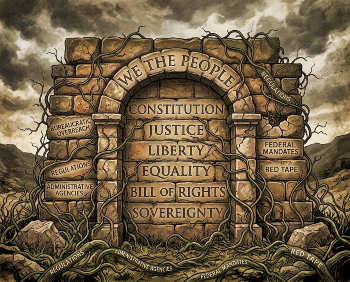 Where both principles erode
Erosion rarely arrives as a dramatic decree. It usually shows up in smaller moves:
- An agency asserting authority that no statute actually grants, then treating its own interpretation as binding.
- Guidance documents, letters, and FAQs treated as if they carried the force of law when they were never adopted through notice-and-comment.
- Enforcement actions brought selectively against disfavored speakers or groups.
- Emergency or temporary orders renewed repeatedly without the ordinary legislative process.
- Local ordinances written so vaguely that officials decide, case by case, who is in compliance.
A practical test for any claim
When someone, an official, a commentator, or a candidate, invokes the rule of law or consent of the governed, four questions separate constitutional argument from political rhetoric:
- What is the source of authority? Ask for the statute, regulation, or constitutional provision by number. “The agency decided” is not a source.
- Was the rule made through the required process? Statutes go through bicameralism and presentment; rules go through notice-and-comment; constitutional amendments go through Article V.
- Is it applied generally? A rule enforced against one speaker but not another fails the generality requirement.
- What is the remedy? If the action is unlawful, there should be a forum, an administrative appeal, a state or federal court, an election, where it can be challenged.
If a claim cannot answer those four questions, treat it as opinion rather than law. That distinction matters, because it tells you whether you are dealing with an enforceable limit or a preference dressed up as one.
The Bill of Rights as published by the National Archives is the first place to look for the limits themselves, because it states them in plain terms. Knowing the text turns a vague sense of grievance into a specific, arguable claim.
Constitutional Rights in Everyday Life: What They Look Like in Practice
Constitutional rights show up in everyday life: speaking at a local school board meeting, publishing an opinion, refusing an unlawful search, assembling peacefully, or challenging a permit denial. The First Amendment protects speech, press, assembly, religion, and petition. The Fourth Amendment limits searches and seizures. The Fifth and Fourteenth Amendments guarantee due process.
A common mistake is assuming rights only matter in dramatic confrontations. In practice, most rights are exercised quietly, in public comment periods, records requests, and local hearings where a handful of residents show up.
 Protecting Individual Liberties From Government Overreach
Protecting individual liberties from government overreach starts with knowing the specific limit that applies. Overreach rarely announces itself. It usually arrives as a routine form, a vague ordinance, or an agency interpretation that quietly expands authority beyond what a statute grants.
Three practical checks help:
- Ask what legal authority the official is citing. Request the statute, rule, or ordinance by number.
- Ask whether the action is consistent with the text and original public meaning of the relevant provision.
- Ask what remedy exists if the action is unlawful, and pursue it in writing.
The Bill of Rights as published by the National Archives is the first place to look, because it states limits in plain terms. Knowing the text turns a vague sense of grievance into a specific, arguable claim.
States’ Rights and Federalism: Where Power Actually Belongs
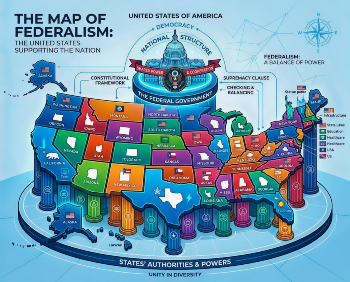
States’ rights and federalism describe the constitutional division of authority between the federal government and the states. The Tenth Amendment reserves to the states or the people powers not delegated to the federal government, making federalism a structural limit rather than a courtesy.
This is where the most consequential modern battles occur. When Washington claims authority it was never granted, the states are the first line of resistance, and citizens acting through state governments have real use. Texas Journal focuses on this layer deliberately, because state-level action is often faster and more durable than waiting on federal reform.
Tensions and Trade-Offs Among Founding Principles
Founding principles genuinely conflict, and pretending otherwise produces shallow analysis. Liberty and equality pull in different directions on questions of regulation and private conduct. Majority rule and individual rights collide whenever a popular measure burdens a minority. Federalism and national uniformity compete on issues from elections to environmental rules.
The framers knew this. Separation of powers and checks and balances exist precisely because they expected conflict and designed a system to slow it down rather than resolve it once and for all.
A useful habit is to name the trade-off explicitly. Saying “this policy favors equality at some cost to liberty” is more honest, and more useful, than pretending the principles always align.
 The Gap Between Founding Ideals and Historical Practice
The gap between founding ideals and historical practice is not a footnote. It is central to understanding the documents. A nation that declared all men created equal permitted slavery for decades, denied women the vote until the early twentieth century, and enforced racial segregation well into living memory.
The principles did not fail because of hypocrisy. People invoked them to close the gap, and the amendments that abolished slavery, guaranteed equal protection, and extended the vote are the record of that work. The Library of Congress collection on the Reconstruction amendments documents how the text itself changed under pressure from citizens who insisted the ideals apply to them too.
That is the practical lesson. Unenforced ideals remain aspirations.
How to Evaluate Claims About Founding Principles
Claims about founding principles are everywhere, and many are selective. A reliable way to evaluate them is to test four things:
- Does the claim cite the actual text of the founding documents, or a paraphrase?
- Does it account for amendments and later interpretation, or stop at 1787?
- Does it apply the principle consistently, or only when convenient?
- Does it distinguish constitutional limits from policy preferences?
If a claim fails two or more of these tests, treat it as political argument rather than constitutional analysis. That distinction matters, because it tells you whether you are dealing with law or opinion.
Civic Duty, Civic Virtue, and Self-Government in 2026
Civic duty and civic virtue are what make self-government work when no court is watching. A republic depends on citizens who show up, read the actual documents, serve on juries, run for local office, and hold representatives accountable between elections.
Self-government is not a spectator sport, and it is not a single vote every few years. It is the accumulated pressure of informed citizens acting locally and consistently.
This is where Texas Journal operates. We provide constitutional education and practical guidance on asserting rights, with a focus on states’ rights and restoring founding principles against the pressure of centralized control. Our services, including Protect Our Traditions and Control Washington From Your State, are built for citizens who want to turn understanding into action rather than complaint.
Conclusion: Carrying Founding Principles Into the Future
The hardest part of preserving founding principles is not learning them. It is applying them when the pressure to look away is strongest, and when the institutions that should check power decline to do so. That work falls to citizens who know the text, understand the trade-offs, and act at the state level where use is real.
Texas Journal exists for exactly that purpose. Our platform offers constitutional education, guidance on asserting the rights the Constitution provides, and a force multiplier through the Patriot Pool that connects individual action to a larger movement. If you are ready to defend founding principles instead of merely admiring them, Click Here to join.

Frequently Asked Questions
What are the founding principles of the United States of America?
The founding principles are the core political ideals expressed in the Declaration of Independence and the U.S. Constitution. They include liberty, equality, individual rights, the rule of law, limited government, popular sovereignty, and self-government. These principles are not just historical artifacts. They continue to guide debates over government power, states’ rights and federalism, and constitutional rights in everyday life. Understanding them helps citizens evaluate policy and defend freedoms.
What are the seven principles of the Constitution?
The seven principles commonly taught are popular sovereignty, limited government, separation of powers, checks and balances, federalism, republicanism, and individual rights. Popular sovereignty means government derives its power from the people. Limited government restricts what officials can do. Separation of powers divides authority among three branches. Checks and balances let each branch restrain the others. Federalism shares power between state and national governments. Republicanism means elected representatives govern. The Bill of Rights protects individual rights.
How do founding principles apply to modern American life?
Founding principles apply every time you speak at a local meeting, petition your state legislature, or challenge a government action that oversteps its authority. For example, the First Amendment protects your right to protest or publish opinions. The Second Amendment protects firearm ownership. Federalism means your state government has powers the federal government does not. Knowing these principles helps you assert constitutional rights in everyday situations, from school board meetings to interactions with federal agencies.
How does the Constitution protect individual liberty?
The Constitution protects individual liberty through structural limits and explicit guarantees. The separation of powers and checks and balances prevent any one branch from dominating. The Bill of Rights lists specific freedoms, such as speech, religion, assembly, and due process. The Ninth and Tenth Amendments reserve unenumerated rights to the people and powers to the states. Courts enforce these limits, but citizens also help by demanding that officials respect constitutional boundaries.
What is the difference between the Declaration of Independence and the Constitution?
The Declaration of Independence, adopted in 1776, states the founding ideals: that all people are created equal and have unalienable rights to life, liberty, and the pursuit of happiness. It explains why the colonies separated from Britain. Ratified in 1788, the Constitution creates the framework of government. It establishes the three branches, divides power between federal and state governments, and includes the Bill of Rights. The Declaration provides the moral vision; the Constitution provides the legal structure.
How can citizens defend their constitutional rights in everyday situations?
Start by knowing your rights. Read the First, Second, Fourth, Fifth, and Tenth Amendments. If a government official asks to search your home, you can politely decline unless they have a warrant. If you are arrested, you have the right to remain silent and to an attorney. At local meetings, you can speak during public comment periods. You can also contact your state representatives to oppose federal overreach. Document interactions and, when necessary, seek legal counsel from organizations that defend constitutional rights.
 memory. Most citizens have never read the documents that define republican self-government, let alone studied the
 Constitutional Limits on Federal Agency Power: A Restoration Guide
 States’ Rights and the Tenth Amendment as the First Line of Defense
 Conclusion: The Republic Is Ours to Restore