Last Updated: November 8, 2026
Quick Summary
Local school boards matter for national values because they decide curriculum, budgets, and policy at the most accessible level of government, where national debates land on a local desk and elected neighbors decide what happens next. Board members set policy, approve budgets, hire superintendents, and adopt curriculum within state and federal limits.
- School board members are the elected officials closest to your front door, and you can speak to them face to face.
- Most districts give public comment speakers two to three minutes, so make one clear request.
- A board vote cannot fix a proposal that conflicts with state statute or federal funding conditions.
- School board races often draw low turnout, so a small, motivated group can decide the outcome.
- Compare the adopted budget to the prior year and watch per-pupil spending, new administrative positions, and consultant contracts.
Table of Contents
- The Local School Board: Where National Values Meet the Classroom
- Why the School Board Is the Most Accessible Seat of Power
- How Local School Boards Govern Public Education
- School Board Elections and Civic Participation
- How School Board Curriculum Decisions Carry National Debates
- How to Speak at a School Board Meeting
- School Board Budget Transparency: Following the Money
- A School Board Meeting Public Comment Template That Works
- Handling Disagreement Without Surrendering Your Principles
- Join the Movement to Reclaim Local Control
- Frequently Asked Questions
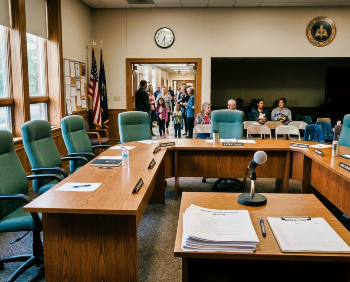 The Local School Board: Where National Values Meet the Classroom
The school board is where national values stop being abstract and start shaping what your kids learn. That’s why local school boards matter for national values: they decide curriculum, budgets, and policy at the most accessible level of government. This guide from Texas Journal shows you how that power works, and how to use it.
Board members themselves often worry about divisive, partisan politics shaping their work. That tension is the story. National debates land on a local desk, and a handful of elected neighbors decide what happens next.
Below, we’ll show you exactly how to speak at a meeting, follow the money, and organize with people who share your principles.
Why the School Board Is the Most Accessible Seat of Power
School board members are the elected officials closest to your front door. You can walk into their meeting tonight, sign a card, and speak to them face to face. No appointment. No gatekeeper.
Compare that to Washington. You can’t call a senator and change a curriculum. You can do that at a school board meeting.
Local governance is where citizen governance actually functions. Board members live in your district. They shop at your grocery store. They answer to neighbors, not party bosses.
The catch? Most people never show up. That’s how small, organized groups end up steering public education for everyone else.
 How Local School Boards Govern Public Education
Local school boards govern public schools by setting policy, approving budgets, hiring superintendents, and overseeing education policy for their school districts. Boards translate state requirements and federal requirements into local policies that fit local realities. But the more useful question for a citizen is not what boards do in the abstract; it is which decisions actually belong to your board, which belong to the state, and which belong to Washington. Most coverage skips that boundary. It is the difference between showing up to a meeting with a real ask and showing up with a demand the board has no power to grant.
Where Local Authority Ends and State Authority Begins
State constitutions and statutes create school districts and delegate power to them. That means board authority is not uniform. A few patterns are common across the country:
- Superintendent employment: Most boards hire and evaluate the superintendent, but some districts share that authority with a city council or mayor, and a handful of large urban districts have moved to mayoral control.
- Curriculum adoption: Many boards formally adopt instructional materials, but the adoption must fall within state academic standards and state-approved lists. In adoption states, the state board approves a list, and local boards choose from it; in other states, local discretion is broader but still bounded by state standards.
- Budget and tax rate: Boards typically propose and adopt a budget, but the taxing authority and any tax-rate ceiling are set by state law, and voters may have to approve bonds or overrides at the ballot.
- School calendars and discipline: Usually local, but state law sets minimum instructional days, graduation requirements, and in some cases discipline rules.
- Federal requirements: Federal law and federal funding conditions, special education under the Individuals with Disabilities Education Act, civil rights obligations under Title VI and Title IX, and reporting under the Every Student Succeeds Act, bind districts regardless of what a local board prefers.
A useful rule of thumb: if a proposal conflicts with a state statute or a federal funding condition, a board vote cannot fix it. The remedy is the state legislature, the state board of education, or Congress, not the local meeting room.
What This Means for a Citizen Walking Into a Meeting
Before you speak, find your district’s board policy manual, usually posted on the district website under a section labeled something like “Board Policy” or “Governance.” Look for policy codes covering curriculum adoption, public comment, and budget adoption. Those codes tell you what the board has committed to and what it has delegated to the superintendent.
Watch out: A common mistake is demanding that a board remove a book, change a graduation requirement, or reject a federal grant when state law or federal funding conditions control the outcome. The board may sympathize and still be legally unable to act. Framing your ask around what the board can actually do- request a policy review, direct the superintendent to publish a report, or place an item on a future agenda- gets you further than a demand the board must decline.
 Board Authority and Responsibilities
A school board’s core duties break down into four buckets:
- Fiscal oversight: approving the budget and tax rate within state limits
- Policy decisions: setting rules on discipline, attendance, and safety
- Curriculum adoption: approving materials within state frameworks
- Personnel: hiring the superintendent and setting district direction
Accountability runs through all four. Each of these decisions is a policy decision with a price tag and a value judgment attached, and each sits somewhere above the local board. Knowing where that boundary falls is what turns civic energy into results.
Board authority is not uniform, but these patterns are common across the country.
| Decision area | What the local board typically does | Where the limit sits |
|---|---|---|
| Superintendent employment | Hires and evaluates the superintendent | Some districts share authority with a city council or mayor |
| Curriculum adoption | Formally adopts instructional materials | Must fall within state academic standards and state-approved lists |
| Budget and tax rate | Proposes and adopts a budget | Taxing authority and tax-rate ceiling are set by state law |
| School calendars and discipline | Usually a local decision | State law sets minimum instructional days and graduation requirements |
| Federal requirements | Binds districts regardless of local board preference | Federal law and federal funding conditions |
School Board Elections and Civic Participation
School board elections are where civic participation pays off fastest. These races often draw low turnout, which means a small, motivated group can decide the outcome.
Since 2021, board races have been dominated by issues like book bans and critical race theory, according to NPR’s reporting on America’s school boards. National debates now show up on local ballots.
That cuts both ways. It raises the stakes and the noise level.
School board candidates who knock on doors and show up to meetings win these seats. Civic engagement at this level is cheap and high-use. One informed neighbor can swing a race.
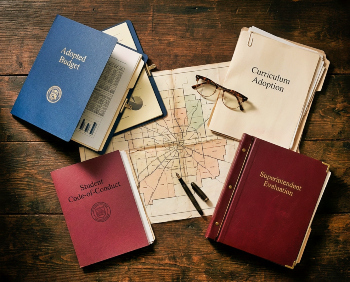 How School Board Curriculum Decisions Carry National Debates
Curriculum decisions are where national values hit the classroom. A board vote on reading lists or history standards is a vote on viewpoint expression and whose story gets told.
Outside groups increasingly seek to influence school boards, and that influence can shape local decisions. Outside money and outside messaging flow into local races.
That’s why local control matters. It keeps curriculum decisions close to the parents and taxpayers who live with the results. If you want to counter outside influence on your district’s curriculum, see how to stop globalist influence locally.
How to Speak at a School Board Meeting
Speaking at a school board meeting takes three steps: find the agenda, sign up for public comment before the deadline, and deliver a short, specific statement within your time limit. Most districts give speakers two to three minutes.
Show up early. Sign the card. Sit near the front.
Then follow this sequence:
- State your name and district
- Name the exact agenda item or policy
- Make one clear request
- Give one reason tied to students or taxpayers
- Thank the board and stop talking
Watch out: speakers who use their two minutes on a general speech often lose the board’s attention. Boards respond best to a specific ask tied to a specific vote.
Public meetings are public record. Your words go into the minutes, and board members notice who keeps showing up.
 School Board Budget Transparency: Following the Money
School board budget transparency starts with one document: the adopted budget. Districts must publish it, and public accountability depends on citizens actually reading it.
Ask for the budget on the district website or at the central office. Then compare it to the prior year.
Watch these line items:
- Per-pupil spending versus enrollment trends
- New administrative positions
- Consultant contracts
- Bond and debt service payments
A budget is a values document. Where the money goes shows what the board actually prioritizes, regardless of what anyone says at the podium.
For a step-by-step walkthrough, use this guide to verify school board budget transparency.
A School Board Meeting Public Comment Template That Works
A strong public comment is short, specific, and respectful. Use this template to fill in and adapt:
“My name is [name], and I live in [district]. I’m here about [agenda item]. I ask the board to [specific request]. My reason is simple: [one sentence tied to students, taxpayers, or policy]. Thank you for your service.”
Keep it under two minutes. Practice it out loud once.
A few rules that make it land:
- Address the board as “you,” not “you people”
- Cite the policy number if you have it
- Bring one page of documentation, not a binder
- Stay to hear other speakers
This template works because it respects the process while making a firm ask. Constituents who use it get taken seriously.
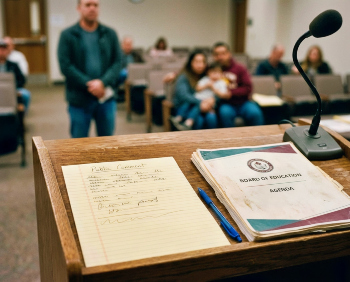 Handling Disagreement Without Surrendering Your Principles
Political polarization is real, and partisan conflict at board meetings can turn ugly fast. You don’t have to match that energy to win. But “stay calm” is not a strategy. What actually works is a repeatable process for disagreement, one that lets you hold your position firmly while keeping the room and the record on your side.
A Four-Step Framework for Contentious Items
1. Separate the value from the mechanism. Most board fights are really two arguments stacked on top of each other: a values claim (what should our schools teach, and to whom?) and a mechanism claim (which policy, budget line, or contract actually delivers it?). Name both. “I care about X, and I think the current policy fails at X for this specific reason” is harder to dismiss than a values statement alone, because it invites a factual response rather than a tribal one.
2. Ask a question the board has to answer on the record. Questions that require a specific, factual answer, “What is the projected cost of this item?”, “Which state standard does this material align with?”, “How many public comments were submitted, and how were they summarized for the board?” force the discussion onto verifiable ground. They also go into the minutes, which matters for the next election.
3. Build a one-issue coalition. You do not need to agree with another parent on everything to agree on one agenda item. A common pattern in districts with contentious boards is that durable majorities form around narrow, concrete issues, a budget line, a transparency rule, a public-comment policy, rather than around broad ideological labels. Coalitions built on one issue survive; coalitions built on a vibe do not.
4. Escalate in order. If a board declines to act, the next steps are usually a written request for a future agenda item, a public-records request for the underlying documents, a state board of education complaint where state law allows, or a ballot challenge in the next election. Skipping straight to the loudest option burns credibility you will need later.
De-Escalation Language That Keeps the Record Clean
When a meeting turns hostile, the person who stays specific wins the room. A few phrases that work:
- “I disagree with the policy, and I want to understand the reasoning behind it.”
- “Can we agree on the facts before we debate the conclusion?”
- “I’m not asking the board to decide tonight. I’m asking for this item on the next agenda.”
- “I’d like my comment reflected in the minutes as written.”
Respectful disagreement is a strength, not a weakness. It also models student civic learning for the kids watching, and students notice which adults keep their composure.
Measuring Whether Engagement Is Working
Constructive engagement is not the same as passive engagement. Track a few simple indicators: whether your comments appear accurately in the minutes, whether items you raised show up on future agendas, whether the board publishes the documents you requested, and whether turnout at meetings is rising or falling. If none of those move after several months, change tactics, not principles.
A qualitative case study of rural school boards examined how locally controlled boards practice community-centered governance. The lesson holds: local boards function best when citizens engage constructively, not just loudly, and constructive engagement is a skill you can practice, measure, and improve.
 Join the Movement to Reclaim Local Control
Local control is not a slogan. It’s a seat at a table in a room down the street, and it’s yours if you take it.
The work is simple and repeatable:
- Attend meetings consistently
- Track the budget
- Speak with a clear ask
- Support school board candidates who share your principles
If you’re ready to act locally, learn the benefits of joining local America First groups. Want to build your own? Use this playbook for organizing local liberty meetings. And if you want broader ways to get involved, here are six ways to support the republic.
At Texas Journal, we built a platform for citizens who want to assert their rights and defend founding principles. Our Patriot Pool is a force multiplier for the movement. We teach you how to use the abilities the Constitution gives you, and we focus on states’ rights as the path to restoring self-government.
You won’t win the fight for local governance on the couch. You win it by showing up, asking hard questions, and holding elected officials to account. Texas Journal gives you the insight and the community to do exactly that, with constitutional education, a states’ rights focus, and a movement that rewards citizens who stand up for the Republic. Get started with Texas Journal and turn your concern into local action.
Dave
Questions? Call!
940-353-1398

Frequently Asked Questions
Why are local school boards important?
Local school boards hold the purse strings and the policy pen for K-12 education in their district. They set budgets, approve curriculum, hire superintendents, and decide how public meetings run. That makes them the most accessible elected body in the country: a parent can speak directly to a board member in a way that is impossible with Congress.
How can parents speak at a school board meeting?
Find the meeting agenda and public comment policy on your district’s website, then sign up in advance if required. Most districts give each speaker two to three minutes. Prepare a written statement, state your name and address, cite the specific agenda item, and close with a clear request. Bring printed copies for the board. Arrive early, sign the sheet, and stay to hear other comments so you understand the room before you speak again at the next meeting.
How can I find my local school board’s budget?
Start with the district website’s business or finance section, where adopted budgets and monthly financial reports are typically posted. If the documents are not there, file a written public records request under your state’s open records law. Attend the budget adoption meeting and ask for line-item detail on curriculum spending, vendor contracts, and federal grant use. Board budget transparency depends on citizens requesting documents in writing and following up when the response is incomplete.
How do school board curriculum decisions affect public education?
Boards approve the curriculum materials and frameworks that teachers use, within state standards. That means a board vote can determine which reading lists, history texts, and health materials reach a classroom. Parents who want a say should read the board packet before the vote, because boards usually decide curriculum adoptions in a single meeting with little public debate.