Table of Contents
- The Blueprint We Stopped Reading
- Defining the Founding Principles That Built the Republic
- The Core Doctrine: Life, Liberty, and Property Rights
- Constitutional Limits on Federal Agency Power: A Restoration Guide
- Federal Overreach Examples: Where the Balance Broke
- States’ Rights and the Tenth Amendment as the First Line of Defense
- From Founding Ideals to Civic Action: Your Role in Restoration
- Conclusion: The Republic Is Ours to Restore
- Frequently Asked Questions
Last Updated: September 6, 2026
The Blueprint We Stopped Reading
The conversation about restoring America founding principles today usually starts with an argument about politics, but the real problem is  memory. Most citizens have never read the documents that define republican self-government, let alone studied the constitutional framework that limits federal power. This guide from Texas Journal provides a practical restoration manual for ordinary Americans who want to understand their rights and act on them.
The founding era produced more than a declaration and a constitution. It produced a coherent philosophy of government built on a specific assumption: that power corrupts and must be checked. The founders did not trust human nature, and they designed institutions accordingly. The National Archives guide to the founding documents preserves these texts for exactly this purpose.
The 5 restoration strategies covered here have helped citizens reassert their sovereignty at the local level. But first, here is what most guides get wrong: they treat the founding principles as abstract ideals rather than operational rules for governance.
Defining the Founding Principles That Built the Republic
The founding principles are the core political commitments embedded in the Declaration of Independence and the Constitution: inalienable rights, popular sovereignty, limited government, and the rule of law. These four commitments form the foundation of American constitutionalism.
Historical integrity matters here. The founders debated fiercely over the proper scope of federal authority, and the Constitution they produced reflects those compromises. The Federalist Papers remain the best window into their intentions, particularly regarding the separation of powers and the dangers of concentrated authority.
What distinguishes the American experiment is its insistence on written limits. Unlike unwritten constitutions, the U.S. system gives citizens a concrete text to appeal to when government oversteps. That text is your first line of defense.
The Core Doctrine: Life, Liberty, and Property Rights
The Declaration identifies three inalienable rights: life, liberty, and the pursuit of happiness. The Constitution translates “pursuit of happiness” into more specific protections, including property rights and economic freedom. This connection is essential to understanding the founders’ vision of human dignity.
Property rights are not merely about ownership. They are the material foundation of individual responsibility and entrepreneurship. When government respects property, it respects the labor and innovation that produce it. When it does not, every other right becomes vulnerable.
The founders believed that protecting property was inseparable from protecting liberty itself. This is why the Constitution includes specific prohibitions on government taking property without due process, and why the Fifth Amendment guards against uncompensated seizures.
 Constitutional Limits on Federal Agency Power: A Restoration Guide
The constitutional limits on federal agency power are found primarily in Article I, which grants Congress enumerated powers, and in the Bill of Rights, which reserves the rest to the states and the people. Understanding this structure is the first step toward restoration.
The problem is that federal agencies now exercise legislative, executive, and judicial functions simultaneously, a combination the founders explicitly warned against. When an agency writes its own rules, enforces them, and adjudicates disputes, it violates the separation of powers in practice if not in name.
Restoring constitutional limits requires returning to first principles: Congress must legislate, the President must execute, and the courts must interpret. The Congressional Research Service report on the separation of powers provides detailed analysis of how these boundaries have eroded over time.
Federal Overreach Examples: Where the Balance Broke
Federal overreach examples are not hard to find once you know what to look for. The pattern is consistent: an agency claims authority Congress never granted, and the courts defer rather than enforce the limits. But naming the specific statutes, cases, and administrative actions makes the problem concrete rather than theoretical.
The Commerce Clause Expansion. The most cited example is the shift in interstate commerce jurisprudence. In 1937, the Supreme Court began deferring to Congress under the Commerce Clause in cases like NLRB v. Jones & Laughlin Steel, upholding the National Labor Relations Act. That deference reached its high-water mark in 1942 with Wickard v. Filburn, where growing wheat for personal use was deemed interstate commerce. The cumulative effect was that nearly any activity could be regulated. The Court did not begin reining this in until United States v. Lopez in 1995 and United States v. Morrison in 2000. Still, the doctrine remains far broader than the founders’ understanding of “commerce among the several states.”
Administrative Agency Rulemaking. The administrative state exercises powers the founders never anticipated. The Clean Air Act, first passed in 1970 and amended in 1990, delegates to the Environmental Protection Agency the authority to set air quality standards. The EPA then enforces those standards and adjudicates disputes through its own administrative law judges. This combination of legislative, executive, and judicial power in a single agency is precisely what the founders warned against in Federalist No. 47, where James Madison wrote that “the accumulation of all powers, legislative, executive, and judiciary, in the same hands… may justly be pronounced the very definition of tyranny.”
Spending Clause Coercion. The federal government has also used its spending power to pressure states into policy changes it cannot mandate directly. The clearest modern example is the National Minimum Drinking Age Act of 1984, which withheld 10 percent of federal highway funds from states that did not raise their drinking age to 21. The Supreme Court upheld this in South Dakota v. Dole (1987), but the Court later signaled limits in NFIB v. Sebelius (2012), where it held that threatening to withdraw all Medicaid funding was “a gun to the head.” The pattern remains: Washington uses conditional grants to achieve what the Constitution’s enumerated powers do not authorize.
The Pattern of Erosion. Federalism did not erode overnight. It accelerated during the New Deal, expanded through the Great Society, and continues today through administrative rulemaking. Each step seemed reasonable at the time, but the cumulative effect has been a fundamental shift in the balance of power between Washington and the states. The restoration task is not to relitigate every case but to understand the mechanisms by which power was consolidated so citizens can identify and resist the next incremental expansion.
 States’ Rights and the Tenth Amendment as the First Line of Defense
States’ rights and the Tenth Amendment are the constitutional mechanism for resisting federal overreach. The Tenth Amendment states plainly that powers not delegated to the federal government are reserved to the states or the people.
This is not a loophole or a technicality. It is the Constitution’s structural design. The founders understood that federal power would expand without checks, so they made the states the primary check. State legislatures, governors, and attorneys general all have tools to resist unconstitutional federal action.
State sovereignty is the first line of defense because it is the closest to the people. Local officials are more accountable, more accessible, and more responsive to citizen concerns than distant federal bureaucrats. The Library of Congress resources on federalism and the Tenth Amendment trace this legal foundation through American history.
From Founding Ideals to Civic Action: Your Role in Restoration
The founding ideals become real only through civic action. Passive agreement changes nothing. Restoration requires citizens who understand the constitutional framework and are willing to act on it at every level of government. Most guides miss that the most effective levers aren’t in Washington; they are at your city hall, county commission, and state legislature.
The Local Governance Gap. Most content on restoring founding principles is abstract or federal-level. But the Tenth Amendment reserves most governing power to the states, and states delegate much of that to local bodies. Your city council decides zoning, property taxes, and police budgets. Your school board sets curriculum and spending priorities. Your county commission administers elections and land use. These are the arenas where the social contract is actually enforced, and where citizen voices carry the most weight.
A Practical Framework for Local Action. Here is a concrete sequence for turning constitutional knowledge into local influence:
- Audit your local code. Most city and county codes are available online. Look for ordinances that exceed state law or delegate legislative authority to staff. Flag them for public comment.
- Attend budget hearings. Budgets are policy in numbers. When a city council votes on a budget, it is deciding which rights to protect and which to deprioritize. Show up and ask questions about line items that fund federal grant-matching programs.
- Use the public comment period. Every city council and school board meeting includes a public comment period. Prepare a three-minute statement that ties a local issue to a constitutional principle. Do this monthly.
- Run for a local office. School board, water district, and city council seats are often uncontested. A single citizen with a clear constitutional framework can win a seat with a few hundred votes in many districts.
- Petition your state legislature. State legislatures are the primary check on federal overreach under the Tenth Amendment. Introduce or support resolutions affirming state sovereignty, such as the model legislation promoted by the American Legislative Exchange Council.
Cross-Generational Dialogue. Restoration also requires bridging generational gaps. Older citizens remember a different relationship between the states and the federal government. Younger citizens are learning these principles for the first time, often through polarized social media rather than primary documents. Organize a monthly reading group that pairs a Federalist Paper with a current event. Invite a high school civics teacher, a veteran, and a college student. The founding imagination must be passed down, not rediscovered every generation.
Comparative Document Study. Reading the Articles of Confederation alongside the Constitution reveals why the founders made the choices they did. The Articles created a weak central government that could not raise revenue or enforce treaties. The Constitution corrected those defects but added explicit limits on federal power. State constitutions offer another layer of comparison; many contain protections that go beyond the federal Bill of Rights. Understanding this layered structure helps citizens know which level of government to petition for which issue.
Here is a practical framework for turning knowledge into action:
| Restoration Step | Time Required | Frequency | Primary Target |
|---|---|---|---|
| Study founding documents | 30 minutes weekly | Ongoing | Personal understanding |
| Audit local code and ordinances | 1 hour monthly | Monthly | City and county governments |
| Attend local government meetings | 2 hours monthly | Monthly | City and county councils |
| Contact state legislators | 15 minutes weekly | Weekly | State sovereignty resolutions |
| Engage in civic education | 1 hour monthly | Monthly | Youth and community groups |
| Monitor federal agency rules | 20 minutes weekly | Weekly | Comment periods and hearings |
The republican self-government the founders envisioned depends on an informed and active citizenry. Civic virtue is not inherited. It is practiced, or it is lost.
 Conclusion: The Republic Is Ours to Restore
The task of restoration is urgent, but it is far from hopeless. The constitutional framework remains intact, waiting for citizens to use it. The founding principles are not obsolete. They are the only proven alternative to the administrative state that now governs so much of American life.
Texas Journal exists to provide the critical insight and discernment needed to assert your rights and defend national values. Through constitutional education and a focus on states’ rights, our resources help citizens understand the unique powers the U.S. Constitution grants. The Patriot Pool offers a force multiplier for those ready to organize and act. Control Washington from your state by joining the mission that matters.
Get started with Texas Journal and learn how to turn your constitutional knowledge into effective civic action.

Frequently Asked Questions
What five founding principles anchor American governance?
The five core founding principles are natural rights (life, liberty, and property), republicanism, constitutionalism, the rule of law, and the social contract. These ideas flow directly from the Declaration of Independence and the Constitution. They establish that government derives its authority from the consent of the governed and exists to protect individual rights. When federal agencies or courts ignore these limits, they break the constitutional framework the Founders designed. Restoring them starts with understanding that elected officials serve the people, not the administrative state.
How do constitutional limits on federal agency power protect individual liberty?
Constitutional limits on federal agency power protect liberty by keeping authority divided and bounded. The Constitution grants Congress specific enumerated powers, not a blanket license to regulate every aspect of life. When agencies create rules with the force of law without congressional vote, they bypass the checks and balances that safeguard freedom. Citizens can push back by demanding legislative review of agency rules, supporting the nondelegation doctrine, and using the courts to challenge overreach. Every regulation stopped at the agency level is a liberty preserved for the individual.
What role do states’ rights and the Tenth Amendment play in restoring the founding framework?
The Tenth Amendment reserves all powers not delegated to the federal government for the states or the people. This makes states’ rights a structural check on Washington, not just a political slogan. States can refuse to enforce unconstitutional federal mandates, pass laws under their own police powers, and sue to challenge federal overreach. For citizens, this means state legislatures are often the most effective venue to defend property rights and personal sovereignty. The Founders intended states to act as laboratories of self-government and guardians against centralized power.
What are the most common examples of federal overreach ordinary citizens face today?
Common federal overreach examples include executive agencies imposing workplace vaccine mandates, the EPA regulating private land under the Commerce Clause, and the ATF reclassifying firearm components without congressional approval. In each case, the agency acts beyond the statutory authority Congress delegated. Citizens fight back by documenting how the rule exceeds the agency’s charter, testifying at state legislative hearings, and supporting state nullification bills. The first step is recognizing that agency action is not law unless it aligns with the constitutional framework and a specific congressional grant of authority.
 The core disagreement in American constitutional theory is between originalism and living constitutionalism, and it shapes nearly every major ruling. Originalism holds that the Constitution’s meaning was fixed at ratification; living constitutionalism holds that meaning evolves with the times. Both camps claim fidelity to the document, but they define fidelity in opposite ways, and the disagreement is not merely academic, because it determines which evidence a court is even willing to look at.
 idea of a “living” document whose broad clauses, due process, equal protection, cruel and unusual punishment, draw their content from evolving social standards.
 Interpretation, in other words, is the lever that moves the whole machine.
 Artificial intelligence is now part of legal research, and it cuts both ways for objectivity. AI tools can scan thousands of pages of founding documents, historical records, and precedent in seconds, surfacing original meanings and patterns a human researcher might miss. That capacity supports more disciplined textual and historical analysis.
 Read it directly rather than relying on summaries.
 The
The  forums like sidewalks and parks are more limited, but not absent.
 Most voters never examine this distinction. They see “conservative group” on a donor form and assume every organization fights the same way. It doesn’t work like that. Some groups write amicus briefs. Some run ballot initiatives. Some knock on doors. The American Principles Project sits closer to the cultural-argument wing of the movement, and that choice shapes everything about how it operates.
 Alternatives that focus on tax policy or deregulation operate through a different channel entirely: they feed language into budget reconciliation, agency rulemaking comments, and the committee staff pipeline, where a well-timed white paper can shape statutory text years before a vote.
 standards revision that a national media operation would never touch.
 Start local. State legislators respond to constituents in a way federal officials rarely do, and state-level policy is where most cultural and constitutional fights are actually decided right now. Attending a school board meeting or a state committee hearing puts you in the room where decisions happen.

 Three more amendments do heavy lifting in overreach disputes:
 But the doctrine has not caught up to the modern toolkit:

 Judicial interpretation has swung between two poles. The early 20th century saw courts strike down federal labor and child-labor laws as exceeding the Commerce Clause. The New Deal era reversed that, and for decades courts read federal power broadly. Modern doctrine, shaped by cases like New York v. United States and Printz v. United States, revived two firm limits: the federal government cannot commandeer state legislatures to enact federal programs, and it cannot commandeer state executive officials to enforce federal law.
 State-led resistance runs along a spectrum, from quiet recalcitrance to formal legislation. Recalcitrance means slow-walking federal requests, declining to prioritize federal enforcement, and interpreting federal guidance narrowly. It is legal, it is common, and it rarely makes headlines.


 You will need:
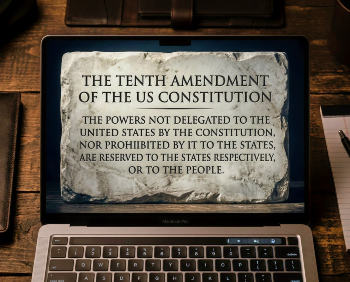 Tenth Amendment State Rights as a Legal Shield
 trade agreements, but they can reshape what their own economies depend on. That is the angle most national coverage misses: the tools are already in the statehouse.
 The central tension running through every policy dispute today is straightforward: federalism policies are no longer abstract legal theory. They are the battleground where questions of vaccine mandates, environmental regulation, and even data privacy are decided. Understanding who holds the power to regulate your daily life is the first step to asserting your sovereignty.
 The 10th Amendment rights in practice are most visible in the fiscal relationship between Washington and the states. Congress cannot commandeer state legislatures to implement federal programs, but it can attach conditions to federal funding. This is where the battle over unfunded mandates and block grants plays out.
 provides a fixed sum and allows states to set priorities. The Temporary Assistance for Needy Families (TANF) program, created in 1996, replaced the open-ended Aid to Families with Dependent Children entitlement with a fixed $16.5 billion annual block grant. That amount has not been adjusted for inflation in nearly three decades, meaning its real value has declined by roughly 40 percent. States gained flexibility but lost a reliable safety-net funding stream, a trade-off that plays out differently in every statehouse.
 states have introduced AI bills that remain in committee. Meanwhile, the federal government has issued executive orders and agency guidance, but no comprehensive statute. The result is that a startup building an AI product must navigate a maze of state-level obligations that did not exist three years ago.
 is essential for lasting change.
 How to document government overreach effectively means staying factual. Describe what occurred, cite the specific regulation or procedure you believe was violated, and avoid inflammatory language. A factual, well-organized record is far more persuasive to a court, a supervisor, or the media than an emotional narrative. The

 The restoration of founding principles begins not in Washington, but in your own community. The liberal world order depends on citizens who feel powerless. Reclaiming authority over local institutions weakens the structure of economic dependency that sustains globalist influence. This is the mission that matters, and it starts with showing up where you live.

 Business Administration guidance on local lending circles